
Table of Contents
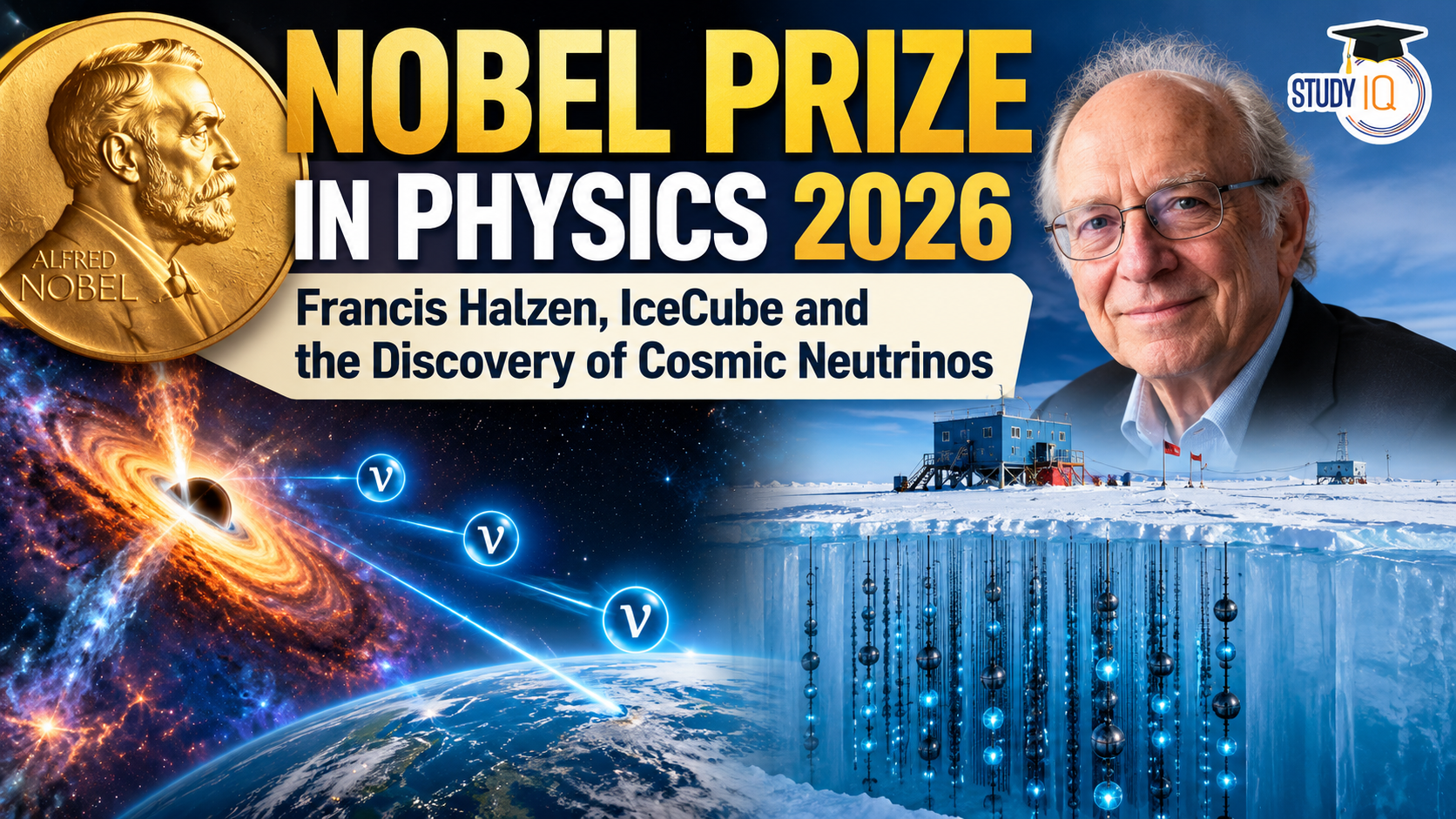
The 2026 Nobel Prize in Physics has been awarded to Francis Halzen for his decisive contributions to the IceCube Neutrino Observatory and the discovery of high-energy neutrinos of astrophysical origin.
His work has opened a new window into the Universe through neutrino astronomy, enabling scientists to study extreme cosmic phenomena that may remain hidden from conventional telescopes.
Read Also: UPSC Daily Current Affairs 2026
Who is Francis Halzen?
- Francis Halzen is a Belgian-born American physicist associated with the University of Wisconsin–Madison.
- His research focuses on particle physics, astrophysics and neutrinos.
- He pioneered the idea of using the vast Antarctic ice sheet as a giant neutrino detector.
- He played a major role in the development of AMANDA, the predecessor to IceCube.
- He subsequently led the development of the IceCube Neutrino Observatory.
What are Neutrinos?
Neutrinos are fundamental subatomic particles belonging to the lepton family.
Important characteristics include:
- They have no electric charge.
- They have an extremely small mass.
- They interact with matter primarily through the weak nuclear force.
- They can travel enormous distances with very little interaction.
- They are produced by the Sun, supernovae, radioactive decay, nuclear reactions and energetic cosmic events.
Since neutrinos have no electric charge, their paths are not significantly affected by magnetic fields. They can therefore carry information from their sources across vast distances.
Why Are Neutrinos Difficult to Detect?
Neutrinos interact with matter extremely rarely. Billions pass through the Earth and our bodies without producing a detectable signal.
This creates a major challenge for scientists: a detector must contain an enormous quantity of material to increase the probability of a neutrino interaction.
This is why IceCube uses a huge volume of Antarctic ice.
What is the IceCube Neutrino Observatory?
The IceCube Neutrino Observatory is located at the South Pole in Antarctica.
It uses approximately one cubic kilometre of Antarctic ice as a natural detection medium.
The observatory contains around 5,160 optical sensors deployed along 86 strings deep beneath the ice. The facility was completed in 2011.
The earlier AMANDA experiment demonstrated the feasibility of detecting neutrinos in Antarctic ice, paving the way for the much larger IceCube observatory.
How Does IceCube Detect Neutrinos?
When a high-energy neutrino occasionally interacts with an atomic nucleus in the ice, it can produce a charged particle.
As this charged particle moves through the ice, it can generate a faint blue light known as Cherenkov radiation.
IceCube’s optical sensors detect this light.
By analysing the timing, intensity and pattern of the light, scientists can estimate the direction and energy of the original neutrino.
Thus, IceCube does not directly “see” the neutrino. Instead, it detects the secondary light produced by a rare neutrino interaction.
Why Use Antarctic Ice?
Deep Antarctic ice provides several advantages:
- Extremely large detection volume
- Very low natural light levels
- Stable environment
- Highly transparent ice at great depths
- Relatively low background interference
- No need to construct a conventional detector covering an enormous volume above ground
The Antarctic ice sheet therefore acts as a naturally occurring gigantic particle detector.
Major Achievement of IceCube
In 2013, the IceCube collaboration reported the first evidence of high-energy neutrinos originating from astrophysical sources.
This represented a breakthrough because it established that neutrinos could be used to investigate the most energetic processes in the Universe.
It helped establish neutrino astronomy as a new way of studying cosmic phenomena.
Why is Neutrino Astronomy Important?
Conventional astronomy relies heavily on electromagnetic radiation, including visible light, radio waves, X-rays and gamma rays.
However, electromagnetic radiation can be absorbed or scattered by gas and cosmic dust.
Neutrinos interact so weakly with matter that they can escape extremely dense environments and travel long distances with comparatively little disturbance.
Therefore, neutrinos can provide information about cosmic environments that may be difficult to study through electromagnetic radiation alone.
Possible Sources of Cosmic Neutrinos
Scientists are investigating several potential sources of high-energy neutrinos, including:
- Active galactic nuclei
- Supernovae
- Gamma-ray bursts
- Other extreme astrophysical environments
One important candidate is NGC 1068, also known as M77, an active galaxy. IceCube has detected neutrinos coming from its direction, although additional observations are needed to establish the source conclusively.

Significance of the Discovery
The IceCube project has significance across several fields:
Particle Physics
It provides information about fundamental particles and their interactions.
Astrophysics
It helps scientists investigate extremely energetic cosmic environments.
Astronomy
It has established neutrino astronomy as a new observational tool.
Multi-Messenger Astronomy
Neutrinos can be studied alongside electromagnetic radiation and other cosmic messengers to develop a more complete picture of astrophysical events.
Understanding the Universe
Neutrino observations could eventually contribute to a better understanding of some of the Universe’s most mysterious phenomena.
 Labour Laws in India: Four Labour Codes,...
 US Defence Policy Under Trump: China, Ru...
 Ramappa Temple: UNESCO World Heritage Si...














 WhatsApp





