Table of Contents
Context: The Central Armed Police Forces (General Administration) Bill, 2026, aims to give statutory backing to the deputation of Indian Police Service (IPS) officers in CAPFs, while resolving ongoing legal and administrative concerns. The Central Government presented the CAPF Bill 2026 in the Rajya Sabha.
CAPF Bill 2026
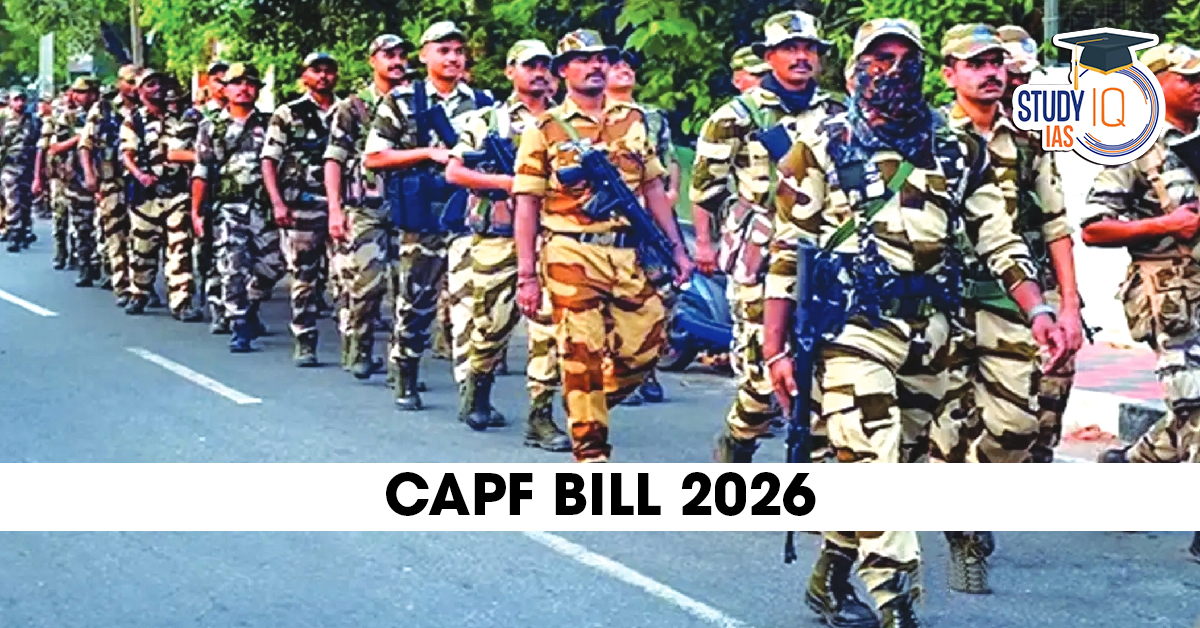
The CAPF Bill 2026 is a proposed legislative measure aimed at reforming the functioning, service conditions, and welfare of India’s Central Armed Police Forces (CAPFs). These forces play a crucial role in maintaining internal security, border management, and counter-insurgency operations across the country.
The bill seeks to address long-standing issues related to personnel welfare, working conditions, and administrative efficiency while strengthening the overall effectiveness of the forces. By introducing key reforms, the CAPF Bill 2026 aims to enhance operational readiness and ensure better support for the personnel serving in challenging environments.
- Scope: Applies to CRPF, BSF, CISF, ITBP, and SSB, with the possibility to include others via notification.
- Rule-making authority: The central government can make rules on recruitment, deputation, and service conditions, superseding previous laws or judicial orders.
- Protection of Benefits: All pre-existing financial and service benefits for Group ‘A’ officers remain intact.
- Personnel Coverage: Includes Group ‘A’ executive officers (Assistant Commandant and above), IPS officers on deputation, and Army officers on deputation or re-employment.
CAPFs and IPS Deputation
- The Central Armed Police Forces (CAPFs) form the backbone of India’s internal security system. These include forces like the CRPF, BSF, ITBP, CISF, and SSB, which handle border management, counter-insurgency, and law-and-order duties.
- Traditionally, leadership roles in CAPFs have been shared between:
- Cadre officers (recruited directly into CAPFs)
- IPS officers on deputation
- As members of an All India Service created under Article 312, IPS officers have historically occupied senior posts to facilitate coordination between the Union and State governments.
Existing deputation framework
- IPS deputation has so far been governed through executive instructions rather than a formal law.
- Approximately 20% of DIG-level posts and 50% of IG-level posts are filled by IPS officers.
- The absence of a statutory structure has led to ambiguity and frequent litigation.
Structural challenges in CAPFs
The issue also reflects broader institutional concerns:
- Around 10 lakh personnel in CAPFs
- Only about 13,000 Group A officers
- Nearly 93,000 vacancies across ranks
These figures highlight gaps in cadre management, promotions, and manpower planning.
Key Features of the CAPF Bill 2026
The CAPF Bill 2026 proposes to formalise and expand IPS’s presence in senior roles:
- 50% of Inspector General (IG) posts reserved for IPS officers
- Minimum 67% of Additional Director General (ADG) posts for IPS officers
- All Special DG and DG posts to be held by IPS officers
It also seeks to establish a unified legal framework governing the recruitment and service conditions of Group A officers in CAPFs.
Rationale behind the bill
- Administrative uniformity: Replaces fragmented executive rules with a clear statutory framework.
- Reducing legal disputes: Aims to minimise recurring conflicts between IPS and CAPF cadre officers.
- Security considerations: The government argues that experienced IPS leadership strengthens operational effectiveness in areas like border security and counter-insurgency.
- Inter-agency coordination: IPS officers bridge CAPFs and State police, enabling smooth operations during internal security challenges.
- Preserving force identity: Ensures CAPFs retain their character as forces supporting civil authority, aligning with the Supreme Court’s observations in Sanjay Prakash (2025).
- National integration: Reflects the vision of Sardar Patel by using IPS officers to maintain a uniform approach across states.
- Legislative supremacy: Clarifies that executive and legislative bodies govern service policies, limiting judicial overreach.
- Training & Camaraderie: Central deputation stints for IPS officers strengthen coordination with CAPF cadre officers.
Government response
- The Bill follows a 2025 Supreme Court ruling, which recommended a gradual reduction in IPS deputation in CAPFs up to the IG level. The Court also:
- Granted CAPF officers Organised Group A Services (OGAS) status
- Called for cadre restructuring and revised service rules
- The proposed legislation is viewed as an attempt to reconcile judicial directions with administrative priorities.
Concerns raised by CAPF officers
The proposal has triggered opposition from within CAPFs:
- Career Stagnation: Limited senior posts and delayed promotions, often taking 15–18 years.
- Perceived Inequity: Reservation of top positions for IPS officers is seen as undermining the prospects of cadre officers.
- Judicial Intent: Critics argue the Bill runs contrary to the Supreme Court’s call to reduce IPS deputation.
Significance of the CAPF Bill 2026
- Legal Clarity: Converts long-standing practices into law, reducing uncertainty.
- Federal Dynamics: Reinforces administrative links between the Centre and States through IPS involvement.
- Civil Services Debate: Revives discussions on the role of All India Services, autonomy of specialised forces, and career progression within uniformed services.
Associated challenges with CAPF Bill 2026
- Promotion bottlenecks: Reserved IPS quotas limit career growth for direct-entry CAPF officers.
- Judicial conflicts: The Bill effectively reverses certain Supreme Court directives on reducing IPS deputation.
- Perceived “parachuting”: Some CAPF officers feel IPS leaders may lack specialised CAPF experience.
- Federal tensions: Centralised IPS leadership may occasionally conflict with state-level operational needs.
- Legal concerns: The “notwithstanding” provisions may face constitutional challenges.
Way Forward
- Regular cadre reviews: Expand available posts to allow growth for both IPS and CAPF officers.
- Balanced deputation: Increase the role of cadre officers in technical or training wings while maintaining IPS leadership at the top.
- Specialised training: Mandatory CAPF induction for IPS officers to familiarise them with force-specific operations.
- Strengthening OGAS rights: Ensure full financial and administrative benefits for CAPF cadre officers.
Conclusion
The CAPF (General Administration) Bill, 2026 codifies the leadership role of the IPS in India’s internal security framework, promoting coordination and unified command. However, it must also address career progression and recognition for CAPF cadre officers to maintain morale and operational efficiency.
|
Read More Notes |
|
| Environment Notes | Art and Culture Notes |
| Science and Tech | History Notes |
| Geography Notes | Indian Polity Notes |
| General Knowledge | International Relation |
|
Explore StudyIQ Courses |
|

 UN Charter Enemy State Clauses: Articles...
 World Tourism Day 2026: Theme, India Tou...
 Anti-Goonda Bill 2026 Explained: Why Pre...











 WhatsApp