Table of Contents
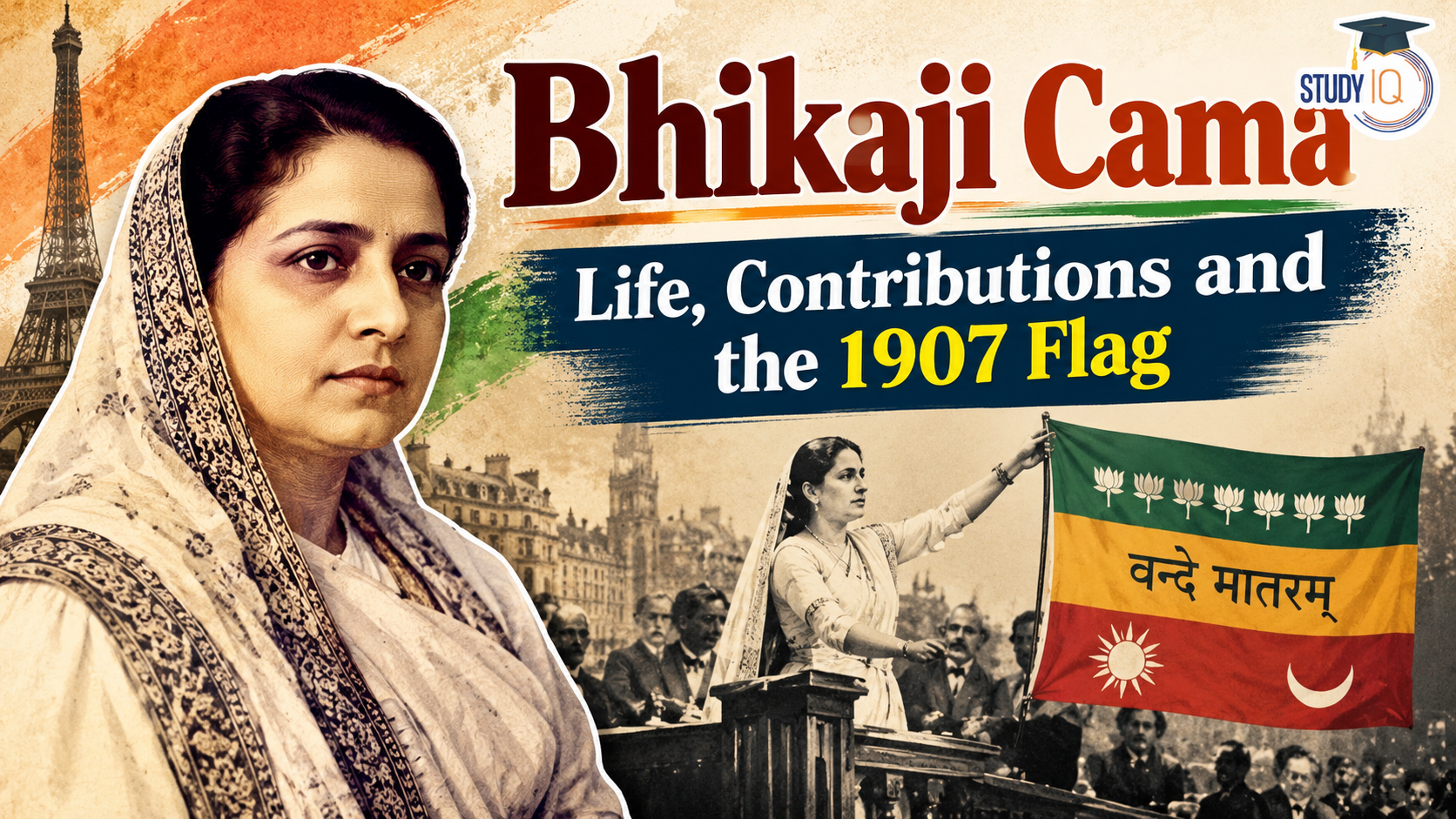
Bhikaji Cama Birth Anniversary 2026: Bhikaji Rustom Cama, one of the prominent women associated with India’s freedom struggle, was born on 24 September 1861 in Bombay (now Mumbai). She is particularly remembered for unfurling an early version of the Indian national flag at the International Socialist Congress in Stuttgart, Germany, in 1907.
Her work in London and Paris helped take the cause of Indian independence beyond India’s borders and brought international attention to the anti-colonial movement.
Bhikaji Cama Birth Anniversary 2026
24 September 2026 marks the 165th birth anniversary of Bhikaji Cama.
Born into a prominent Parsi family in Bombay, Cama initially engaged in social work before becoming increasingly involved in the nationalist movement. Her activities later took her to Europe, where she worked with Indian nationalists and supported revolutionary activities against British colonial rule.
She spent several years in London and Paris, using these international centres to promote the cause of Indian independence.
Who Was Bhikaji Cama?
Bhikaji Rustom Cama (1861–1936) was an Indian nationalist, social worker and prominent supporter of the overseas revolutionary movement.
She became associated with several important Indian nationalists, including:
- Dadabhai Naoroji
- Shyamji Krishna Varma
- V.D. Savarkar
- Lala Har Dayal
Cama also advocated greater participation of women in public and political life.
Early Life and Education
Bhikaji Cama was born on 24 September 1861 in Bombay into a wealthy Parsi family.
She was educated at the Alexandra Girls’ English Institution in Bombay. In 1885, she married Rustomji Cama, a lawyer.
Her involvement in social and political activities gradually increased. During the 1896 plague outbreak in Bombay, she worked among affected people and contracted the disease herself.
She subsequently travelled to London around 1902, where her political activities expanded.
Bhikaji Cama’s Role in India’s Freedom Struggle
Cama’s contribution was particularly significant because she worked outside India to internationalise India’s struggle against British colonial rule.
In London, she came into contact with Dadabhai Naoroji and other Indian nationalists. She attended political meetings and spoke publicly about India’s political and economic condition under British rule.
Later, Paris became an important base for her activities. From there, she supported Indian revolutionaries and helped circulate nationalist literature.
Her work demonstrates the important role played by Indians abroad in the anti-colonial movement.
Bhikaji Cama and the Stuttgart Flag of 1907
One of the most important events associated with Bhikaji Cama took place at the Second International Socialist Congress in Stuttgart, Germany, on 22 August 1907.
Cama unfurled an early version of an Indian national flag before an international audience. The event helped bring India’s demand for independence to an international political platform.
Features of the 1907 Flag
The flag associated with the Stuttgart episode consisted of three horizontal bands:
- Green band: contained eight lotuses.
- Saffron/yellow central band: carried the words “Vande Mataram.”
- Red band: featured symbols of the sun and crescent.
The design was influenced by the evolution of earlier nationalist flags, including the Calcutta Flag of 1906.
It should be noted that this flag was not the same as the present Indian national flag. It was one of the early nationalist flags developed before independence.
Paris and Revolutionary Activities
After her activities in London, Cama became closely associated with Indian nationalist circles in Paris.
She supported organisations and individuals involved in India’s revolutionary movement and helped circulate nationalist literature.
She was associated with publications such as:
Bande Mataram
Cama supported the publication and circulation of Bande Mataram, which propagated nationalist ideas and criticised British colonial rule.
Madan’s Talwar
She was also associated with Madan’s Talwar, a revolutionary publication named after Madan Lal Dhingra, who had been executed for assassinating British official Sir Curzon Wyllie.
These publications helped spread revolutionary nationalist ideas among Indians both in Europe and India.
Bhikaji Cama During World War I
During the First World War, Britain and France were allied powers. Because of her anti-British political activities and links with Indian revolutionaries, Cama faced restrictions from the French authorities.
She was interned for several years during World War I.
Despite these restrictions, her earlier activities had already established her as an important figure in the international dimension of India’s freedom movement.
Return to India and Death
After spending several decades abroad, Bhikaji Cama was permitted to return to India in 1935.
She returned to Bombay at the age of 74 and died on 13 August 1936.
Her legacy continues to be associated with India’s freedom struggle, women’s participation in nationalism and the development of early Indian nationalist symbols.
Bhikaji Cama: Key Facts
| Particular | Details |
|---|---|
| Full Name | Bhikaji Rustom Cama |
| Born | 24 September 1861 |
| Birthplace | Bombay, British India |
| Community | Parsi |
| Spouse | Rustomji Cama |
| Major political centres | London and Paris |
| Famous for | Unfurling an early Indian flag abroad |
| Flag event | Stuttgart, Germany |
| Flag date | 22 August 1907 |
| Congress/Event | International Socialist Congress |
| Associated publications | Bande Mataram, Madan’s Talwar |
| Return to India | 1935 |
| Died | 13 August 1936, Bombay |
 World Maritime Day 2026: Know the Theme,...
 Kathmandu Declaration: SAWEN, Wildlife C...
 UPSC EPFO APFC Result 2026 Out at upsc.g...









 WhatsApp