Table of Contents
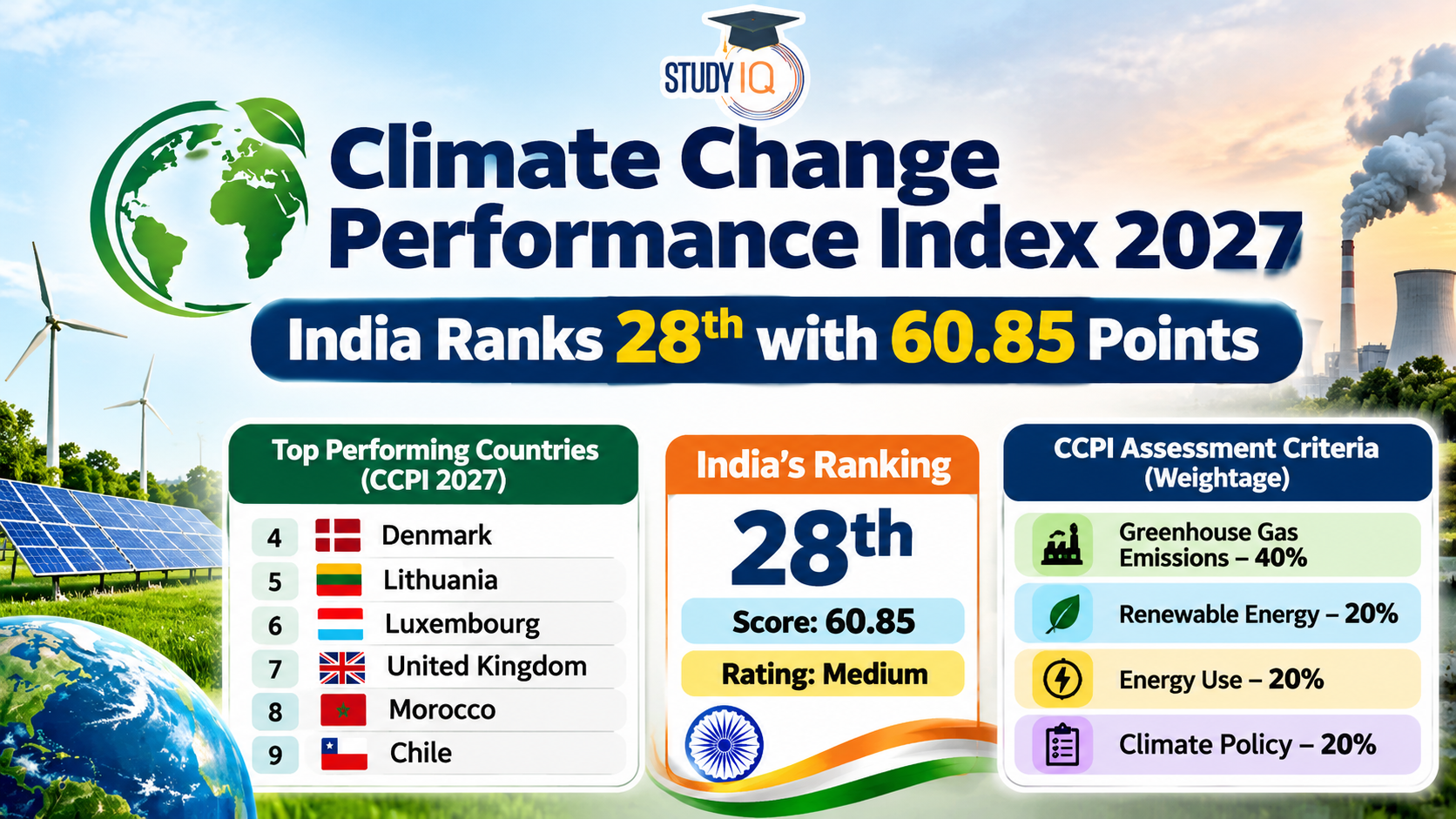
India has secured the 28th rank in the Climate Change Performance Index (CCPI) 2027, scoring 60.85 points. This represents a decline of five positions from its 23rd rank in 2026. Although India has made significant progress in renewable energy expansion, continued dependence on coal, rising greenhouse gas emissions and gaps in climate policy implementation remain major challenges.
The index, published by Germanwatch and the NewClimate Institute, evaluates the climate performance of countries and their efforts to achieve global climate goals. The CCPI 2027 covers 64 countries and the European Union, accounting for over 90% of global greenhouse gas emissions.
What is the Climate Change Performance Index (CCPI)?
The Climate Change Performance Index is an independent international assessment tool established in 2005. It monitors and compares the climate protection performance of countries based on their efforts to reduce emissions and promote sustainable energy systems.
The index is published annually by Germanwatch and the NewClimate Institute, with support from Climate Action Network International.
It assesses countries across four major categories: greenhouse gas emissions, renewable energy, energy use and climate policy.
Climate Change Performance Index 2027: Global Rankings
One of the major findings of CCPI 2027 is that no country achieved a Very High rating. Consequently, the top three positions remained vacant.
Denmark secured the fourth position, making it the highest-ranked country for the sixth consecutive year. Other high-performing countries included Lithuania, Luxembourg, the United Kingdom, Morocco and Chile.
| Country/Region | Rank |
|---|---|
| Denmark | 4 |
| Lithuania | 5 |
| Luxembourg | 6 |
| United Kingdom | 7 |
| Morocco | 8 |
| Chile | 9 |
| European Union | 19 |
| India | 28 |
| China | 56 |
| United States | 67 |
| Iran | 68 |
The United Kingdom was the only G20 country to receive a High rating, while several major economies continued to perform poorly.
India’s Performance in CCPI 2027
India ranked 28th with 60.85 points, receiving an overall Medium rating. Its ranking has declined over the last three editions.
| Edition | India’s Rank |
|---|---|
| CCPI 2025 | 10 |
| CCPI 2026 | 23 |
| CCPI 2027 | 28 |
India’s performance reflects the challenges of balancing rapid economic development, increasing energy demand and environmental sustainability.
Four Assessment Categories of CCPI
The index uses 14 indicators divided into four categories, with the following weightage:
| Assessment Category | Weightage |
|---|---|
| Greenhouse Gas Emissions | 40% |
| Renewable Energy | 20% |
| Energy Use | 20% |
| Climate Policy | 20% |
Greenhouse gas emissions carry the highest weightage because reducing emissions is central to limiting global warming.
The renewable energy category examines the expansion of clean energy sources such as solar and wind. Energy use assesses consumption patterns and efficiency, while climate policy evaluates national and international climate commitments and their implementation.
Why Has India’s Ranking Declined?
1. Coal Dependency: Coal remains a major source of electricity generation in India. Continued dependence on fossil fuels makes the transition towards a low-carbon economy challenging.
2. Rising Greenhouse Gas Emissions: Industrialisation, urbanisation, transportation and increasing electricity consumption contribute to India’s growing emissions.
3. Renewable Energy Integration: Although India has expanded renewable energy capacity, inadequate transmission infrastructure, energy storage and grid flexibility limit its effective utilisation.
4. Climate Policy Implementation: Better coordination, monitoring and implementation of climate policies are essential to achieve India’s environmental commitments.
India’s Climate Targets by 2035
India’s updated Nationally Determined Contribution (NDC), as reported in the supplied CCPI summary, outlines important climate targets for 2035:
- Reduce the emissions intensity of GDP by 47% from the 2005 level.
- Achieve approximately 60% non-fossil fuel-based installed electricity capacity.
- Create an additional carbon sink of 3.5–4 billion tonnes of CO₂ equivalent.
India has also announced its long-term objective of achieving Net Zero emissions by 2070.
Government Initiatives for Climate Change
India has introduced several programmes to accelerate its clean energy transition:
- National Solar Mission: Promotes solar energy development.
- National Green Hydrogen Mission: Encourages green hydrogen production and utilisation.
- PM Surya Ghar: Muft Bijli Yojana: Promotes rooftop solar installations.
- FAME India Scheme: Supports electric mobility.
- Green India Mission: Focuses on increasing forest and tree cover.
- Mission LiFE: Encourages environmentally responsible lifestyles.
Conclusion
The Climate Change Performance Index 2027 highlights the gap between India’s renewable energy progress and its broader climate performance. India needs to accelerate clean energy adoption, reduce coal dependence, improve electricity infrastructure and strengthen climate policy implementation.
For India, the challenge is not merely reducing emissions but ensuring a just energy transition that balances economic growth, energy security and environmental sustainability.

FAQs
1. What is India’s rank in CCPI 2027?
India ranked 28th with 60.85 points.
2. Who publishes the Climate Change Performance Index?
Germanwatch and NewClimate Institute publish the index with support from Climate Action Network International.
3. Which country ranked highest in CCPI 2027?
Denmark ranked fourth, as the top three positions remained vacant.
4. How many categories are included in CCPI?
Four: greenhouse gas emissions, renewable energy, energy use and climate policy.
5. What is India’s Net Zero target?
India aims to achieve Net Zero emissions by 2070.
 List of Military Exercises of India 2026...
 Lithium-Ion Battery Waste Export Ban 202...
 India’s Russia-Ukraine Diplomacy 2026:...














 WhatsApp