
Table of Contents
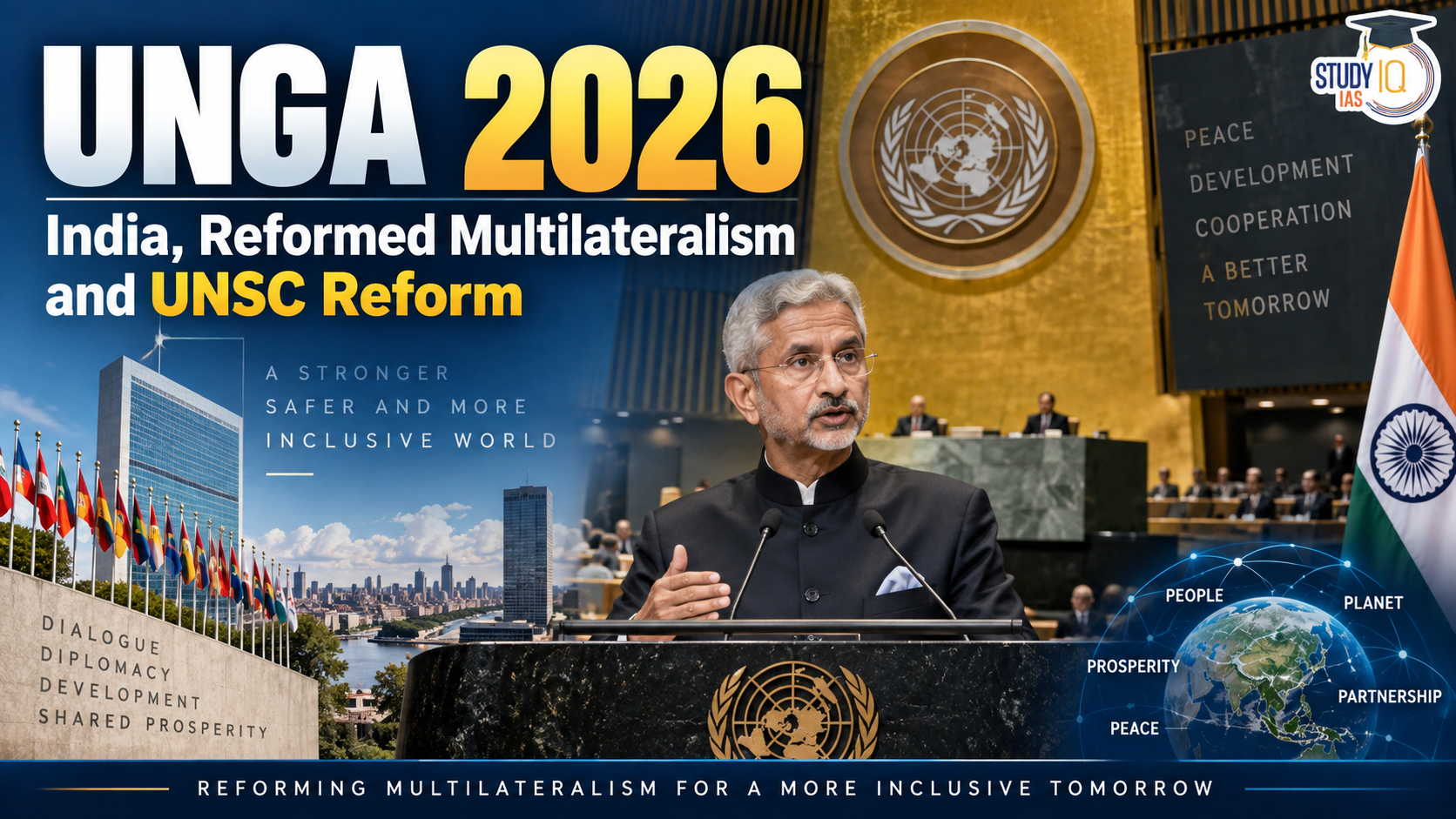
The 81st United Nations General Assembly (UNGA) 2026 has highlighted growing concerns over geopolitical tensions, strategic competition and the effectiveness of existing global institutions. India has called for stronger and reformed multilateralism to make global governance more representative, transparent and responsive to contemporary challenges.
External Affairs Minister S. Jaishankar stressed the importance of international cooperation while co-chairing the inaugural Partners for Multilateralism, International Law, Peace & Prosperity (P4M) Summit with European Council President Antonio Costa.
Read Also: UPSC Daily Current Affairs 2026
Why Is Multilateralism Under Stress?
The international system is facing multiple challenges, including:
- Intensifying geopolitical competition
- Prolonged conflicts and security crises
- Disruptions in global supply chains
- Climate change and disasters
- Technological disruptions
- Food and energy insecurity
- Pandemic-related vulnerabilities
- Shortcomings in representation within international institutions
India argues that global institutions created in an earlier geopolitical era need to reflect the current distribution of economic and political power.
What Is Reformed Multilateralism?
Reformed multilateralism refers to restructuring global institutions to make them more representative, participatory and effective.
India emphasises:
- Greater representation of developing countries
- Participatory decision-making
- Transparency in international institutions
- Respect for international law
- Strengthening rules and norms
- More effective responses to global challenges
For India, UN Security Council reform is a major component of this agenda.
India and UNSC Reform
The UN Security Council (UNSC) was established in the post-World War II era, but its composition does not fully reflect today’s geopolitical and economic realities.
The UNSC has 15 members:
- 5 permanent members: China, France, Russia, the United Kingdom and the United States
- 10 non-permanent members, elected for two-year terms
India has consistently advocated expansion of both the permanent and non-permanent categories to improve the Council’s representativeness and legitimacy.
India’s demand is closely linked with its broader objective of providing the Global South with greater representation in global decision-making.
The “4F” Crisis
At the UNGA, attention was also drawn to vulnerabilities surrounding four critical areas:
Fuel – Food – Fertiliser – Finance
Geopolitical conflicts and disruptions in global trade can simultaneously affect these four sectors.
India has therefore emphasised:
De-risking + Diversification + Resilient Supply Chains
Diversification of suppliers, markets and strategic dependencies can reduce exposure to geopolitical chokepoints and external shocks.
Strategic Autonomy
India’s approach to multilateralism is also connected with its principle of strategic autonomy.
Rather than aligning exclusively with competing geopolitical blocs, India seeks to maintain the ability to take independent decisions based on its national interests.
This approach is reflected in India’s engagement with multiple major powers and regional groupings.
V4+India Cooperation
Another important development was the first V4+India Foreign Ministers’ Meeting.
The Visegrád Group (V4) consists of:
- Czechia
- Hungary
- Poland
- Slovakia
The V4+India framework provides another platform for cooperation between India and Central Europe in areas such as:
- Trade and economy
- Defence and security
- Technology
- Space
- Connectivity
- Political and diplomatic cooperation
- People-to-people relations
Slovakia also expressed support for India’s bid for permanent membership of the UNSC.
Why Is UNGA 2026 Important for India?
India’s position at UNGA 2026 reflects several major foreign-policy priorities:
- Global South leadership – Greater voice for developing countries in global institutions.
- Strategic autonomy – Maintaining independent foreign-policy choices.
- UNSC reform – Making the Security Council more representative.
- Supply-chain resilience – Reducing excessive dependence on strategic chokepoints.
- Rules-based international order – Strengthening international law and norms.
- Multilateral cooperation – Collective responses to climate change, pandemics, terrorism and technological disruption.
Way Forward
The effectiveness of multilateralism will depend on whether global institutions can adapt to changing geopolitical and economic realities. Greater representation, transparent decision-making and stronger international cooperation can help address challenges that no country can manage independently.
For India, reformed multilateralism is therefore closely linked with UNSC reform, Global South representation, strategic autonomy and a resilient rules-based international order.
 Hurricane Polo 2026: Category 5 Storm, E...
 East Sea (Sea of Japan): Location, Count...
 WMO State of Global Water Resources 2025...




 WhatsApp





