Table of Contents
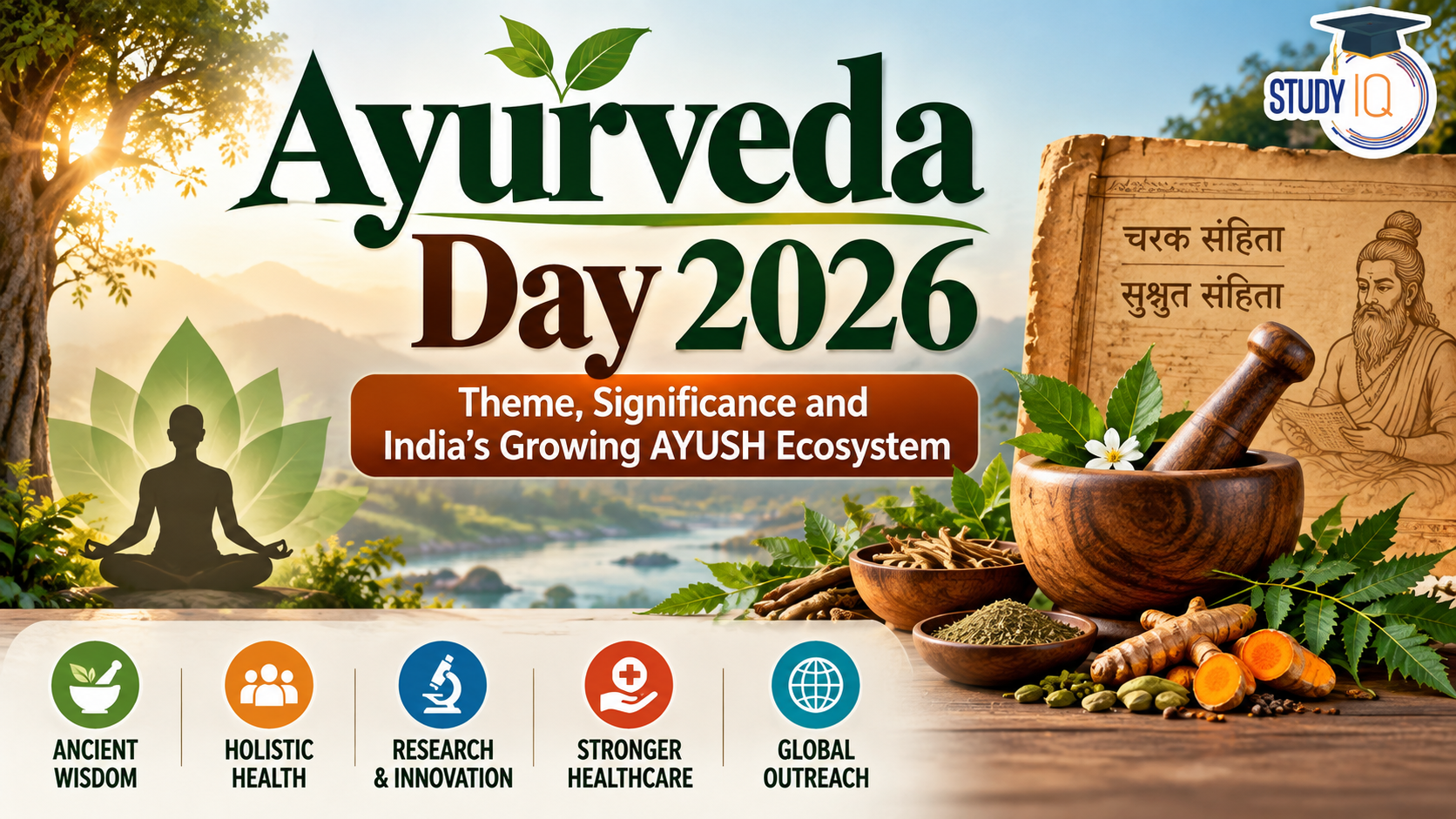
Ayurveda Day 2026 will be observed on September 23, 2026, marking the 11th Ayurveda Day in India. The theme for this year is “Ayurveda for a Healthier Tomorrow”. The occasion highlights the growing role of Ayurveda in preventive healthcare, research, education, digital health, insurance coverage and international cooperation.
Ayurveda Day 2026: Key Highlights
- Date: September 23, 2026
- Edition: 11th Ayurveda Day
- Theme: Ayurveda for a Healthier Tomorrow
- Nodal Ministry: Ministry of Ayush
- Major programme: National Ayush Mission (NAM)
- Ayurveda Day: Observed annually on September 23
- WHO Global Traditional Medicine Centre: Jamnagar, Gujarat
What is Ayurveda?
Ayurveda is one of India’s traditional systems of medicine and has a historical tradition spanning thousands of years. The term Ayurveda is derived from Ayu, meaning life, and Veda, meaning knowledge or science.
Its early roots are associated with the Vedic tradition, while classical Ayurvedic knowledge is extensively documented in texts such as the Charaka Samhita and Sushruta Samhita.
Ayurveda adopts a holistic approach to health, emphasising the balance of doshas, agni, dhatus and malas, along with physical, mental and overall well-being.
Why is Ayurveda Day Celebrated?
Ayurveda Day aims to:
- Promote awareness about Ayurveda and traditional healthcare systems.
- Highlight the role of Ayurveda in preventive and holistic healthcare.
- Encourage scientific research and evidence generation.
- Strengthen Ayurveda education and healthcare infrastructure.
- Promote India’s traditional knowledge globally.
- Integrate AYUSH services with mainstream healthcare systems.
Expansion of Ayushman Arogya Mandirs
The government is expanding AYUSH healthcare services through the National Ayush Mission (NAM) and integration with the broader public health system.
Between 2014-15 and 2025-26, more than ₹6,406.99 crore was released to States and Union Territories under NAM.
As of September 19, 2026, 12,260 Ayushman Arogya Mandirs (Ayush) were functional against a target of 12,500.
AYUSH services are also available at 13,249 public health facilities, including:
- 6,302 Primary Health Centres
- 3,191 Community Health Centres
- 475 District Hospitals
- 3,281 other health facilities
The government also supports 25,322 AYUSH doctors and 5,666 AYUSH paramedics.
Ayurveda and eSanjeevani
The digital expansion of AYUSH is another important development.
AYUSH services have been integrated into eSanjeevani, the government’s telemedicine platform. The platform has served more than 50 crore patients and provides access to AYUSH OPD services.
This integration can improve access to healthcare for people living in remote and underserved areas.
Ayurveda and Health Insurance
AYUSH treatments have also received greater attention within India’s health insurance ecosystem.
In 2024, the Insurance Regulatory and Development Authority of India (IRDAI) directed insurers to offer products or add-ons covering different systems of medicine, including Ayurveda, subject to their applicable underwriting policies.
On February 10, 2026, the All India Institute of Ayurveda (AIIA), New Delhi, signed a Common Empanelment MoU with the General Insurance Council. The agreement empanelled AIIA with 32 general insurance companies for cashless treatment.
Ayurveda and WHO ICD-11
A significant step towards the international standardisation of traditional medicine has been the inclusion of Ayurveda, Siddha and Unani (ASU) within a WHO ICD-11 module.
Standardised classification can support:
- Health data collection
- Research
- Policy formulation
- International comparability
- Healthcare documentation
- Insurance-related processes
Growth of Ayurveda Education
India’s Ayurveda education ecosystem has expanded significantly.
As of March 13, 2026, India had:
- 593 Ayurveda colleges
- 45,245 undergraduate seats
- 5,673 postgraduate seats
Under the National Ayush Mission, 17 AYUSH colleges have been approved, including 12 focused on Ayurvedic education.
AYURGYAN and SPARK Programmes
The government is also promoting research in Ayurveda.
AYURGYAN Scheme
The AYURGYAN Scheme, launched in 2021-22, supports education, research and development in the AYUSH sector.
Of the cited ₹17.79 crore allocation across 34 research projects, ₹9.38 crore was allocated to 17 Ayurveda projects.
SPARK Programme
SPARK stands for Studentship Programme for Ayurveda Research Ken.
It aims to develop research aptitude among undergraduate Ayurveda students by supporting short-term research projects.
Between 2022-23 and 2024-25, the programme benefited 289 Ayurveda colleges.
AI and Translation of Ayurveda Research
Technology is also being used to expand access to Ayurveda literature.
In March 2026, the Central Council for Research in Ayurvedic Sciences (CCRAS) partnered with Anuvadini AI, an AI-based translation initiative developed by AICTE under the Ministry of Education.
The initiative aims to translate Ayurveda research, educational resources and medical journals into 13 Indian regional languages.
This can help bridge language barriers and make scientific literature more accessible.
India’s Global Ayurveda Outreach
India has increasingly used Ayurveda and traditional medicine as part of its international health cooperation.
India’s AYUSH-related international engagements include:
- 27 country-to-country MoUs
- 16 MoUs for AYUSH Academic Chairs
- 57 institute-to-institute MoUs
- 46 AYUSH Information Cells
- Information Cells across 43 countries
- 104 scholarships for foreign nationals
The WHO Global Traditional Medicine Centre in Jamnagar, Gujarat, is another major component of India’s global traditional medicine ecosystem.
Union Budget 2026-27 and AYUSH
The Union Budget 2026-27 allocated ₹4,408 crore to the Ministry of Ayush.
Major announcements include:
- Establishment of three new All India Institutes of Ayurveda
- Upgradation of AYUSH pharmacies
- Strengthening of Drug Testing Laboratories
- Further development of the WHO Global Traditional Medicine Centre at Jamnagar
Significance of Ayurveda Day 2026
Ayurveda Day 2026 reflects the broader transformation of India’s traditional medicine sector from a predominantly traditional knowledge system towards a more research-oriented, standardised and technology-enabled healthcare ecosystem.
Its integration with telemedicine, insurance, formal education, AI-based translation and international health institutions represents an effort to expand accessibility while strengthening institutional and scientific frameworks.
At the same time, the expansion of Ayurveda requires continued emphasis on evidence-based research, quality control, standardisation, patient safety and rigorous evaluation of therapeutic claims.
 Hurricane Polo 2026: Category 5 Storm, E...
 East Sea (Sea of Japan): Location, Count...
 UPPSC PCS Interview Letter 2026 Released...






 WhatsApp