
Table of Contents
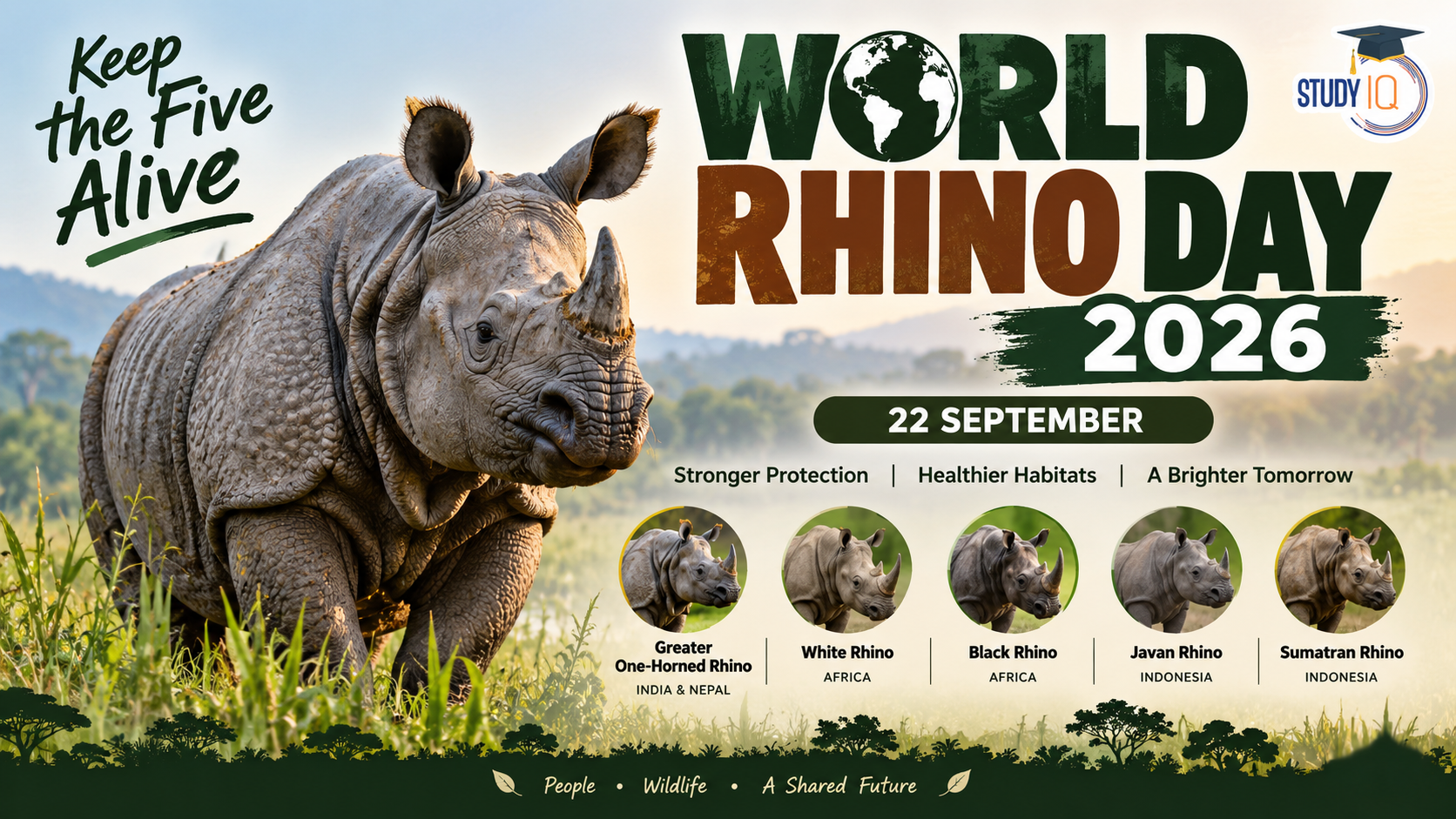
World Rhino Day 2026 is observed on 22 September every year to raise awareness about the conservation of rhinoceroses and the threats facing their populations. The day highlights the need to protect the world’s five surviving rhino species from poaching, illegal wildlife trade, habitat loss and fragmentation.
Rhino conservation is particularly important for India because the country is home to the Greater One-Horned Rhinoceros (Rhinoceros unicornis). Assam is the country’s principal rhino landscape, while West Bengal and Uttar Pradesh also support important populations.
Read Also: UPSC Daily Current Affairs 2026
World Rhino Day 2026: Key Facts
| Particular | Details |
|---|---|
| Date | 22 September 2026 |
| Theme | Keep the Five Alive |
| First announced | 2010 |
| International observance | Since 2011 |
| Living rhino species | 5 |
| Global rhino population | About 26,700 |
| Rhino species in India | Greater One-Horned Rhino |
| Scientific name | Rhinoceros unicornis |
| IUCN status | Vulnerable |
What is World Rhino Day?
World Rhino Day is an international conservation observance dedicated to the protection of rhinoceroses. It brings together wildlife departments, conservation organisations, NGOs, zoos and local communities to raise awareness about rhino conservation.
The observance covers both African and Asian rhinos and draws attention to threats ranging from illegal hunting to habitat degradation.
World Rhino Day History
World Rhino Day was first announced by WWF-South Africa in 2010. In 2011, conservation advocates Lisa Jane Campbell and Rhishja Cota helped develop the initiative into a global campaign representing all five surviving rhino species.
Since then, 22 September has been observed annually as World Rhino Day, with the objective of strengthening public awareness and supporting conservation initiatives.
World Rhino Day 2026 Theme
The theme associated with World Rhino Day 2026 is “Keep the Five Alive.”
The phrase refers to the five surviving rhinoceros species and emphasizes the need to ensure that none of them becomes extinct.
Five Rhino Species
There are five living rhino species in the world:
| Species | Major Distribution |
|---|---|
| Greater One-Horned Rhino | India and Nepal |
| White Rhino | Africa |
| Black Rhino | Africa |
| Javan Rhino | Indonesia |
| Sumatran Rhino | Indonesia |
Thus, two species occur in Africa and three in Asia.
Global Rhino Population
The International Rhino Foundation’s State of the Rhino 2026 estimates the world’s total rhino population at approximately 26,700.
The conservation situation varies significantly among species. The Greater One-Horned and Black Rhino populations have shown important recovery, while the Javan and Sumatran rhinos remain critically endangered and face serious long-term risks.
The estimated Greater One-Horned Rhino population is around 4,075, while the Black Rhino population was approximately 6,788 at the end of 2024.
India’s Greater One-Horned Rhino
India is home to the Greater One-Horned Rhino, also known as the Indian Rhino.
- Scientific name: Rhinoceros unicornis
- IUCN status: Vulnerable
- Major range: India and Nepal
- Major Indian population: Assam
- Other important states: West Bengal and Uttar Pradesh
The species experienced severe historical population declines because of hunting and habitat loss. Strong protection and habitat management have helped its population recover to more than 4,000 globally.
Rhino Population in India
Recent state-level figures indicate:
| State | Population | Census |
|---|---|---|
| Assam | 3,260 | 2026 |
| West Bengal | 392 | 2025 |
| Uttar Pradesh | 53 | 2026 |
These figures originate from separate state-level census exercises and different years, so they should not be considered a single simultaneous national census.
Assam
Assam is India’s most important rhino conservation landscape. Major habitats include:
- Kaziranga National Park and Tiger Reserve
- Pobitora Wildlife Sanctuary
- Orang National Park
- Manas National Park
The 2022 Kaziranga census recorded 2,613 rhinos.
West Bengal
West Bengal recorded 392 rhinos in its 2025 census:
- Jaldapara National Park – 331
- Gorumara National Park – 61
Uttar Pradesh
The 2026 census at Dudhwa National Park recorded 53 rhinos. Dudhwa is an important example of rhino reintroduction and translocation. Rhinos were reintroduced into the landscape in 1984, with animals brought from Assam and Nepal.
Major Threats to Rhinos
The major threats include:
- Poaching
- Illegal wildlife trade
- Habitat loss
- Habitat fragmentation
- Grassland degradation
- Invasive alien species
- Human-wildlife conflict
- Small and isolated populations
Rhino horn is primarily made of keratin, the same structural protein found in human hair and nails. Traditional beliefs surrounding rhino horn have historically contributed to illegal demand and poaching.
Why Are Rhinos Important?
Rhinos are often described as ecosystem engineers because their grazing, movement and wallowing influence vegetation and habitat structure.
Consequently, protecting rhinos also helps conserve associated grassland, wetland and floodplain ecosystems and the species dependent on them.
Conservation Measures
Rhino conservation involves several approaches:
- Protected-area management
- Anti-poaching patrols
- Wildlife crime enforcement
- Habitat restoration
- Grassland management
- Translocation
- Reintroduction
- Population monitoring
- Community participation
- Use of technologies such as radio and satellite tracking
India’s experience with Kaziranga and Dudhwa demonstrates the importance of combining habitat protection with population management.

 Daily Current Affairs PDF 2026: Download...
 World Pharmacists Day 2026: Date, Theme,...
 UPSC EPFO Exam Strategy 2026: Complete 3...














 WhatsApp





