
Table of Contents
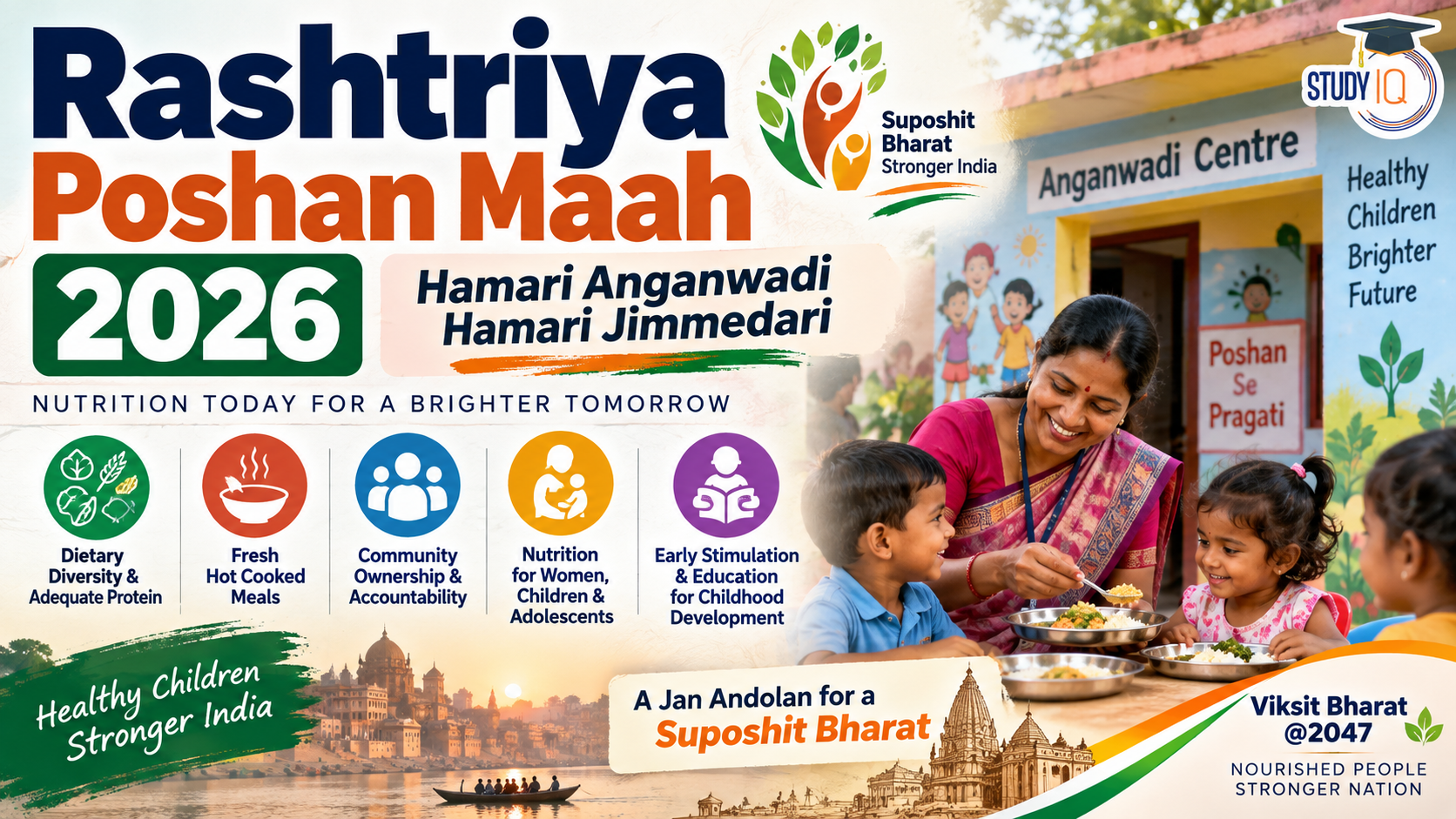
The 9th Rashtriya Poshan Maah 2026 is being launched in Varanasi by the Ministry of Women and Child Development. Observed every September, Poshan Maah seeks to transform nutrition into a Jan Andolan by encouraging communities to adopt healthier nutrition, caregiving and child-development practices.
The 2026 theme, “Hamari Anganwadi Hamari Jimmedari”, places the Anganwadi Centre (AWC) at the heart of community-led efforts for nutrition, health, care and early learning.
Read Also: UPSC Daily Current Affairs 2026
Poshan Abhiyaan and Poshan Maah
Poshan Abhiyaan, launched in 2018, placed nutrition at the centre of India’s development agenda. It follows a convergence-based approach, bringing together multiple sectors involved in nutrition and human development.
Rashtriya Poshan Maah, observed annually in September, has subsequently emerged as a platform for mass mobilisation involving families, communities, frontline workers, local institutions and government departments.
The broader objective is to build a “Suposhit Bharat”, recognising nutrition as an essential foundation for Viksit Bharat @2047.
Theme: “Hamari Anganwadi Hamari Jimmedari”
The 2026 theme signifies a shift from viewing Anganwadi Centres merely as government service-delivery points to recognising them as community institutions.
Anganwadi Centres provide an important grassroots platform for:
- Supplementary nutrition
- Maternal and child health
- Growth monitoring
- Early childhood care and education
- Early stimulation
- Nutrition and health awareness
Greater community ownership can improve transparency, monitoring and last-mile delivery.
Five Key Focus Areas
1. Dietary Diversity and Adequate Protein
Poshan Maah 2026 emphasises nutritional quality rather than calories alone. A diverse diet containing adequate protein, vegetables, fruits, pulses, millets and other nutrient-rich foods is essential for healthy growth and development.
This is particularly important because India faces multiple forms of malnutrition, including undernutrition, micronutrient deficiencies and anaemia.
2. Fresh Hot Cooked Meals
A major focus is providing fresh, hot cooked meals at Anganwadi Centres. The revised Supplementary Nutrition Programme (SNP) Guidelines provide greater clarity regarding Hot Cooked Meals.
The objective is to improve the quality, diversity and nutritional value of supplementary nutrition while encouraging locally available and culturally appropriate foods.
3. Community Ownership and Accountability
The campaign seeks to strengthen Anganwadi Management Committees (AMCs) and community participation.
The revised guidelines also provide for SNP Menu Boards, improving transparency regarding the meals being provided at Anganwadi Centres.
This represents an important governance principle: beneficiaries should be active stakeholders in monitoring public services rather than passive recipients.
4. Nutrition and Maternal-Child Health
The campaign continues to emphasise nutrition among women, children and adolescents. Maternal nutrition, infant feeding and appropriate complementary feeding are critical because nutritional deficiencies during early life can have long-term consequences for physical and cognitive development.
5. Early Stimulation and Childhood Development
Nutrition alone cannot ensure optimal childhood development. The 2026 campaign therefore links nutrition with early stimulation, responsive caregiving and early childhood education.
This integrated approach recognises that the early years are critical for brain development, learning and future human capital formation.
Revised SNP Guidelines: Significance
The revised Supplementary Nutrition Programme Guidelines under Mission Saksham Anganwadi and Poshan 2.0 are an important component of this year’s campaign.
Key provisions include:
- Formal recognition of Hot Cooked Meals
- Mandatory SNP Menu Boards
- Guidelines for Anganwadi Management Committees
- Greater emphasis on community participation and accountability
These reforms aim to strengthen the chain of service delivery → transparency → community monitoring → accountability → improved nutrition outcomes.
UPSC Mains Significance
From a UPSC perspective, Poshan Maah reflects India’s transition from a narrow food-supplementation approach to a multidimensional nutrition strategy.
Malnutrition is influenced by poverty, dietary diversity, sanitation, healthcare, maternal health, education and caregiving practices. Hence, effective intervention requires inter-sectoral convergence and strong last-mile institutions.
The Anganwadi system is particularly important because it connects national nutrition policy with households at the grassroots.
Way Forward
India needs to focus on quality of nutrition services, stronger Anganwadi infrastructure, community monitoring, dietary diversity and outcome-based evaluation. Greater convergence between health, education, sanitation and women-and-child development programmes can further improve results.
UPSC IAS Live GS P2I Foundation 2027 Pratigya August Evening Batch 2 (Basic)
Conclusion
Rashtriya Poshan Maah 2026 goes beyond nutrition awareness. Its theme, “Hamari Anganwadi Hamari Jimmedari,” seeks to make communities partners in strengthening India’s frontline nutrition and early-childhood institutions.
Ultimately, a Suposhit Bharat requires more than providing food—it requires ensuring that every child has the nutrition, healthcare, care and early learning necessary to survive, grow, learn and reach their full potential.
Sharing is caring!
 India-China Border Tensions 2026: LAC, I...
 Career247 Rebrands as Adda247 Skills to ...
 GRAP Stage I Explained: AQI Limits, Meas...





 WhatsApp





