Table of Contents
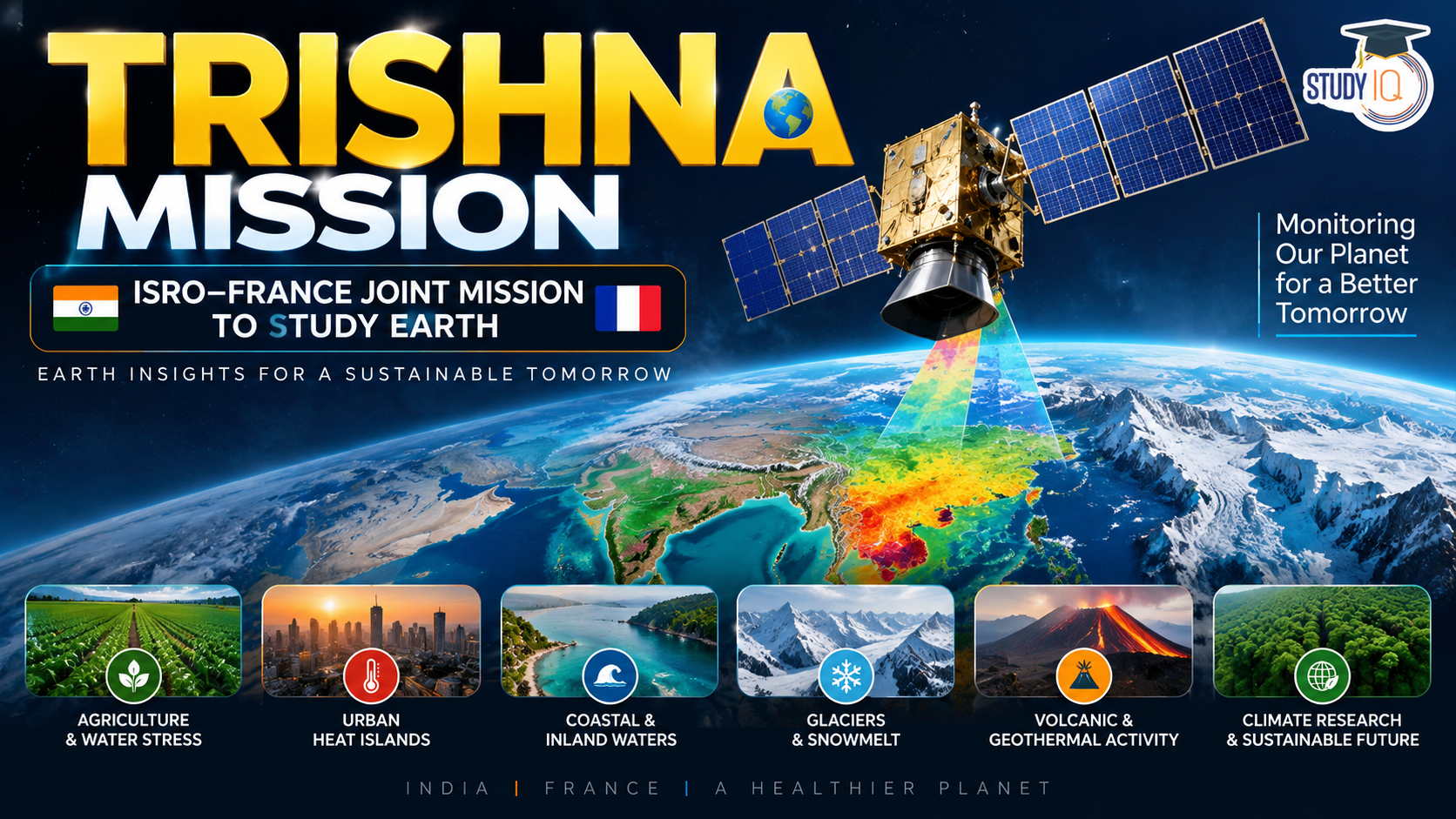
TRISHNA Mission is a joint Earth-observation satellite mission of the Indian Space Research Organisation (ISRO) and France’s CNES (Centre National d’Études Spatiales). TRISHNA stands for Thermal Infra-Red Imaging Satellite for High-resolution Natural resource Assessment.
The mission will use advanced thermal-infrared and multispectral observations to study Earth’s surface temperature, water stress, evapotranspiration, vegetation, inland and coastal waters, glaciers and urban heat.
The mission is particularly important because climate change and growing water demand are increasing the need for accurate information on how water and energy move through terrestrial ecosystems.
Read Also: UPSC Daily Current Affairs 2026
What is TRISHNA Mission?
TRISHNA is designed to provide high-resolution observations of Earth’s surface.
Its key scientific objective is to understand the interaction between water, energy and vegetation. By measuring land-surface temperature and combining it with optical observations, the satellite will help scientists identify areas experiencing water stress and assess how efficiently water is being used.
The mission is planned for launch on an Indian PSLV, with the launch currently targeted for 2027.
Key Facts about TRISHNA
- Full form: Thermal Infra-Red Imaging Satellite for High-resolution Natural Resource Assessment
- Nature: Indo-French Earth-observation mission
- Agencies: ISRO and CNES
- Launch vehicle: PSLV
- Planned launch: 2027
- Orbit: 761-km Sun-synchronous orbit
- Mission life: 5 years
- Main instruments: TIR and VNIR/SWIR
- Primary focus: Surface temperature, water stress and environmental monitoring
Major Objectives of TRISHNA
1. Monitoring Water Stress
TRISHNA will help detect terrestrial water stress by observing changes in land-surface temperature and vegetation. This can improve understanding of water requirements in agricultural and natural ecosystems.
2. Improving Agricultural Water Management
The satellite will provide information related to evapotranspiration, helping estimate how much water is lost through evaporation and plant transpiration.
This data can support precision agriculture and efficient irrigation, particularly in water-stressed regions.
3. Studying Urban Heat Islands
TRISHNA will help map urban heat islands, where built-up areas experience higher temperatures than surrounding regions.
Such information can support climate-resilient urban planning and heat-risk assessment.
4. Monitoring Glaciers and Snow
Thermal observations will contribute to studies of glacier dynamics, snowmelt and runoff, which are important for understanding changes in mountain ecosystems and water resources.
5. Monitoring Inland and Coastal Waters
TRISHNA will study the temperature and dynamics of inland and coastal waters, contributing to research on aquatic ecosystems and environmental changes.
6. Detecting Thermal Anomalies
The mission can help identify thermal anomalies associated with volcanic and geothermal regions, supporting geological and disaster-related studies.
TRISHNA Payloads
TRISHNA will carry two major instrument systems developed through India-France cooperation.
Thermal Infrared (TIR) Payload
The TIR instrument is provided by CNES. It uses four thermal-infrared bands to measure land and water surface temperature and emissivity.
VNIR/SWIR Payload
The VNIR/SWIR instrument is developed by ISRO. It combines visible, near-infrared and short-wave infrared spectral bands to provide information about vegetation, surface reflectance and environmental conditions.
Combining thermal and optical observations is a major strength of the mission.
Why is TRISHNA Important?
TRISHNA can contribute to multiple areas:
- Agriculture: Better irrigation and crop-water management
- Water security: Monitoring water consumption and stress
- Climate studies: Understanding land-atmosphere interactions
- Urban planning: Mapping urban heat
- Cryosphere: Monitoring glaciers and snow
- Disaster management: Detecting thermal anomalies
- Coastal studies: Monitoring coastal water conditions
The mission will therefore generate data relevant to climate adaptation, sustainable resource management and environmental policymaking.
India-France Space Cooperation
TRISHNA further strengthens the growing India-France partnership in space technology and Earth observation. India contributes its expertise in satellite development, remote sensing and launch capabilities, while France contributes advanced thermal-infrared Earth-observation technology.

 India-China Border Tensions 2026: LAC, I...
 Career247 Rebrands as Adda247 Skills to ...
 GRAP Stage I Explained: AQI Limits, Meas...














 WhatsApp