Table of Contents
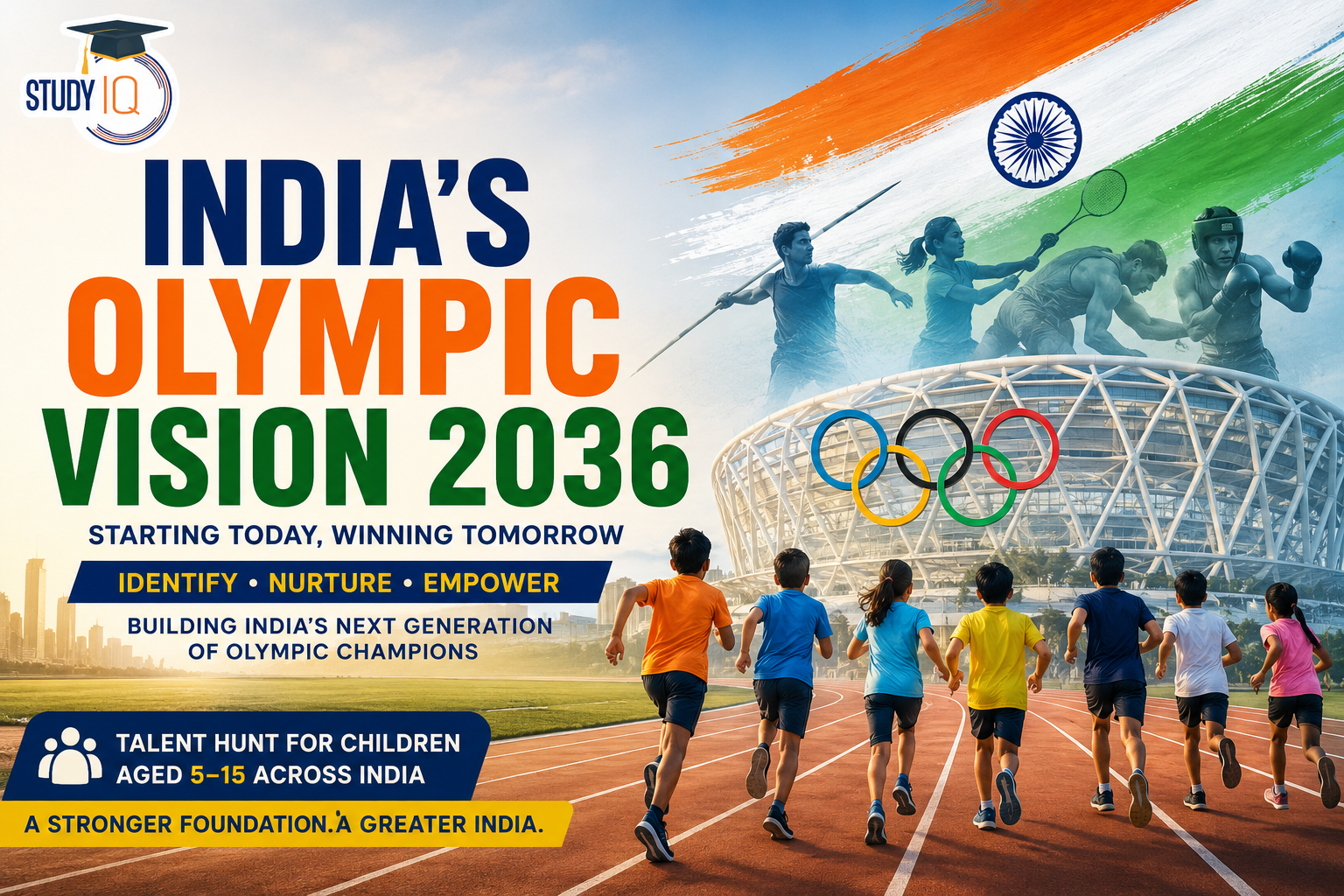
India is preparing for a long-term transformation of its sporting ecosystem with a focus on identifying talent at the grassroots level. In his Independence Day Address on August 15, 2026, Prime Minister Narendra Modi announced a nationwide talent hunt for children aged 5–15 years to identify promising sporting talent across villages, towns, cities and schools.
The initiative assumes significance against the backdrop of India’s ambition to host the 2036 Olympic Games. The broader objective is to create a strong pipeline of athletes who can potentially represent India at the highest level.
Read Also: UPSC Daily Current Affairs 2026
What Did PM Modi Announce?
Prime Minister Narendra Modi emphasised the importance of discovering sporting talent from a young age. The proposed nationwide exercise will seek to identify children with sporting potential across different parts of the country.
The focus on villages, small towns and schools is particularly important because sporting talent is not restricted to metropolitan cities. Many talented children may never get an opportunity to access professional coaches, specialised facilities or organised competitions.
A wider talent-identification network could therefore help India expand its sporting base and bring previously unidentified athletes into the formal sports ecosystem.
Why Are Children Aged 5–15 Being Targeted?
Elite sporting performance generally requires years of systematic development. Identifying potential at an early stage provides a longer window for developing physical abilities, technical skills and psychological resilience.
However, early identification should not necessarily mean intense professional training at a very young age. The emphasis should ideally be on age-appropriate physical development, sporting exposure and gradual specialisation.
The 5–15 age group provides an opportunity to:
- Develop physical literacy and basic sporting skills
- Identify sport-specific aptitude
- Provide scientific and age-appropriate coaching
- Improve strength, endurance, flexibility and coordination
- Give children structured competition exposure
- Track their long-term athletic development
The ultimate objective is to create a pathway from school-level participation to elite international competition.
How Is It Linked to the 2036 Olympics?
India’s proposed 2036 Olympic ambition makes the timing of the initiative particularly significant.
A child who is 10 years old in 2026 would be around 20 in 2036, while a 15-year-old would be around 25. These age groups could therefore constitute a significant part of India’s potential athlete pool if India hosts the Games in 2036.
The strategy can broadly be visualised as:
Talent Identification → Scientific Training → Competitive Exposure → Elite Development → Olympic Participation
This makes today’s children an important part of India’s long-term sporting strategy.
KIRTI and Khelo India Connection
India already has initiatives aimed at identifying young sporting talent. One prominent programme is KIRTI (Khelo India Rising Talent Identification) under the Khelo India ecosystem.
KIRTI uses structured assessments, technology and talent assessment centres to identify promising young athletes.
The proposed nationwide talent hunt can complement existing mechanisms by expanding the reach of talent identification, particularly in rural areas, smaller towns and schools.
The broader objective is to create a larger and more diverse talent pool rather than relying on a relatively small group of established sporting centres.
Why Grassroots Sports Development Matters
Olympic success depends on a strong sporting pyramid. At its foundation must be mass participation, followed by systematic talent identification and athlete development.
The pathway can be represented as:
Mass Participation → Talent Identification → Coaching → District/State Competition → National Level → International Excellence
A wider grassroots base increases the probability of discovering exceptional athletes.
For India, this is particularly relevant because the country has a large young population but has historically achieved strong Olympic results in a relatively limited number of disciplines.
A larger talent pool could help India develop capabilities across a broader range of Olympic sports.
Potential Benefits
1. Discovery of Hidden Talent
Children from remote villages and small towns could receive opportunities previously unavailable to them.
2. Greater Sports Participation
A nationwide programme could encourage more children to participate in organised sports and develop healthier lifestyles.
3. Wider Olympic Representation
India could potentially develop athletes in disciplines where it has traditionally had limited representation.
4. Scientific Athlete Development
Talent identification can be integrated with sports science, nutrition, biomechanics, psychology, strength and conditioning, and injury prevention.
5. Social and Economic Opportunities
Sport can become an avenue for social mobility, scholarships, employment and national representation, particularly for talented children from disadvantaged backgrounds.
Challenges Ahead
Talent identification alone cannot produce Olympic champions. The more difficult task begins after a promising athlete is identified.
India will need quality coaches, modern sporting infrastructure, sports-science support, nutrition, financial assistance and regular competition exposure.
The selection process must also remain transparent and scientifically credible. Talent from rural and economically weaker backgrounds should receive equal opportunities.
Another important challenge is maintaining a healthy balance between education and sporting development, particularly for children in the younger age group.
 Gandhi Jayanti 2026: History, Significan...
 Right to Vote in India: Constitutional S...
 Daily Mains Articles 2026 – Updated Da...





 WhatsApp