Table of Contents
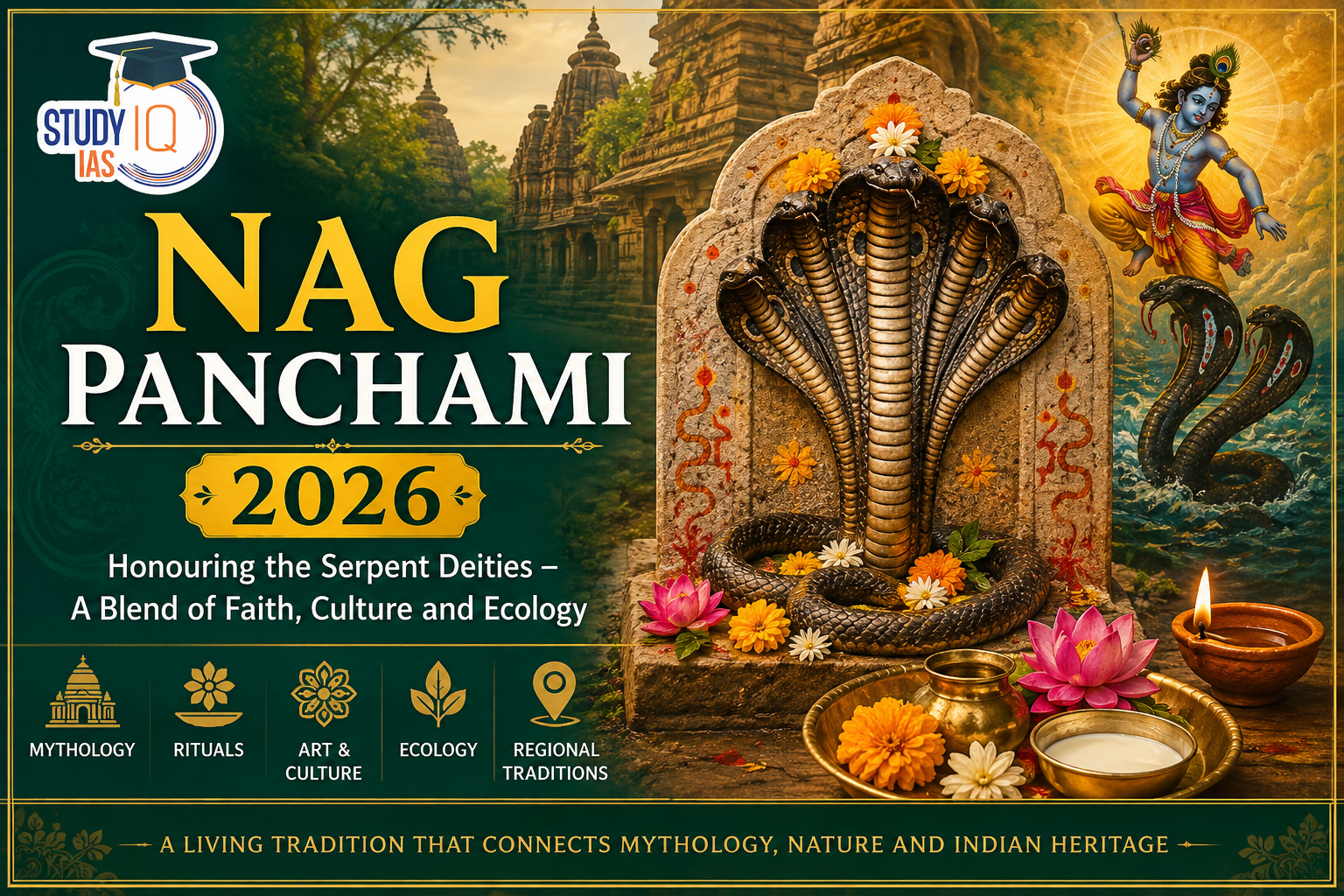
Nag Panchami 2026 is an important Hindu festival dedicated to the worship of Nagas or serpent deities. It is observed on the fifth day (Panchami) of the Shukla Paksha in the month of Shravan. In 2026, Nag Panchami is being observed on Monday, 17 August.
From the perspective of Indian Art and Culture, Nag Panchami is significant because it brings together religion, mythology, folk traditions, agricultural practices, ecology, sculpture, painting, music and regional cultural diversity.
Read Also: UPSC Daily Current Affairs 2026
What is Nag Panchami?
Nag Panchami is a traditional festival in which serpents and Naga deities are revered as sacred beings. The festival reflects the long-standing Indian cultural tradition of associating elements of nature with the divine.
Snakes occupy an important position in Hindu iconography. Shesha is associated with Lord Vishnu, Vasuki with Lord Shiva and the Samudra Manthan, while Kaliya is associated with the Krishna tradition. These associations make the serpent an important symbol in Indian mythology and visual culture.
The festival is particularly important in agrarian societies because snakes help control rodents and other pests that can damage crops. The Maharashtra Tourism Department notes that serpent worship combines religious beliefs with traditional ecological awareness and reverence for nature.
Nag Panchami 2026: Important Facts
| Feature | Details |
|---|---|
| Festival | Nag Panchami |
| Year | 2026 |
| Date | 17 August 2026 |
| Day | Monday |
| Hindu Month | Shravan |
| Tithi | Shukla Paksha Panchami |
| Object of Worship | Nagas/Serpent Deities |
| Major Themes | Nature worship, fertility, protection, agriculture and mythology |
| Major Regions | Maharashtra, Karnataka, Uttar Pradesh, Bihar, West Bengal, Kerala and other parts of India |
Historical and Cultural Roots
Serpent worship in India is much older than the contemporary festival format. Nagas appear in several layers of Indian religious and cultural traditions and are associated with water bodies, fertility, fertility of the land, underground realms and protection.
The tradition also reflects the process through which indigenous and local nature-worship traditions became integrated with wider Hindu religious traditions.
For an Art and Culture perspective, this is important because Indian traditions often demonstrate syncretism between local folk practices and pan-Indian religious traditions.
Nagas in Indian Mythology
1. Shesha or Ananta
Shesha, also known as Ananta, is the cosmic serpent associated with Lord Vishnu. Vishnu is traditionally depicted reclining upon Shesha in the cosmic ocean.
The image represents the relationship between cosmic order, eternity and the preservation of the universe.
2. Vasuki
Vasuki is one of the most important Nagas in Hindu mythology. According to the Samudra Manthan narrative, Vasuki served as the serpent-rope used by the Devas and Asuras to churn the ocean of milk.
Thus, the serpent becomes an important element of one of the central mythological narratives of Hinduism.
3. Kaliya
The story of Kaliya and Krishna is particularly prominent in the Bhagavata tradition.
Krishna is believed to have subdued the poisonous serpent Kaliya in the Yamuna. The episode has been represented extensively in Indian miniature paintings, temple sculpture, folk art and performing traditions.
4. Takshaka
Takshaka is a prominent Naga in the Mahabharata. The Naga tradition is particularly important in the Mahabharata narrative involving King Parikshit and the subsequent Sarpa Satra of Janamejaya.
The story of Astika, who intervened to stop the serpent sacrifice, is another important narrative associated with the Naga tradition.
Nag Panchami and Indian Art
Nag Panchami has considerable relevance to Indian art and iconography.
Serpents appear in:
- Temple sculptures
- Stone carvings
- Bronze images
- Folk paintings
- Terracotta traditions
- Wall paintings
- Ritual drawings
- Manuscript illustrations
- Folk theatre and dance
The image of the serpent is frequently incorporated into representations of Shiva, Vishnu and Krishna, demonstrating how mythology and visual art interact in Indian culture.
The Kaliya Mardana motif, depicting Krishna dancing on Kaliya’s hood, is especially important in Indian religious art.
Regional Variations of Nag Panchami
One of the most important aspects for understanding Indian culture is that Nag Panchami is not celebrated identically across India.
Maharashtra
Nag Panchami has a strong cultural presence in Maharashtra. Clay or other representations of serpents may be worshipped, while traditional songs, dances, fairs and community rituals form part of the celebration.
The Maharashtra Tourism Department highlights the connection between the festival, agrarian life, folklore and ecological awareness.
In parts of Maharashtra, the festival is also associated with anthill worship, reflecting the traditional belief that snakes inhabit underground spaces.
Karnataka
In Karnataka, serpent worship is deeply connected with local traditions of Naga shrines and sacred spaces.
Serpent images may be worshipped and decorated, while traditional rituals involve women, family welfare and community participation.
Kerala
Kerala has a distinctive tradition of Sarpa Kavu, or sacred serpent groves.
These sacred groves are particularly important from an Art and Culture and environmental perspective because they demonstrate the traditional conservation of small forest patches through religious beliefs.
Serpent worship therefore becomes an example of how religious institutions can contribute to traditional ecological conservation.
North India
In several parts of North India, devotees worship Naga deities and visit temples or draw serpent figures on walls and floors.
Regional customs vary considerably, demonstrating India’s characteristic unity in diversity.
Major Rituals
Common practices associated with Nag Panchami include:
- Worship of Naga deities
- Offering flowers and traditional food
- Drawing or installing serpent images
- Visiting Naga shrines
- Observing fasts
- Reciting prayers and mantras
- Decorating sacred spaces
- Participating in regional fairs and folk traditions
In some traditions, devotees historically worshipped live snakes. However, from a modern wildlife-conservation perspective, snakes should not be handled, captured or forced to consume milk. Worshipping symbolic representations or visiting temples is safer and more consistent with wildlife protection.
Nag Panchami and Ecology
Nag Panchami provides an interesting example of the relationship between religious belief and ecological awareness.
Snakes play an important role in ecosystems by controlling populations of rodents and other animals. In agricultural communities, this ecological function can directly benefit crop production.
Traditional practices such as avoiding the disturbance of underground habitats on Nag Panchami have sometimes been interpreted as cultural mechanisms encouraging coexistence with wildlife. Maharashtra Tourism also highlights the festival’s ecological dimension and its message of harmony with nature.
For examination purposes, this can be connected with the broader concept of sacred ecology—the protection of nature through culturally embedded beliefs and practices.
Nag Panchami and Women’s Traditions
In many regions, women have played an important role in Nag Panchami rituals.
The festival may involve:
- Fasting
- Household worship
- Ritual drawings
- Prayers for family welfare
- Community gatherings
- Folk songs
- Traditional food preparation
Such practices provide an important window into women’s participation in India’s intangible cultural heritage.
Nag Panchami as Intangible Cultural Heritage
Nag Panchami should not be understood only as a religious festival.
It represents multiple dimensions of India’s intangible heritage:
Mythology → Ritual → Folk traditions → Performing arts → Food traditions → Community participation → Ecological knowledge
This makes it relevant to the study of Indian society, religion, folk traditions, performing arts and cultural continuity.
Nag Panchami and the Idea of Sacred Geography
The Naga tradition is closely associated with rivers, ponds, wells, forests, anthills and underground spaces.
This creates a cultural connection between serpent worship and sacred landscapes.
The concept of sacred groves such as Kerala’s Sarpa Kavu is particularly important because it demonstrates how particular landscapes acquire religious significance and are consequently protected by communities.
Key Takeaways
- Nag Panchami 2026: 17 August 2026.
- It is observed on Shravan Shukla Panchami.
- It is dedicated to Naga/serpent deities.
- Important Naga figures include Shesha, Vasuki and Takshaka.
- Kaliya Mardana is an important theme in Indian religious art.
- Maharashtra and Karnataka have particularly prominent traditions.
- Kerala’s Sarpa Kavu demonstrates the connection between serpent worship and sacred groves.
- The festival reflects mythology, folk culture, agriculture and ecology.
- For Art and Culture, it is an example of India’s living and regionally diverse intangible cultural heritage.
 Gandhi Jayanti 2026: History, Significan...
 Right to Vote in India: Constitutional S...
 Daily Mains Articles 2026 – Updated Da...














 WhatsApp