Table of Contents
Context
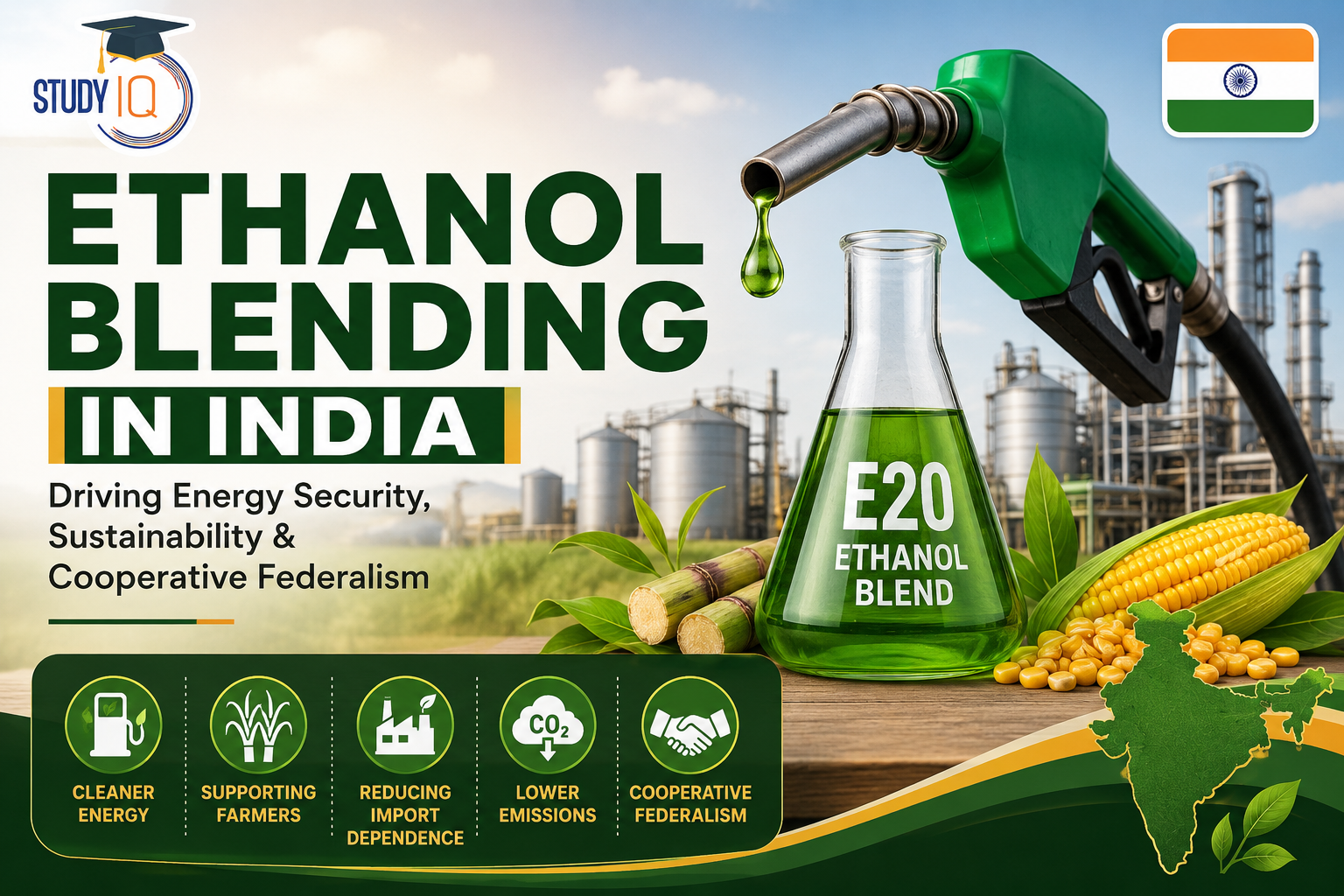
Although India has rapidly expanded ethanol blending to strengthen energy security and reduce emissions, consumer concerns over mileage, engine compatibility and fuel costs continue to shape public acceptance. In contrast, Brazil’s long experience with flex-fuel vehicles and stable ethanol markets highlights that successful energy transitions depend not only on technology and policy but also on sustained consumer confidence.
How has ethanol blending transformed energy transition into an arena of cooperative federalism?
- Fiscal Partnership: The Union’s blending targets depended on state-level feedstock production, making financial incentives a subject of Centre–State negotiation rather than unilateral policymaking.
- g. States such as Uttar Pradesh and Maharashtra provided tax concessions and investment incentives alongside the Centre’s Interest Subvention Scheme to expand ethanol production.
- Regulatory Coordination: As fiscal incentives expanded production, aligning ethanol supply required harmonising regulations, since the Centre procures ethanol while States administer sugarcane, molasses and excise laws.
- g. State governments periodically revise molasses reservation and release policies to align with the Centre’s ethanol procurement programme.
- Constitutional Balancing: As regulatory coordination accelerated production, implementation increasingly depended on State List subjects, requiring national energy objectives to accommodate state control over agriculture, land use and irrigation.
- g. Maharashtra’s restrictions on sugarcane cultivation in drought-prone Marathwada influenced the pace of ethanol expansion despite national blending targets.
- Resource Facilitation: As constitutional constraints determined where expansion was feasible, scaling ethanol capacity required States to facilitate industrial resources through land for distilleries, power connectivity and local infrastructure in partnership with the Centre.
- g. Grain-based distilleries in Madhya Pradesh and Chhattisgarh were established through central interest subvention complemented by state-level land allocation and utility support.
- Institutional Federalism: As developmental collaboration multiplied Centre–State implementation partnerships across states, sustained coordination required permanent intergovernmental institutions rather than ad hoc negotiations.
- g. The National Biofuel Coordination Committee provides a platform for coordinating Centre–State decisions on feedstock availability, blending targets and implementation issues.
How does the ethanol blending programme demonstrate that sustainability transitions are fundamentally systems transitions rather than fuel transitions?
- Agricultural System Reconfiguration: The blending mandate first transformed fuel demand into agricultural demand, making sugarcane and maize cultivation increasingly respond to ethanol procurement prices rather than food markets.
- g. Maize prices surged in 2023–24 as ethanol distilleries competed directly with the poultry-feed industry for the same grain.
- Industrial System Transformation: As agricultural output shifted towards ethanol feedstock, absorbing this expanding supply required dedicated processing capacity, transforming distilleries from flexible alcohol producers into capital-intensive ethanol manufacturers.
- g. The Interest Subvention Scheme financed standalone grain-based ethanol plants designed exclusively for blending supply.
- Energy Logistics Modernisation: As dedicated industrial capacity scaled ethanol production, the existing petroleum logistics network became the binding constraint, requiring storage, transport and dispensing systems to be redesigned for ethanol handling.
- g. Oil Marketing Companies upgraded storage tanks, pipelines and depot infrastructure before the E20 rollout.
- Mobility Technology Adaptation: Even after supply chains became blending-ready, sustainability transition remained incomplete because the vehicle fleet itself was not, necessitating engine redesign and flex-fuel technologies.
- g. Flex-Fuel Vehicles required modified fuel systems, while older vehicles faced compatibility and warranty concerns.
- Natural Resource Reallocation: As vehicle adaptation locked in sustained long-term ethanol demand, maintaining this supply required continued feedstock expansion, intensifying competition for land and water between food and fuel production.
- g. Sugarcane-based ethanol expansion in drought-prone Marathwada increased pressure on already stressed groundwater resources.
- Institutional Coordination Challenge: These cumulative agricultural, industrial, technological and environmental interdependencies exposed the limits of fragmented governance, requiring coordinated regulation across multiple sectors rather than isolated fuel policy.
- g. Although the National Biofuel Coordination Committee sets blending targets, water-use regulation remains fragmented across ministries and states.
Why has Brazil been able to integrate higher ethanol blends into its transport sector with relatively fewer consumer concerns than India?
- Fleet Design Legacy: Brazil introduced flex-fuel vehicles with engines designed for variable ethanol–petrol blends from the outset, eliminating compatibility concerns for consumers. India, by contrast, relied on petrol-optimised vehicles, making higher ethanol blends a retrofit challenge rather than a native design feature.
- g. Brazilian FFVs operate seamlessly on any blend from E20 to E100, whereas many pre-2023 Indian vehicles carried manufacturer warranty limitations beyond E10.
- Consumer Market Choice: Once vehicles became blend-neutral, ethanol adoption shifted from a technical constraint to a consumer choice, making transparent fuel pricing and competition central to public acceptance.
- g. Brazilian fuel stations display both hydrous ethanol (E100) and petrol prices, enabling drivers to choose the more economical fuel in real time.
- Competitive Production Economics: For consumers to consistently prefer ethanol, market choice had to be supported by structurally competitive production costs, which Brazil achieved through its highly efficient sugarcane-based ethanol industry.
- g. Brazil’s sugarcane produces significantly higher ethanol yields per hectare than India’s mixed sugarcane–grain feedstock system, enabling lower retail prices.
- Policy Credibility: Even competitive production economics was insufficient without confidence that government support would endure market disruptions, prompting Brazil to sustain its ethanol programme despite supply crises rather than reversing course.
- g. Following the 1989–90 ethanol shortage, Brazil strengthened the Proálcool programme through policy continuity instead of abandoning ethanol blending.
- Institutional Trust Accumulation: Sustained policy credibility gradually transformed ethanol from an alternative fuel into a trusted default, reducing consumer concerns over fuel availability, quality and long-term government commitment.
- g. After nearly five decades of Proálcool, Brazilian consumers generally regard ethanol as a dependable transport fuel, whereas India’s accelerated post-2014 expansion has had less time to build comparable trust.
Way Forward
- Accelerate Fleet Readiness: Higher ethanol blends can gain public acceptance when vehicles are designed for blend flexibility rather than retrofitted after deployment. India should fast-track universal Flex-Fuel Vehicle (FFV) compatibility across new vehicle segments.
- g. Time-bound FFV adoption standards and uniform E20 warranty coverage across automobile manufacturers would reduce consumer uncertainty.
- Strengthen Consumer Price Competitiveness: Once vehicles become blend-compatible, consumers need a clear economic incentive to prefer ethanol, requiring competitive pricing through improved production efficiency and transparent pricing mechanisms.
- g. Improving ethanol productivity and displaying ethanol-equivalent fuel costs at retail outlets can encourage informed consumer choice.
- Enhance Production Competitiveness: Sustaining price competitiveness requires lowering production costs, making feedstock diversification and commercial-scale second-generation (2G) ethanol essential for reducing dependence on food-based ethanol.
- g. Scaling up agricultural residue-based ethanol under the Pradhan Mantri JI-VAN Yojana can improve long-term supply without intensifying food–fuel competition.
- Ensure Policy Credibility: Even competitive ethanol markets cannot sustain consumer confidence without predictable policy support, requiring stable blending targets and consistent long-term incentives.
- g. Maintaining a transparent roadmap for E20 and future blending milestones, with stable procurement policies, would reduce policy uncertainty for consumers and industry.
- Build Institutional Trust: Sustained policy credibility should culminate in long-term public trust, requiring integrated governance, quality assurance and continuous consumer engagement.
- g. A statutory National Biofuel Authority, supported by nationwide fuel-quality certification and public awareness campaigns, can strengthen confidence in ethanol as a reliable transport fuel.
Read Also: UPSC Daily Current Affairs 2026
 Species in News: Asian Wild Pig- Habitat...
 BRICS AI Open-Source Community: China’...
 India’s Artificial Sun: New 82.6 GHz G...














 WhatsApp