Table of Contents
Context
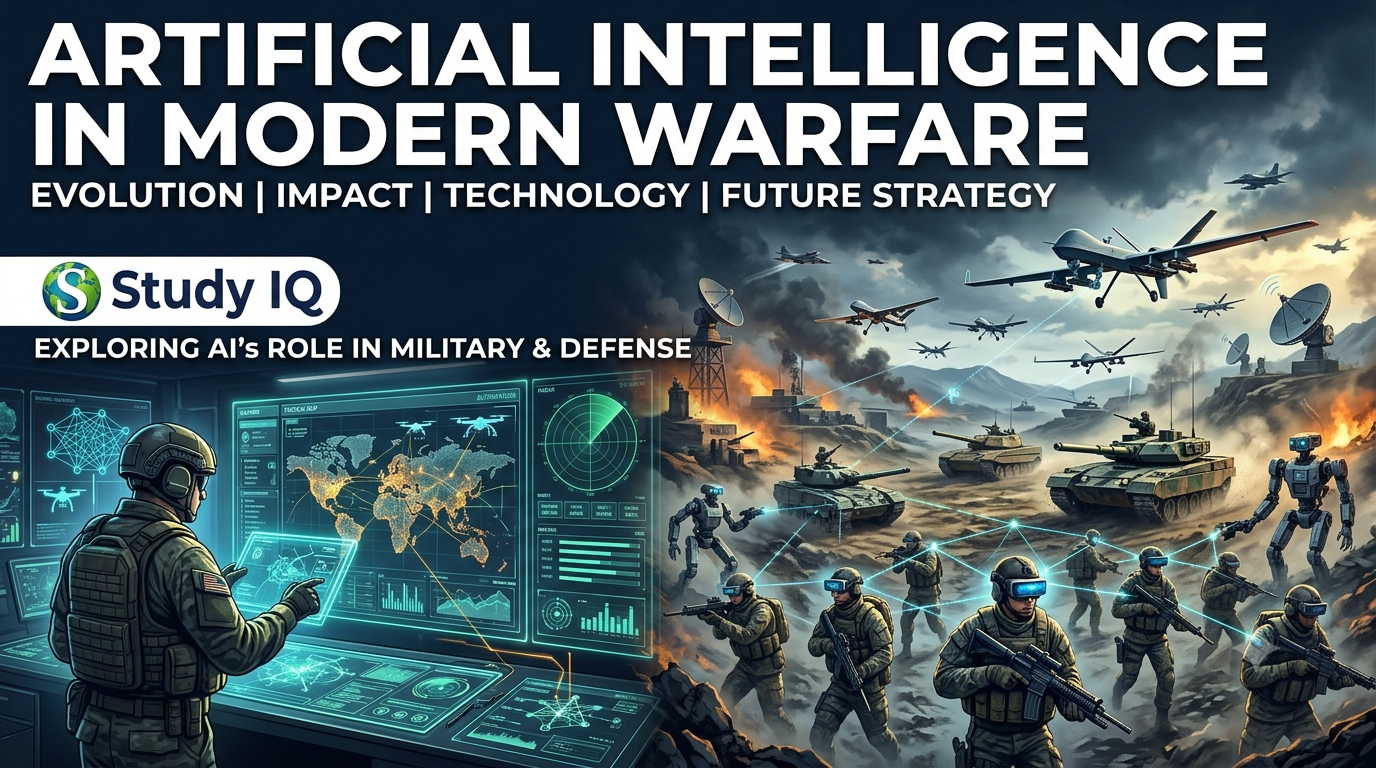
The strategic-military landscape is undergoing a transformative shift, with Artificial Intelligence (AI), military autonomy and algorithmic warfare redefining the nature of modern warfare.
How is AI Reshaping Modern Warfare?
- AI-Enabled Battlefield Awareness: AI integrates data from satellites, drones, sensors and intelligence networks to generate a common operational picture, enabling commanders to assess threats and coordinate operations in real time.
- g. The U.S. Project Maven employs AI to process drone imagery for intelligence and target identification.
- Machine-Speed Targeting: AI-powered kill webs connect sensors, command centres and weapon systems, reducing the time between target detection and engagement.
- g. The U.S. Joint All-Domain Command and Control (JADC2) initiative links assets across land, sea, air, space and cyber for rapid targeting.
- Drone-Centric Warfare: Unmanned systems have become indispensable for intelligence, surveillance, reconnaissance (ISR), precision strikes, logistics support and damage assessment, lowering operational risks to troops.
- g. The Russia–Ukraine War has demonstrated the large-scale use of FPV drones for reconnaissance and precision attacks.
- Autonomous Warfare: AI-enabled autonomous platforms can independently navigate, detect and engage targets with minimal human intervention, expanding the role of machines in combat operations.
- g. Israel’s Harpy loitering munition autonomously detects and destroys enemy radar installations.
- Startup-Driven Defence Innovation: Defence innovation is increasingly being led by agile technology startups developing AI, autonomous systems and advanced military software in partnership with conventional defence industries.
- g.Anduril Industries has developed the AI-enabled Lattice platform for autonomous surveillance and battlefield command and control.
What are the Key Challenges for India in Modern AI Warfare?
- Lack of an Integrated AI Battlefield Network: India lacks a unified AI-enabled command-and-control architecture capable of integrating data from land, air, sea, space and cyber domains into a single operational picture.
- g. Projects such as Project Sanjay and the Combat Information Decision Support System (CIDSS) are under development, but India still lacks an integrated multi-domain battlefield network comparable to advanced militaries.
- Limited AI Integration in Military Operations: AI-driven decision support, predictive analytics, autonomous systems and human-machine teaming remain at an early stage of operational deployment.
- g. The Army AI Incubation Centre is fostering AI innovation, but large-scale integration across the Army, Navy and Air Force remains limited.
- Limited Persistent Space-Based ISR Capabilities: India lacks sufficient Low Earth Orbit (LEO) satellite coverage for continuous intelligence, surveillance and reconnaissance (ISR), constraining real-time situational awareness.
- Interoperability and Software Integration Constraints: AI integration is hindered by the diverse mix of foreign and indigenous military platforms operating on incompatible software architectures.
- g. Integrating Russian, French, American and indigenous platforms into a unified AI-enabled command network remains difficult due to proprietary and closed software systems.
- Slow Defence Procurement and Institutional Reforms: Defence acquisition and organisational processes have struggled to keep pace with the rapid advancement of AI, software and autonomous technologies.
- g. Despite reforms under the Defence Acquisition Procedure (DAP) and iDEX, procurement and induction cycles remain significantly slower than commercial technology innovation.
Way Forward
- Develop an Indigenous AI Battlefield Network: Build an integrated AI-enabled command-and-control platform that fuses real-time data from land, air, sea, space and cyber domains for faster decision-making.
- g. Develop an indigenous battlefield management system on the lines of Ukraine’s Delta, adapted to India’s multi-front operational environment.
- Advance Autonomous Drone Warfare: Develop indigenous AI software for autonomous drone swarms capable of collaborative navigation, target recognition and mission execution with human oversight.
- g. Scale up swarm technologies under iDEX and Army Design Bureau initiatives.
- Scale Indigenous Drone Production: Create a robust domestic drone manufacturing ecosystem to ensure affordable, mass deployment during high-intensity conflicts.
- g. Expand production through the Production Linked Incentive (PLI) scheme and private defence startups.
- Expand Space-Based ISR: Increase the number of Low Earth Orbit (LEO) satellites to enable persistent intelligence, surveillance and reconnaissance across multiple theatres.
- g. Fast-track the Space-Based Surveillance (SBS-III) programme with greater participation from private space companies.
- Prioritise Software-Centric Defence Modernisation: Shift defence investment from hardware-centric procurement towards AI, software, cloud computing, cybersecurity and advanced data analytics.
- g. Allocate a dedicated share of the defence modernisation budget for AI and digital warfare technologies.
Latest UPSC Updates
| Resource | Link |
|---|---|
| UPSC Prelims Result 2026 | Check Here |
| UPSC Exam Calendar 2027 | View Calendar |
| UPSC Question Paper 2026 | Download PDF |
| UPSC Prelims Answer Key 2026 | Check Answer Key |
| UPSC Cut Off 2026 | View Cut Off |
| UPSC Syllabus 2026 | Read Syllabus |
| Daily Current Affairs 2026 | Read Updates |
| StudyIQ UPSC IAS Foundation 2027 (English) | Join Course |
| StudyIQ UPSC IAS Foundation 2027 (Hindi) | Join Course |
| StudyIQ UPSC IAS Foundation 2027 (Bilingual) | Join Course |
 UPSC NDA 2 Result 2026 Out: Download Mer...
 Circular Economy in India: Benefits, Cha...
 EPFO Wage Ceiling Hike 2026: Social Secu...













 WhatsApp