Table of Contents
Context
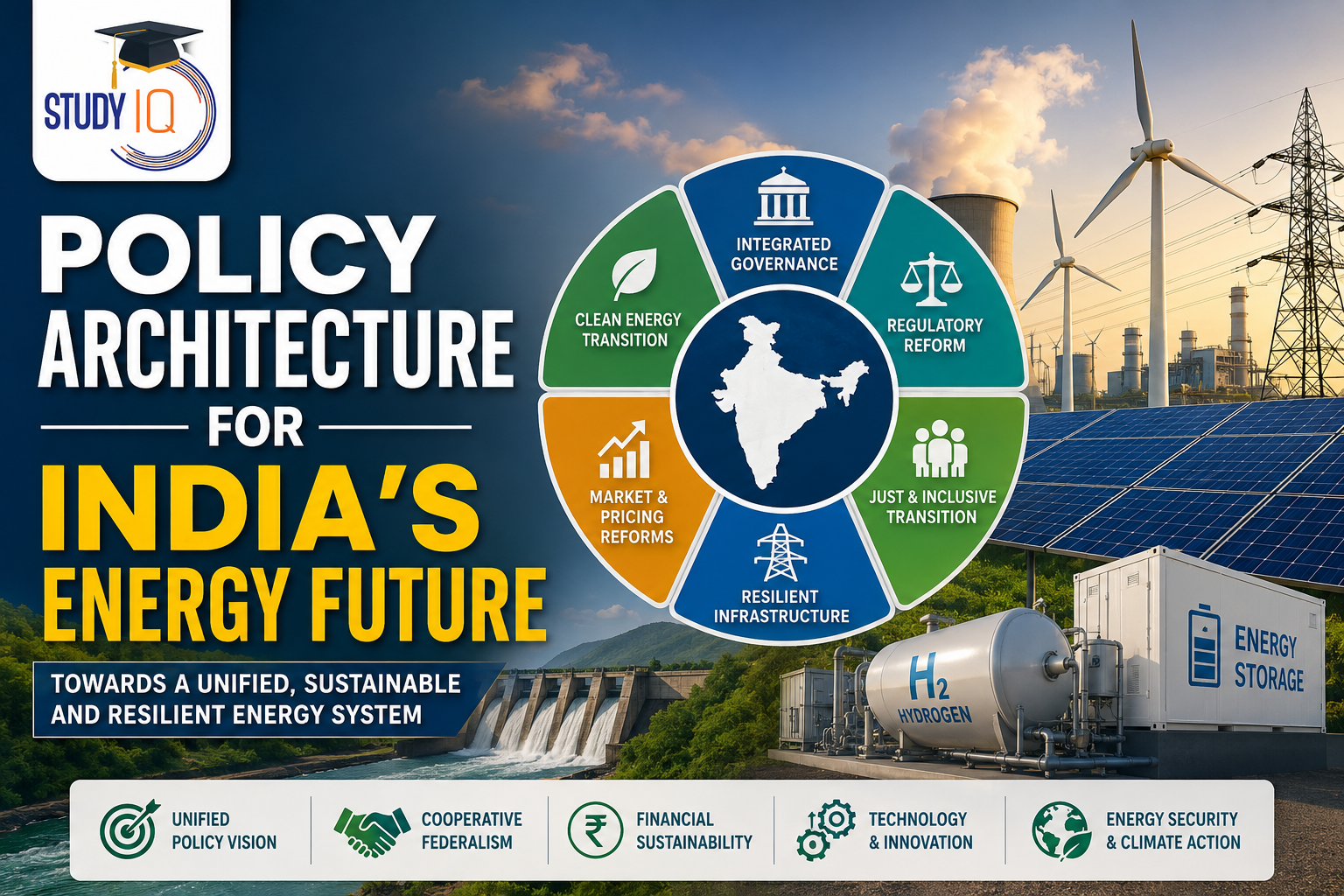
The Indian National Science Academy (INSA), through its Centre for Science, Technology, Innovation and Policy (CSTIP), has released a policy brief calling for the adoption of a unified national energy policy framework to strengthen India’s energy governance and support the clean energy transition.
Why Does India Need a Unified Energy Policy Architecture?
- Breaking Institutional Silos: India’s energy ecosystem is governed through fragmented ministries and agencies, resulting in disconnected policymaking and inefficient resource allocation.
- g., Coal, petroleum, electricity, renewable energy, and energy efficiency are administered separately despite operating within the same energy system.
- Creating Integrated Energy Markets: A unified architecture must align policy, regulation, pricing, and investment to create financially sustainable energy markets rather than isolated sectoral reforms.
- g., Financially weak DISCOMs and politically constrained tariff reforms continue to undermine renewable integration despite rising generation capacity.
- Strengthening Regulatory Governance: Effective energy transition requires independent and coordinated regulation to balance consumer welfare, investment certainty, and market efficiency.
- g., Greater coordination and autonomy of CERC and SERCs can enable cost-reflective tariffs, open access, and competitive electricity markets.
- Managing India’s Dual Energy Transition: India must simultaneously expand reliable baseload power while rapidly scaling clean energy, requiring coordinated planning for legacy and emerging energy systems.
- g., Coal remains critical for grid stability even as solar, wind, battery storage, and green hydrogen expand, necessitating mechanisms to manage stranded thermal assets and support coal-dependent regions.
- Institutionalising Cooperative Energy Federalism: Since electricity is a Concurrent List subject, national energy objectives must be implemented through incentive-based Centre–State coordination rather than administrative centralisation.
- g., Performance-linked support under schemes such as the Revamped Distribution Sector Scheme (RDSS) can encourage States to undertake tariff reforms, reduce distribution losses, and modernise power infrastructure.
Challenges in Implementing a Unified Energy Policy Architecture
- Siloed Institutional Governance: Ministries and agencies pursue competing policy objectives, making integrated decision-making difficult.
- g., The Ministry of Coal seeks to maximise domestic coal production, while the Ministry of New and Renewable Energy (MNRE) prioritises decarbonisation, often creating policy trade-offs.
- Grid Integration and Infrastructure Bottlenecks: Integrating variable renewable energy into an ageing grid requires extensive transmission expansion, storage, and land acquisition, delaying implementation.
- g., Renewable-rich regions require new transmission corridors, but Right of Way (RoW) disputes and land acquisition delays slow projects.
- Technology Dependence and Supply Chain Risks: The clean-energy transition could replace fossil-fuel import dependence with dependence on critical minerals and advanced technologies.
- g., Large-scale deployment of Battery Energy Storage Systems (BESS) increases reliance on imported lithium, cobalt, and rare earth elements.
- Political Economy of Energy Pricing: Financial sustainability requires cost-reflective tariffs, but political considerations often favour subsidies and cross-subsidisation.
- g., Financially stressed DISCOMs continue to face losses due to subsidised electricity, delayed tariff revisions, and cross-subsidisation between industrial and residential consumers.
- Just Transition and Federal Asymmetry: The energy transition creates uneven economic impacts across States, making national consensus difficult.
- g., Renewable-rich States such as Gujarat, Rajasthan, and Tamil Nadu benefit from clean-energy investments, whereas coal-dependent States like Jharkhand, Chhattisgarh, and Odisha face revenue losses, employment challenges, and stranded assets.
Way Forward
- Establish a Unified Energy Governance Architecture: Create an apex institutional mechanism to integrate planning across fuels, electricity, climate, and industrial policy while preserving ministerial expertise.
- g., A National Energy Commission (or unified Ministry of Energy, as proposed by the Kelkar Committee) can coordinate policies across coal, petroleum, power, and renewable energy.
- Undertake Market and Pricing Reforms: Restore financial sustainability by rationalising tariffs, reducing cross-subsidies, and improving the commercial viability of the power sector.
- g., Implement Direct Benefit Transfer (DBT) for electricity subsidies and advance reforms under the Electricity (Amendment) Bill to strengthen DISCOMs and promote competitive electricity markets.
- Build a Flexible and Resilient Power System: Prioritise grid modernisation, storage infrastructure, and digital technologies to support high renewable penetration.
- g., Scale up Battery Energy Storage Systems (BESS), Pumped Storage Projects (PSPs), smart grids, and Green Energy Corridors.
- Strengthen Domestic Clean Energy Ecosystems: Reduce external dependencies by building indigenous manufacturing capacity for next-generation energy technologies.
- g., Expand Production Linked Incentive (PLI) schemes for Advanced Chemistry Cells (ACC), solar PV modules, electrolysers, and other strategic clean-energy technologies.
- Institutionalise a Just and Cooperative Energy Transition: Balance national decarbonisation goals with the developmental needs of States through targeted fiscal support and workforce transition.
 US Treasury Yields at 25-Year High: Impa...
 National Coastal Mission 2.0 (NCM 2.0): ...
 New CAFE Norms 2027–32: Key Features, ...














 WhatsApp