Table of Contents
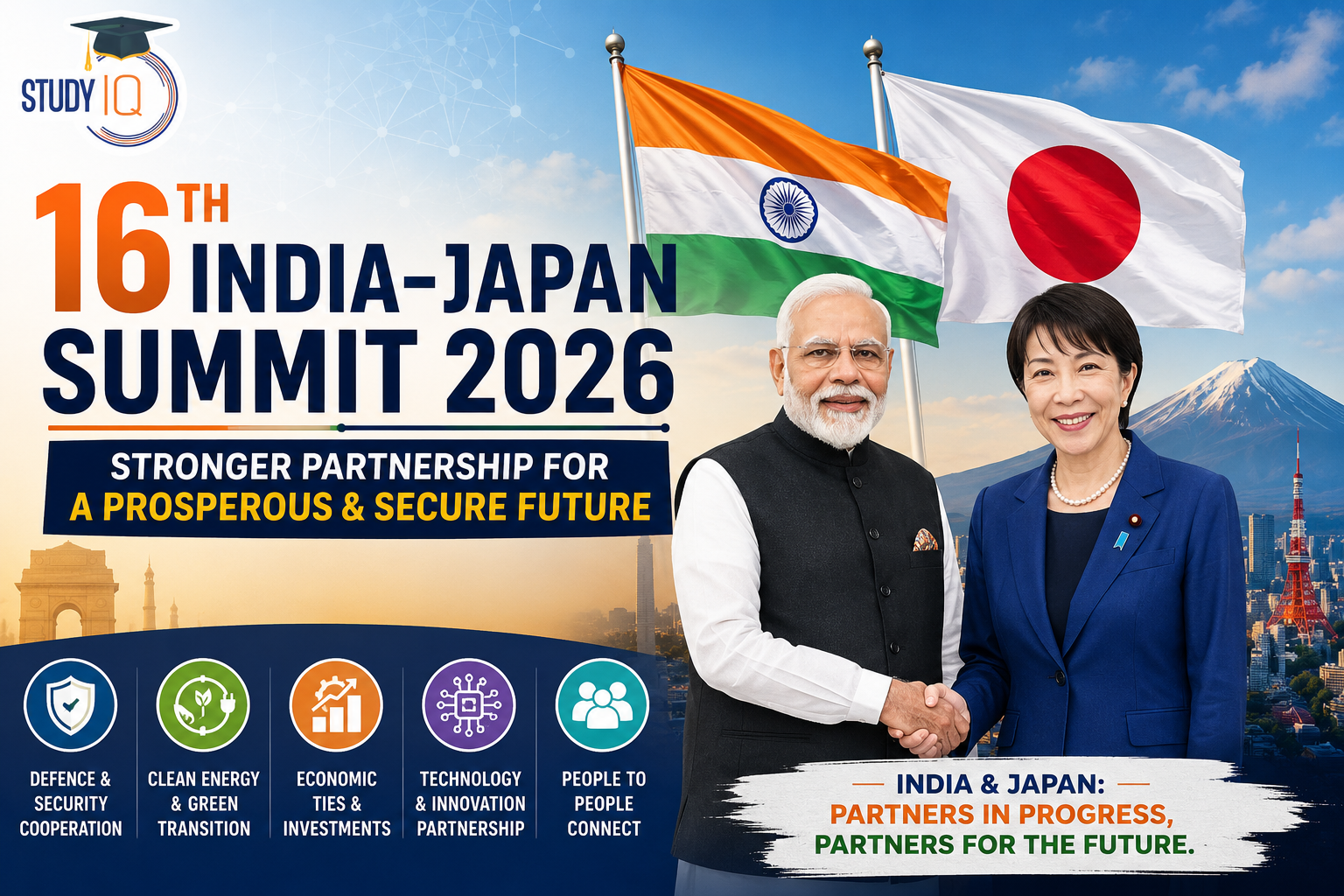
The 16th India–Japan Annual Summit marked another milestone in the Special Strategic and Global Partnership between India and Japan. During the summit, Japanese Prime Minister Sanae Takaichi visited India and held high-level discussions with Prime Minister Narendra Modi on strengthening cooperation in defence, clean energy, emerging technologies, economic security, and Indo-Pacific stability.
The summit highlighted the growing strategic convergence between the two countries amid changing geopolitical dynamics and reinforced their commitment to a free, open, inclusive, and rules-based Indo-Pacific.
Highlights of the 16th India–Japan Summit
| Particular | Details |
|---|---|
| Summit | 16th India–Japan Annual Summit |
| Host Country | India |
| Japanese Prime Minister | Sanae Takaichi |
| Indian Prime Minister | Narendra Modi |
| Focus Areas | Defence, Energy, AI, Indo-Pacific, Technology, Economic Security |
| Key Outcomes | UNICORN Project, Biogas Initiative, Green Hydrogen, AI Strategic Dialogue, Strategic Petroleum Reserves |
Key Outcomes of the 16th India–Japan Summit
1. Defence Cooperation Gets a Major Boost
One of the most significant announcements was progress on the UNICORN Project, the first-ever India–Japan defence technology co-development initiative.
UNICORN Project
- Both countries agreed on the remaining technical aspects.
- It marks the first joint defence technology development programme.
- Strengthens defence industrial cooperation.
- Supports India’s Make in India and Atmanirbhar Bharat initiatives.
- Enhances interoperability between the armed forces.
Expanded JAIMEX Naval Exercises
India and Japan decided to expand the JAIMEX (Japan-India Maritime Exercise).
Key objectives include:
- Greater naval interoperability
- Maritime domain awareness
- Joint anti-submarine warfare training
- Indo-Pacific maritime security
- Freedom of navigation
2. Cooperation in Maintenance, Repair and Overhaul (MRO)
Japan agreed to deepen collaboration in Maintenance, Repair and Overhaul (MRO) capabilities under India’s Make in India programme.
Benefits
- Development of India’s defence manufacturing ecosystem.
- Reduced dependence on imports.
- Better maintenance infrastructure for defence platforms.
- Technology transfer and industrial cooperation.
16th India–Japan Summit 2026 UPSC Prelims Facts
| Topic | Key Fact |
|---|---|
| Summit | 16th India–Japan Annual Summit |
| Japanese PM | Sanae Takaichi |
| Defence Project | UNICORN (first India–Japan defence technology co-development initiative) |
| Naval Exercise | JAIMEX |
| Defence Industry | MRO cooperation under Make in India |
| Clean Energy | India–Japan Cooperative Biogas for Growth Initiative |
| Biogas Target | 1,000 biogas plants |
| Green Hydrogen | Odisha Green Hydrogen and Clean Ammonia Project |
| Energy | Energy Resilience Statement on Strategic Petroleum Reserves |
| AI | India–Japan AI Strategic Dialogue |
| IEA | Japan reaffirmed support for India’s membership in the International Energy Agency |
Clean Energy Cooperation
The summit significantly expanded bilateral cooperation in clean and renewable energy.
India–Japan Cooperative Biogas for Growth Initiative
A major announcement was the launch of the India–Japan Cooperative Biogas for Growth Initiative.
Objectives
- Support India’s target of establishing 1,000 biogas plants.
- Promote clean and renewable energy.
- Improve rural energy access.
- Reduce agricultural waste burning.
- Enhance energy security.
- Generate rural employment.
Importance
The initiative supports India’s goals under:
- Net Zero by 2070
- Energy transition
- Circular economy
- Sustainable agriculture
- Climate change mitigation
Odisha Green Hydrogen and Clean Ammonia Project
The two countries reaffirmed cooperation on the Odisha Green Hydrogen and Clean Ammonia Project.
Project Significance
- Production of green hydrogen using renewable energy.
- Manufacturing clean ammonia for domestic use and exports.
- Reduction in industrial carbon emissions.
- Development of green fuel supply chains.
- Promotion of India’s National Green Hydrogen Mission.
Benefits
- Energy diversification
- Export opportunities
- Industrial decarbonisation
- Technology collaboration
Energy Security Partnership
Another important outcome was the signing of the Energy Resilience Statement on Strategic Petroleum Reserves (SPR).
Strategic Petroleum Reserves (SPR)
Strategic Petroleum Reserves are emergency stockpiles of crude oil maintained to deal with supply disruptions caused by:
- Wars
- Natural disasters
- Global energy crises
- Supply chain disruptions
Importance for India
- Strengthens national energy security.
- Protects against global oil price shocks.
- Ensures uninterrupted fuel supply.
- Supports economic stability.
Japan Supports India’s Membership in the International Energy Agency (IEA)
Japan reiterated its support for India’s membership in the International Energy Agency (IEA).
Why It Matters
IEA membership would help India:
- Participate in global energy governance.
- Access strategic energy information.
- Improve energy planning.
- Strengthen energy resilience.
- Enhance international cooperation.
India–Japan AI Strategic Dialogue
The summit also established the India–Japan AI Strategic Dialogue.
Objectives
The dialogue aims to promote collaboration on:
- Trusted Artificial Intelligence
- Secure AI systems
- AI governance
- Ethical AI development
- Responsible innovation
- Research collaboration
- Digital public infrastructure
Importance
As AI becomes central to national security and economic competitiveness, India and Japan seek to jointly develop trustworthy AI technologies while ensuring data security and responsible innovation.
India–Japan Relations: An Overview
India and Japan share a Special Strategic and Global Partnership built on shared democratic values, economic cooperation, and commitment to regional peace.
Major Areas of Cooperation
Defence and Security
- 2+2 Ministerial Dialogue
- Acquisition and Cross-Servicing Agreement (ACSA)
- Defence equipment cooperation
- Maritime security
- Indo-Pacific strategy
Economic Cooperation
- Comprehensive Economic Partnership Agreement (CEPA)
- Infrastructure investment
- Industrial corridors
- Dedicated Freight Corridor
- High-Speed Rail Project (Mumbai–Ahmedabad Bullet Train)
Connectivity
Japan has been a key partner in:
- Delhi Metro
- Metro rail projects
- Smart Cities
- Industrial corridors
- Northeast connectivity
Indo-Pacific Cooperation
Both countries support:
- Free and Open Indo-Pacific (FOIP)
- Rule-based international order
- Freedom of navigation
- Maritime security
- Regional stability
Importance of the 16th India–Japan Summit
The summit is significant because it:
- Deepens defence technology collaboration.
- Strengthens maritime security cooperation.
- Enhances India’s clean energy transition.
- Supports green hydrogen development.
- Promotes trusted AI collaboration.
- Improves energy resilience through strategic petroleum reserves.
- Advances Make in India and Atmanirbhar Bharat.
- Reinforces cooperation in the Indo-Pacific.
Challenges in India–Japan Relations
Despite strong cooperation, certain challenges remain:
- Slow implementation of infrastructure projects.
- Trade imbalance.
- Regulatory hurdles.
- Global geopolitical uncertainties.
- Supply chain vulnerabilities.
- Differences in investment pace.
Way Forward
To further strengthen bilateral ties, both countries should:
- Accelerate defence co-development projects.
- Expand semiconductor cooperation.
- Increase investments in clean energy.
- Enhance AI and digital technology partnerships.
- Strengthen resilient supply chains.
- Promote greater people-to-people exchanges.
- Expand cooperation in critical minerals and emerging technologies.
- Deepen Indo-Pacific security collaboration.
Conclusion
The 16th India–Japan Summit represents a major step in advancing one of Asia’s most important strategic partnerships. From the UNICORN defence technology project and expanded JAIMEX naval exercises to cooperation in green hydrogen, biogas, artificial intelligence, and strategic petroleum reserves, the summit reflects the growing depth of India–Japan relations. As both nations navigate an increasingly complex geopolitical landscape, these initiatives are expected to strengthen regional security, accelerate the clean energy transition, and foster innovation-driven economic growth.
 US Treasury Yields at 25-Year High: Impa...
 National Coastal Mission 2.0 (NCM 2.0): ...
 New CAFE Norms 2027–32: Key Features, ...














 WhatsApp