Table of Contents
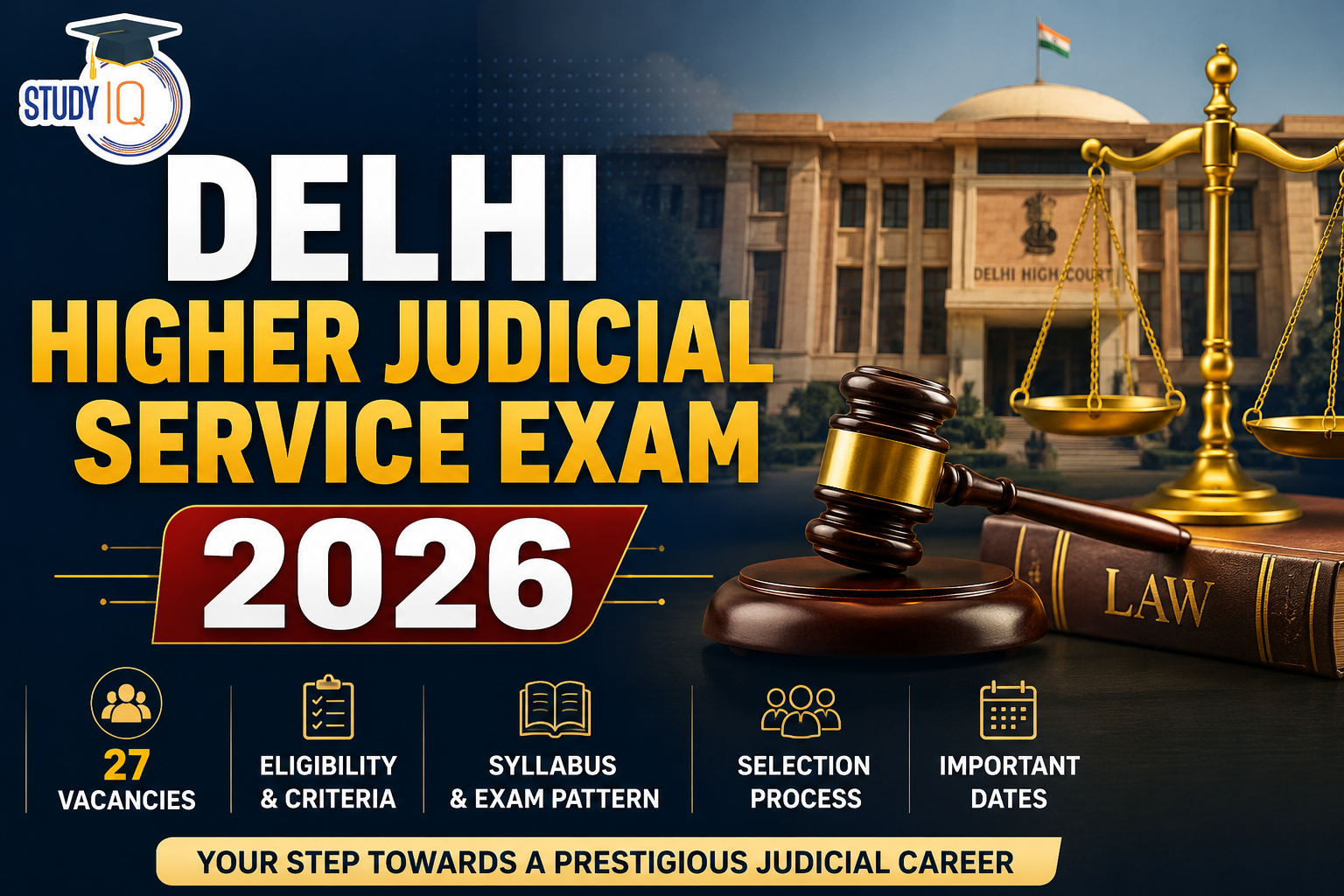
The Delhi Higher Judicial Service Exam 2026 is one of the most prestigious judicial recruitment examinations in India, conducted by the High Court of Delhi for the direct recruitment of eligible Advocates to the cadre of District Judges under the Delhi Higher Judicial Service Rules. Unlike the Delhi Judicial Service (Civil Judge) Examination, which is meant for fresh law graduates, the DHJS Examination is specifically designed for experienced Advocates who fulfil the prescribed eligibility conditions. Candidates selected through this examination are appointed as District Judges and play a crucial role in the administration of justice in the National Capital Territory of Delhi.
Delhi Higher Judicial Service Exam 2026 Notification: Latest Update
The High Court of Delhi released the Delhi Higher Judicial Service Examination 2026 Notification on 1 July 2026, inviting online applications for 27 vacancies under the direct recruitment quota from the Bar. The online application process commenced on 1 July 2026 and will continue till 15 July 2026, while the Preliminary Examination is scheduled to be held on 26 July 2026. With a short application and examination timeline, aspirants should complete the registration process promptly and begin focused preparation.
DHJS 2026 Highlights
| Particular | Details |
| Exam Name | Delhi Higher Judicial Service Examination 2026 |
| Conducting Authority | High Court of Delhi |
| Notification Release Date | 1 July 2026 |
| Total Vacancies | 27 |
| Mode of Application | Online |
| Application Dates | 1 July – 15 July 2026 |
| Preliminary Examination | 26 July 2026 |
| Selection Process | Preliminary Exam, Main Written Examination & Viva-Voce |
| Official Website | Delhi High Court |
Important Dates
| Event | Date |
| Notification Released | 1 July 2026 |
| Online Application Starts | 1 July 2026 |
| Last Date to Apply | 15 July 2026 |
| Preliminary Examination | 26 July 2026 |
| Main Examination | To be notified |
| Viva-Voce | To be notified |
Eligibility Criteria
To apply for the Delhi Higher Judicial Service Examination 2026, a candidate must satisfy the eligibility conditions prescribed by the Delhi Higher Judicial Service Rules and the official notification.
- Must be a citizen of India.
- Must possess a Bachelor’s Degree in Law from a recognised university.
- Must be an Advocate and fulfil the minimum practice requirement prescribed under the applicable rules on the last date of submission of the application.
- Must satisfy the prescribed age limit and other eligibility conditions mentioned in the notification.
Candidates are advised to read the detailed notification carefully before submitting their application to ensure compliance with all eligibility requirements.
Selection Process
The recruitment process consists of three stages:
Stage I – Preliminary Examination
The Preliminary Examination is an objective-type screening test consisting of Multiple Choice Questions (MCQs). It is conducted to shortlist candidates for the Main Written Examination. The marks secured in this stage are not considered for the preparation of the final merit list.
Stage II – Main Written Examination
Candidates qualifying the Preliminary Examination are called for the Main Examination, which is descriptive in nature. This stage evaluates legal knowledge, analytical ability, drafting skills, interpretation of statutes, and judgment writing.
Stage III – Viva-Voce
Candidates qualifying the written examination are called for the Viva-Voce. The interview assesses legal acumen, professional experience, communication skills, judicial temperament, ethics, personality, and suitability for appointment to the Higher Judicial Service.
Weightage of Examination
The Preliminary Examination is only a screening test and does not contribute to the final merit. The Main Written Examination carries the maximum weight in the selection process, while the Viva-Voce serves as the final assessment of the candidate’s overall suitability. Therefore, aspirants should focus equally on conceptual clarity, descriptive answer writing, and interview preparation.
Delhi Higher Judiciary Syllabus 2026
The DHJS syllabus is comprehensive and tests both substantive and procedural laws, along with practical application of legal principles.
Preliminary Examination Syllabus
The Preliminary Examination generally covers:
- Constitution of India
- Bharatiya Nyaya Sanhita (BNS)
- Bharatiya Nagarik Suraksha Sanhita (BNSS)
- Bharatiya Sakshya Adhiniyam (BSA)
- Code of Civil Procedure
- Indian Contract Act
- Specific Relief Act
- Transfer of Property Act
- Limitation Act
- Arbitration and Conciliation Act
- Commercial Courts Act
- Hindu Law
- Muslim Law
- Law of Torts
- Delhi Rent Control Act
- Current Legal Affairs
- Recent Supreme Court and High Court Judgments
- General Legal Knowledge
The Preliminary Examination primarily evaluates conceptual clarity, statutory interpretation, and legal aptitude.
Main Examination Syllabus
The Main Examination is descriptive and requires candidates to demonstrate legal reasoning, application of law, drafting ability, and judgment writing skills.
Paper I – General Knowledge & Language
- Current Legal Developments
- English Essay
- Precis Writing
- Comprehension
- Translation (English–Hindi and Hindi–English)
- Legal Drafting
- Grammar and Vocabulary
Paper II – Civil Law
- Indian Contract Act
- Sale of Goods Act
- Transfer of Property Act
- Specific Relief Act
- Hindu Law
- Muslim Law
- Law of Torts
- Commercial Courts Act
- Delhi Rent Control Act
Paper III – Civil Procedure & Evidence
- Code of Civil Procedure
- Bharatiya Sakshya Adhiniyam
- Limitation Act
- Registration Act
- Arbitration & Conciliation Act
- Execution Proceedings
- Pleadings
- Framing of Issues
- Appreciation of Evidence
Paper IV – Criminal Law
- Bharatiya Nyaya Sanhita
- Bharatiya Nagarik Suraksha Sanhita
- Constitutional Principles relating to Criminal Justice
- Special Criminal Laws
- Framing of Charges
- Judgment Writing
- Sentencing Principles
Interview (Viva-Voce)
The Viva-Voce is the final stage of the recruitment process and is intended to assess qualities that cannot be evaluated through written examinations. The interview broadly focuses on:
- Legal knowledge
- Practical courtroom experience
- Analytical thinking
- Decision-making ability
- Judicial ethics
- Personality
- Communication skills
- Awareness of recent legal developments
Candidates should also be prepared to discuss important constitutional issues, landmark judgments, and contemporary legal challenges.
DHJS 2026 Exam Pattern & Marks Distribution
The Delhi Higher Judicial Service Examination is conducted in three stages—Preliminary Examination, Main Written Examination, and Viva-Voce (Interview). While the Preliminary Examination serves as a screening test, the final merit is prepared on the basis of the marks secured in the Main Written Examination and the Viva-Voce, subject to the qualifying criteria prescribed by the Delhi High Court.
Stage-wise Exam Pattern
| Stage | Nature of Exam | Marks | Qualifying/ Merit |
| Preliminary Examination | Objective (MCQs) | 250 | Qualifying (Marks not added in final merit) |
| Main Written Examination | Descriptive | 850 | Merit Determining |
| Viva-Voce (Interview) | Personality Test | 150 | Merit Determining |
| Total (Mains + Interview) | — | 1000 | Final Merit |
Preliminary Examination Pattern
| Particular | Details |
| Mode of Examination | Offline (OMR Based) |
| Type of Questions | Multiple Choice Questions (MCQs) |
| Maximum Marks | 250 Marks |
| Duration | 2 Hours |
| Negative Marking | 25% (0.25 mark deduction for every incorrect answer) |
| Purpose | Screening Test for Mains |
Main Written Examination Pattern
| Paper | Subject | Marks |
| Paper I | General Knowledge & Language | 200 |
| Paper II | Civil Law-I | 200 |
| Paper III | Civil Law-II | 200 |
| Paper IV | Criminal Law | 250 |
| Total | Main Written Examination | 850 Marks |
Viva-Voce (Interview)
| Particular | Details |
| Maximum Marks | 150 Marks |
| Purpose | Assessment of legal knowledge, professional experience, communication skills, judicial temperament, ethics, personality and overall suitability for appointment to the Higher Judicial Service |
Final Merit Calculation
The final merit list is prepared on the basis of:
- Main Written Examination: 850 Marks
- Viva-Voce (Interview): 150 Marks
- Total Merit: 1000 Marks
The Preliminary Examination is only a qualifying stage, and the marks obtained in this examination are not counted towards the final merit list. Candidates must also secure the minimum qualifying marks prescribed by the Delhi High Court at each stage of the examination. As per the 2026 instructions, candidates are required to secure 45% marks in the Preliminary Examination, 40% in each paper and 45% in aggregate in the Main Written Examination, and 45% marks in the Viva-Voce to qualify, subject to the applicable category-wise rules.
Previous Year Cut-off Trends
The Delhi High Court does not prescribe a fixed cut-off for every recruitment cycle. The cut-off varies depending on the number of vacancies, the difficulty level of the examination, and the overall performance of candidates. Since DHJS recruitment is conducted periodically and the number of vacancies differs from year to year, aspirants should avoid relying solely on previous cut-offs. Instead, they should aim to score well above the minimum qualifying standards by strengthening both objective and descriptive preparation.
Preparation Strategy
Given the short timeline for the Preliminary Examination, candidates should prioritise Bare Act reading, revision of substantive and procedural laws, and practice of previous years’ questions. Simultaneously, preparation for the Main Examination should begin from day one, with a strong focus on descriptive answer writing, judgment writing, framing of issues, drafting, and recent Supreme Court and Delhi High Court judgments. Regular reading of constitutional developments, commercial law updates, and landmark judicial pronouncements will provide a competitive advantage during both the written examination and the interview.
Why DHJS 2026 is an Important Opportunity
The announcement of 27 vacancies makes the DHJS Examination 2026 one of the most significant Higher Judicial Service recruitments in recent years. Appointment to the Delhi Higher Judicial Service offers an excellent salary, career progression, judicial independence, and the opportunity to serve in one of India’s most respected judicial institutions. For experienced advocates aspiring to join the Bench, this recruitment presents an outstanding opportunity to transition from litigation to the higher judiciary. Aspirants should utilise the limited preparation window effectively by combining rigorous Bare Act study with answer-writing practice and interview preparation to maximise their chances of success.
Read Also: Judiciary Current Affairs
 RPSC APO Result 2026 Out: Merit List PDF...
 CG ADPO 2026 Answer Key (Set A): Answer ...
 Chhattisgarh Judicial Service Exam 2026:...



 WhatsApp