Table of Contents
Context
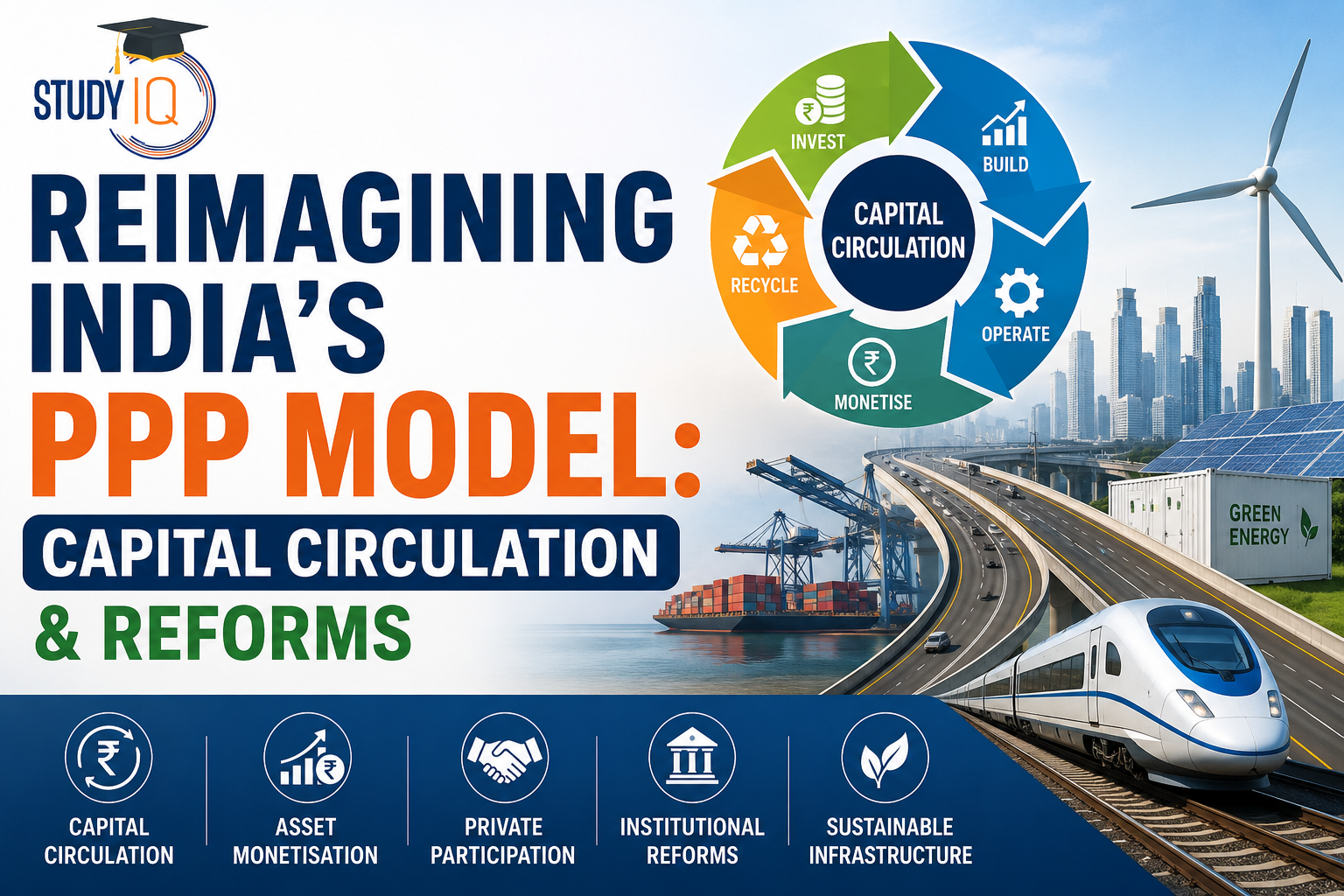
India’s aspiration to become a developed economy by 2047 and achieve net-zero emissions by 2070 demands massive infrastructure investment. While first-generation PPPs expanded infrastructure, their financing model proved unsustainable. Hence, India needs a second-generation PPP framework based on capital circulation, enabling continuous recycling of public and private capital for long-term infrastructure financing.
Why Does India Need to Reimagine its PPP Model?
- Correcting Flawed Risk Allocation: Earlier PPP models transferred excessive construction, land acquisition, regulatory, and demand risks to private developers, resulting in stalled projects and the Twin Balance Sheet
- g., The Hybrid Annuity Model (HAM) shares construction costs, while the government assumes land acquisition and traffic risks, improving project viability.
- Shifting from Capital Mobilisation to Capital Circulation: Infrastructure financing is moving from continuously raising fresh capital to recycling capital locked in operational assets.
- g., The National Monetisation Pipeline (NMP), Infrastructure Investment Trusts (InvITs), and recent State-level asset monetisation initiatives unlock value from brownfield assets to finance new infrastructure.
- Building a Climate-Ready PPP Framework: Traditional PPP contracts are ill-suited to emerging sectors with high technological and commercial uncertainty, requiring innovative financing structures.
- g., Green hydrogen, battery storage, and carbon capture projects require blended finance, Viability Gap Funding (VGF), and differentiated risk-sharing mechanisms.
- Institutionalising Flexible Contract Governance: Long-term infrastructure projects require predictable regulation, transparent contract renegotiation, and efficient dispute resolution to sustain investor confidence.
- g., The Kelkar Committee on PPPs recommended structured renegotiation frameworks and faster dispute resolution to revive stressed infrastructure projects.
- Crowding-in Private Capital for Viksit Bharat 2047: As public finances face increasing fiscal constraints, PPPs must evolve into a mechanism that leverages public investment to attract long-term private capital.
- g., With record public capital expenditure in recent Union Budgets, a reimagined PPP framework can multiply infrastructure investment by mobilising institutional investors, pension funds, and sovereign wealth funds.
How Can Capital Circulation Transform Infrastructure Financing?
- Equity Recycling through Asset Monetisation: Operational infrastructure assets can be monetised to unlock equity for new greenfield projects, reducing dependence on fresh public borrowing.
- g., The National Monetisation Pipeline (NMP) and Infrastructure Investment Trusts (InvITs)monetise operational highways, transmission lines, and pipelines, generating capital for new infrastructure.
- Debt Recycling through Infrastructure Debt Funds (IDFs): Refinancing completed projects with long-term capital frees commercial banks from holding illiquid infrastructure loans and supports fresh lending.
- g.,Infrastructure Debt Funds (IDFs) refinance operational assets, addressing banks’ Asset–Liability Mismatch (ALM) and enabling new project financing.
- Mobilising Long-Term Institutional Capital: Mature infrastructure assets with stable cash flows attract patient investors seeking predictable returns.
- g.,Pension funds, insurance companies, and sovereign wealth funds invest in operational infrastructure through InvITs.
- Expanding Sovereign Fiscal Space: Asset recycling allows governments to sustain infrastructure investment without proportionately increasing fiscal deficits or public debt.
- g., Capital unlocked through the NMP enables continued infrastructure spending while supporting fiscal consolidation under the FRBM framework.
- Corporate Balance Sheet De-leveraging: Monetisation of mature assets enables private developers to reduce debt, improve financial health, and reinvest in new infrastructure projects.
- g., By transferring operational assets to InvITs, infrastructure developers can deleverage their balance sheets, avoiding a repeat of the Twin Balance Sheet crisis and increasing their capacity to undertake new PPP projects.
What Institutional Reforms Are Needed to Build a Next-Generation PPP Ecosystem?
- Institutionalise Dynamic Contract Governance: Replace rigid PPP contracts with adaptive frameworks that allow transparent, rule-based renegotiation to accommodate long-term economic and technological changes.
- g., The Kelkar Committee recommended structured contract renegotiation mechanisms to revive stressed PPP projects while preserving transparency and investor confidence.
- Establish Independent Statutory Regulators: Separate the government’s role as project sponsor from its role as regulator to ensure impartial oversight, policy certainty, and investor confidence.
- g., While sectors such as telecom (TRAI) and airports (AERA) have independent regulators, extending similar regulatory models to highways and railways can reduce conflicts of interest and regulatory capture.
- Create Specialised Infrastructure Dispute Resolution Mechanisms: Fast-track contractual disputes through dedicated infrastructure tribunals and modern arbitration frameworks.
- g., Specialised infrastructure tribunals and reforms to the Specific Relief Act can minimise litigation-induced project delays.
- Institutionalise Project Preparation through Dedicated Facilities: Strengthen project bankability by completing technical, financial, legal, and environmental preparation before tendering.
- g., A Project Preparation Facility (PPF) can operationalise a “plug-and-play” model by ensuring land acquisition, statutory clearances, and project structuring are completed before private bidding.
- Build Sub-Sovereign PPP Capacity: Empower States and Urban Local Bodies (ULBs) with specialised institutions to develop, finance, and manage infrastructure projects.
- g., Dedicated municipal PPP cells can structure projects using municipal bonds, blended finance, and innovative PPP models for urban transport, water supply, and waste management.
Latest UPSC Updates
| Resource | Link |
|---|---|
| UPSC Prelims Result 2026 | Check Here |
| UPSC Exam Calendar 2027 | View Calendar |
| UPSC Question Paper 2026 | Download PDF |
| UPSC Prelims Answer Key 2026 | Check Answer Key |
| UPSC Cut Off 2026 | View Cut Off |
| UPSC Syllabus 2026 | Read Syllabus |
| Daily Current Affairs 2026 | Read Updates |
| StudyIQ UPSC IAS Foundation 2027 (English) | Join Course |
| StudyIQ UPSC IAS Foundation 2027 (Hindi) | Join Course |
| StudyIQ UPSC IAS Foundation 2027 (Bilingual) | Join Course |
 Gandhi Jayanti 2026: History, Significan...
 Right to Vote in India: Constitutional S...
 Daily Mains Articles 2026 – Updated Da...













 WhatsApp