Table of Contents
Context
British Prime Minister Keir Starmer has resigned both as PM and leader of the Labour Party.
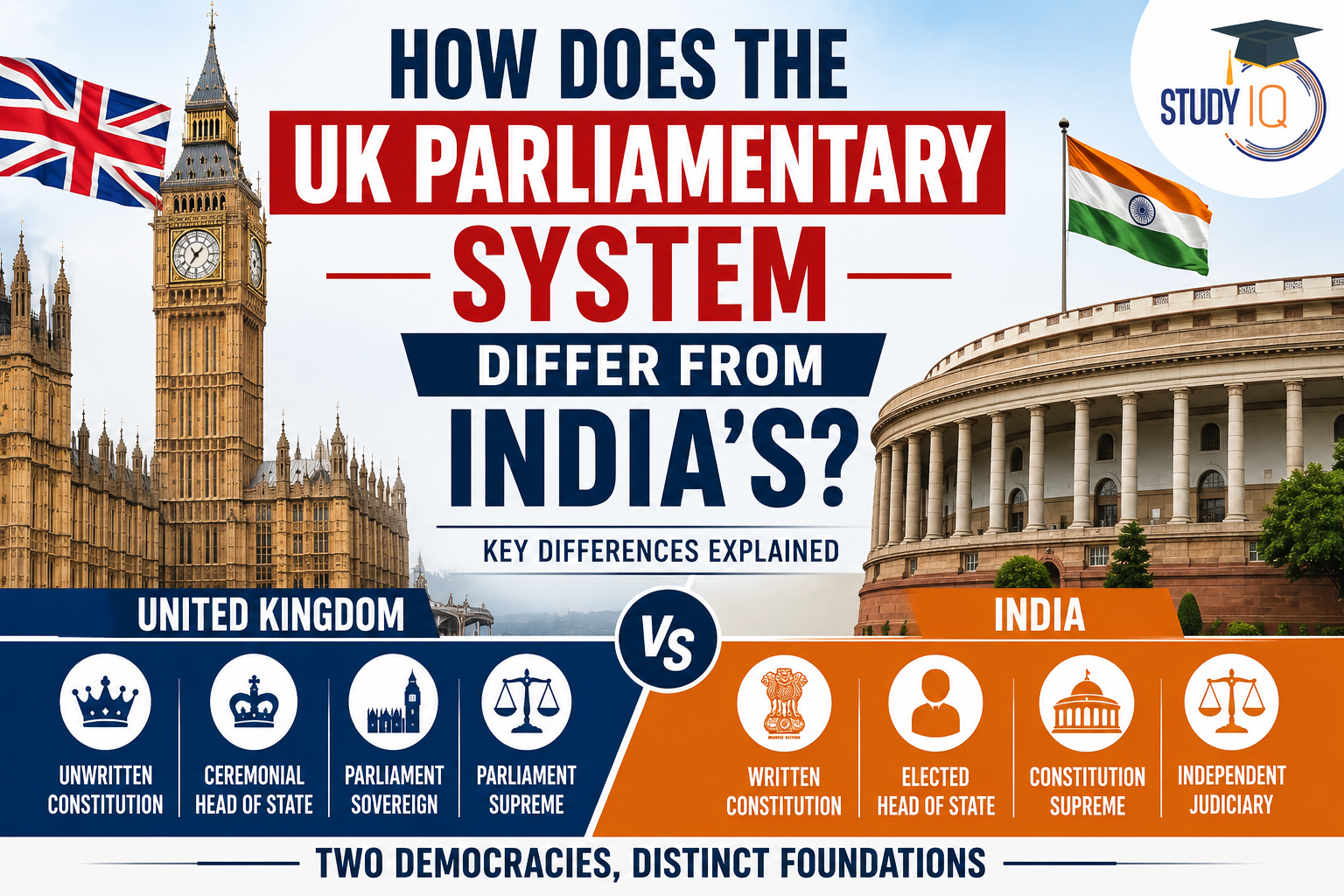
Differences between the British and Indian approaches to Parliamentary sovereignty:
| Aspect | British Approach | Indian Approach |
| Constitutional Foundation | Uncodified constitution – parliamentary sovereignty rests on conventions and judicial precedents. | Codified constitution – Parliament’s powers are explicitly delimited; Constitution is the supreme document. |
| Judicial Review | Parliament is theoretically sovereign; courts cannot strike down Parliamentary legislation. | The Constitution is supreme – the judiciary can review and strike down laws that violate constitutional provisions. |
| Federal Structure | Unitary system – parliamentary sovereignty is indivisible and centralised. | Federal system – sovereignty is shared; bicameral parliament reflects Centre-State division of powers. |
| Heads | UK Monarch – Ceremonial head in a hereditary position. | The President of India is mostly a ceremonial head of state. |
| Prime Minister Term Flexibility | May be applied to earlier elections | 5 years |
| Speaker | Non-Partisan Speaker
Speaker is an independent figure not affiliated to any party. |
Party-Affiliated Speaker
Speaker is typically a member of the ruling party. |
| Amendment of Constitution | Parliament can alter any law including constitutional principles without any special procedure (no written constitution). | Special majority + State ratification required for key amendments; Basic Structure doctrine (Keshavananda Bharati, 1973) makes certain provisions unamendable. |
| Individual Rights | No formalised constitutional rights document; reliance on common law and statutes. | Fundamental Rights (Part III) are justiciable and cannot be overridden by parliamentary law; judiciary protects these even against Parliament. |
| Emergency Powers | Parliament has wide-ranging emergency powers with minimal constitutional restriction. | Emergency powers are constitutionally regulated (Articles 352–360). |
| Sovereignty Principle | Parliamentary sovereignty is absolute – Parliament can make or unmake any law. | Constitutional sovereignty is primary – Parliament operates within constitutional limits. |
Despite structural differences, both systems share foundational commonalities
- Supreme Legislative Body: Parliament is the highest law-making authority in both systems. The UK Parliament enacted the Brexit legislation; India’s Parliament passed the GST Bill – both landmark exercises of legislative supremacy.
- Executive Accountability: In both systems, the executive is answerable to Parliament. The UK’s Prime Minister’s Questions (PMQs) and India’s Question Hour reflect the same constitutional logic: the cabinet governs with parliamentary confidence.
- Financial Control: Both parliaments exercise sovereign control over national finances. India’s Union Budget is presented in the Lok Sabha; the UK’s Chancellor presents it in the House of Commons – in both cases, no expenditure is lawful without parliamentary sanction.
- Committee System: Parliamentary committees exercise detailed oversight. The Public Accounts Committee in both countries scrutinises government expenditure to ensure lawfulness and efficiency.
- Separation of Powers: Both systems maintain an independent judiciary, even if its relationship to parliamentary sovereignty differs significantly.
- Ceremonial Monarchy: The Crown in the UK and the President in India both hold largely ceremonial roles – royal or presidential assent is constitutionally expected, not discretionary.
- Privilege Motions: Members in both systems can move privilege motions against those who mislead Parliament – a tool to protect parliamentary dignity and accountability.
Latest UPSC Updates
| Resource | Link |
|---|---|
| UPSC Prelims Result 2026 | Check Here |
| UPSC Exam Calendar 2027 | View Calendar |
| UPSC Question Paper 2026 | Download PDF |
| UPSC Prelims Answer Key 2026 | Check Answer Key |
| UPSC Cut Off 2026 | View Cut Off |
| UPSC Syllabus 2026 | Read Syllabus |
| Daily Current Affairs 2026 | Read Updates |
| StudyIQ UPSC IAS Foundation 2027 (English) | Join Course |
| StudyIQ UPSC IAS Foundation 2027 (Hindi) | Join Course |
| StudyIQ UPSC IAS Foundation 2027 (Bilingual) | Join Course |
 US Treasury Yields at 25-Year High: Impa...
 National Coastal Mission 2.0 (NCM 2.0): ...
 New CAFE Norms 2027–32: Key Features, ...







 WhatsApp