Table of Contents
Context
The safeguarding of children holds a key role within India’s constitutional and legislative framework. Judicial bodies have repeatedly acknowledged that children represent one of the most vulnerable segments of society and necessitate specialised protection to safeguard their physical, emotional, psychological, and developmental welfare. In recent years, a rising number of custody disputes, parental access conflicts, and abuse cases have necessitated courts to address intricate issues related to child psychology and mental health.
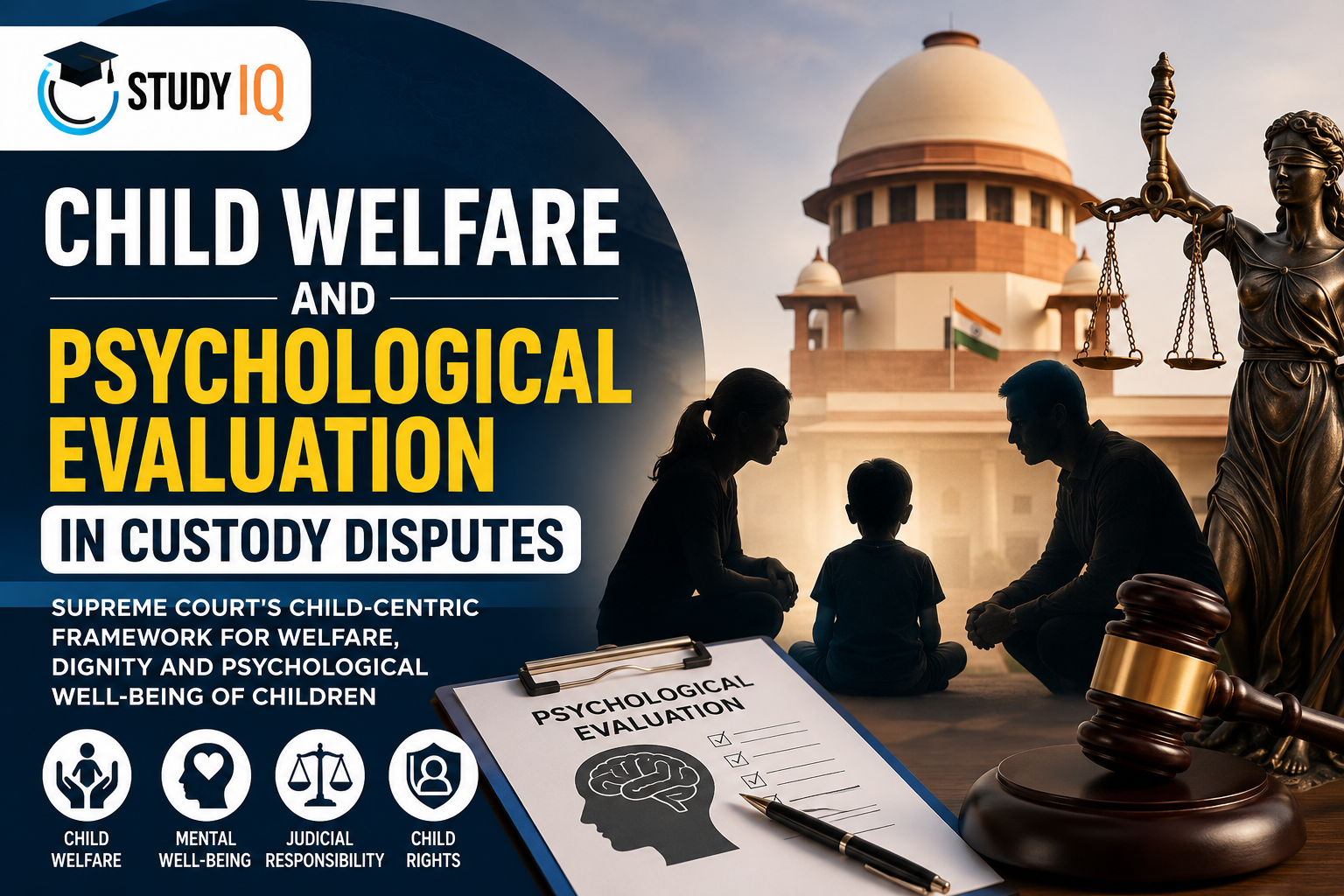
In this context, the Supreme Court of India, in Sheetal Vasant Thakur v. Chirag Arora (SLP(C) Nos. 18701-18702/2024), reported as 2026 LiveLaw (SC) 618, issued an important decision establishing overarching principles regarding requests for psychological and psychiatric assessments of children in custody, visitation, and parental access conflicts. This decision is particularly significant as it pertains to cases when a child is not only involved in a custody dispute but is also an accused victim of sexual abuse under the Protection of Children from Sexual Offences Act, 2012 (POCSO Act). This ruling indicates an increasing court acknowledgement that children should not endure recurrent psychological interventions only due to adult litigation. Courts must prioritise the child’s emotional security, dignity, and wellness, ensuring that judicial actions do not inflict additional stress.
Read Also: Judiciary Current Affairs
Historical Context of Child Custody and Welfare Jurisprudence in India
Indian family law has traditionally regarded the welfare of the minor as the paramount consideration in custody disputes. The welfare principle has consistently served as the guiding criterion under the Guardians and Wards Act of 1890, the Hindu Minority and Guardianship Act of 1956, and the constitutional jurisprudence established by the Supreme Court.
The notion of child welfare encompasses more than mere physical custody and financial assistance. Contemporary judicial interpretation acknowledges that wellbeing encompasses emotional stability, psychological growth, educational prospects, social connections, and safeguarding against trauma. As a result, courts are progressively depending on psychologists, psychiatrists, counsellors, and child welfare specialists to aid in ascertaining the arrangement that would most effectively serve a child’s needs. The increasing dependence on expert evaluations has raised apprehensions. Multiple evaluations, repeated interviews, and extensive questioning may inadvertently expose children to emotional distress. These worries become especially pronounced when the youngster is purportedly a victim of abuse or sexual assault. The Supreme Court’s recent decision aims to navigate the intricate equilibrium between securing expert advice and safeguarding children from unwarranted psychological intrusion.
Protection of Minors and Child Rights in India
The legal system concerning children in India has seen substantial evolution over the decades. Constitutional provisions, including Articles 14, 15(3), 21, 21A, 23, 24, 39(e), 39(f), 45, and 47, collectively mandate the State to protect children’s rights and foster their development. The implementation of the Juvenile Justice (Care and Protection of Children) Act, 2015 was a significant advancement in child protection law. The statute establishes provisions for the care, protection, rehabilitation, and reintegration of children requiring assistance, including those accused of legal infractions.
The Protection of Children from Sexual Offences Act, 2012 established a specialised legal framework to combat child sexual abuse via child-friendly processes. The act acknowledges that children subjected to abuse necessitate careful treatment and safeguarding from secondary victimisation during investigative and judicial processes. India is an international signatory to the United Nations Convention on the Rights of the Child (UNCRC), which prioritises the best interests of the child in all matters pertaining to children. The Supreme Court has often utilised these international standards in its interpretation of domestic laws concerning children.
Details and Context of the Current Case
The Supreme Court case originated from a custody conflict about a youngster who was purportedly a victim of sexual abuse. During the hearings, enquiries arose concerning the psychiatric evaluation and assessment of the child. The Court assessed how judicial bodies need to handle requests for psychological and psychiatric evaluations in child custody cases, acknowledging the wider ramifications of the matter. The Bench, consisting of Justice Sanjay Karol and Justice N. Kotiswar Singh, underscored that its remarks were not meant to serve as inflexible or comprehensive directives. Instead, they were intended to aid courts facing similar circumstances concerning the psychological well-being of children. The Court recognised that although expert evaluations may occasionally be essential, they should not become standard elements of custody disputes.
Welfare, dignity, and psychological well-being as primary considerations
The core of the judgement emphasises that the welfare, emotional security, dignity, and psychological well-being of the child must be the primary focus in all proceedings. The Court emphasised that this concept holds even greater significance when the child is an alleged victim under the POCSO Act. Children who have endured abuse frequently incur profound emotional and psychological repercussions. Repetitive enquiries or superfluous assessments may exacerbate these challenges. Consequently, courts must guarantee that each procedural determination is guided by the child’s best interests rather than the tactical aims of the litigating parents.
The Principle of Minimal Intrusion
The judgment’s notable contribution is its clarification of the notion of minimal intrusion and minimal exposure. The Court determined that psychological or psychiatric evaluations should not be mandated frequently, only due to the emergence of custody, visitation, or parental access disputes. Prior to conducting such an examination, courts must document explicit justifications detailing the necessity of the assessment, its intended purpose, its relevance to the dispute, and the insufficiency of less intrusive options.
This criterion signifies a crucial transition from procedure-focused adjudication to child-focused adjudication. The Court underscored that frequent, redundant, or multi-faceted psychological assessments should generally be eschewed. Repeated evaluations by several professionals may be superfluous and could heighten the likelihood of mental suffering and re-traumatisation. Thus, when an examination is required, the Court specified that it should typically be performed by a single independent expert chosen by the court, who possesses specialised expertise in child psychology and trauma.
Risk of Re-Traumatisation
A significant issue recognised by the Supreme Court is the risk of re-traumatization. Children who have endured abuse or severe parental discord may find the constant recounting of traumatic incidents emotionally draining. The Court noted that the quantity of sessions, length of interactions, frequency of enquiries, and number of professionals engaged can profoundly influence a child’s psychological condition.The Court emphasised that a procedure seemingly innocuous in isolation can induce psychological distress when performed in an adversarial court context.
This acknowledgement signifies a trauma-informed methodology progressively embraced by courts globally. It recognises that legal procedures can occasionally become causes of harm if not meticulously monitored. The Court instructed judges to be attentive to the cumulative effects of evaluations and to intervene anytime the procedure seems likely to negatively harm the child’s welfare or psychological health.
The Psychological State of Parents and Its Significance for Child Welfare
A notably important element of the Supreme Court’s decision is its acknowledgement that courts should not concentrate solely on the kid when evaluating psychological assessments. The Court noted that a child’s welfare and psychological development are frequently interconnected with the emotional and psychological state of the parents. Thus, evaluating parental mental health may yield important insights for identifying the arrangement that most effectively supports the child’s needs.
The Court determined that while it is crucial to comprehend a child’s response to each parent, it is as vital to evaluate the psychological state of the parents responsible for the child’s upbringing and development. The mental well-being of parents may affect their ability to offer emotional stability, sustain healthy relationships, and positively impact the child’s development. The Court noted that prior to exposing a child to comprehensive psychological evaluation, courts must consider acquiring psychological assessment papers pertaining to both parents. Such evaluations may aid judges in comprehending the wider familial context and in formulating more effective custody, visitation, and parental access agreements.
The Court additionally noted that custody disputes are often marked by heightened emotions, animosity, and extended fighting. In these situations, professional evaluation of the psychological state of both parents may function as an extra court instrument to ensure that orders are aligned with the child’s best interests rather than solely addressing conflicting parental assertions.
The Doctrine of Parens Patriae and Judicial Accountability
The decision emphatically reinforces the idea of parens patriae, a fundamental pillar of child welfare law. According to this idea, courts serve as protectors for those incapable of safeguarding their own interests, especially minors. In adjudicating custody and visitation issues, courts serve not only as arbitrators between conflicting parents but also as protectors of the child’s welfare.
The Supreme Court underscored that courts possess an autonomous and paramount duty to protect the dignity, welfare, and emotional security of children, regardless of the parents’ stances. Even when both parents pursue psychological examination or therapy intervention, courts must independently assess if these treatments are truly required, proportional, and advantageous for the kid. The Bench noted that judicial accountability cannot be wholly assigned to experts, counsellors, psychologists, or litigants. Although expert testimonies may aid the court, the final obligation for safeguarding the child is with the judiciary. This method underscores the concept that children’s rights are independent of parental rights. They are separate rights warranting autonomous judicial protection.
Institutional Impartiality and Non-Confrontational Assessments
A significant aspect of the judgement is its emphasis on institutional neutrality.The Court noted that psychological examinations must not transform into contentious endeavours aimed at bolstering one parent’s position against the other. When an evaluation procedure starts to mimic an investigative endeavour aimed at corroborating or refuting charges, it jeopardises the child’s trust and mental stability.
To maintain the welfare-focused essence of these assessments, the Court mandated that evaluations should typically be carried out by independent and impartial experts designated by the court. The expert must hold specialised credentials in child psychology, psychiatry, or trauma assessment and should typically have had no previous involvement with either litigating party, except in a strictly professional context. The formation of panels consisting of numerous specialists should be an exception rather than a standard practice, utilised only when the factual intricacy of a case necessitates such a configuration. The Court emphasised that neutrality is not only a procedural necessity but also a fundamental protection for children against parental conflict.
Confidentiality and Safeguarding of the Child’s Privacy
The Supreme Court emphasised the necessity of upholding stringent confidentiality during the review process. Children engaged in custody conflicts and abuse charges frequently reveal intimate experiences during therapeutic or evaluation sessions. Public exposure or unrestricted access to such material may erode trust, inhibit candid conversation, and potentially inflict more emotional distress.
The Court mandated that a child’s identity, disclosures made during assessment, therapy records, session notes, and evaluative findings must be kept absolutely confidential. The judge additionally ruled that audio recordings, video recordings, therapeutic notes, and analogous information should generally not be directly accessible to the parties unless a judge explicitly concludes that such disclosure is essential.
Furthermore, evaluative reports must be restricted to the objectives for which the evaluation was commissioned. Experts should refrain from making determinations regarding criminal culpability, guilt, or innocence, as these issues are solely within the purview of judicial adjudication. These provisions embody the overarching constitutional dedication to preserving children’s dignity and privacy.
Alignment with the POCSO Framework
An essential element of the decision is the requirement that all assessments adhere to the child-centric framework outlined by the POCSO Act. The Court explicitly cited Sections 24, 33(5), 36, and 39 of the Act, which encapsulate concepts aimed at reducing trauma during investigation and adjudication. These regulations underscore child-sensitive protocols, the avoidance of repetitive enquiries, safeguarding against intimidation, and the establishment of a nurturing environment.The Court noted that any psychological assessment must be performed in accordance with these legal safeguards. The aim should be to promote the child’s well-being rather than to convert the assessment procedure into an extra source of anxiety. This method illustrates the increasing alignment between child psychology and legal processes in Indian jurisprudence.
Established Therapeutic Relationships and Continuity of Care
The Supreme Court acknowledged that numerous children engaged in litigation may already be getting assistance from therapists, counsellors, or mental health specialists. In such circumstances, altering the current therapeutic environment may adversely affect the child’s well-being. Therefore, the Court mandated that when the competency and impartiality of a current therapist are acknowledged by the court, steps should typically be undertaken to maintain continuity of therapy.The verdict acknowledges the significance of trust in therapeutic partnerships. Children frequently need much time to cultivate comfort and confidence with mental health practitioners. Superfluous alterations in therapeutic setups may jeopardise treatment efficacy and emotional equilibrium.
Ongoing Supervisory Authority
The Supreme Court further highlighted that courts must maintain ongoing supervisory authority over the evaluation process. Judges must not perceive the issuance of an evaluation order as the conclusion of their obligations. Courts must oversee the procedure and be ready to amend, control, or terminate it if conditions indicate it could negatively impact the child’s welfare.The Court noted that psychological evaluations may require frequent administration as children develop and situations change. Assessments, when required, must be conducted in collaboration with experienced child psychologists to guarantee that judicial decisions align with the evolving requirements of the child.
Applicable Judicial Precedents
This judgement is founded on a substantial body of Indian child welfare jurisprudence. In Gaurav Nagpal v. Sumedha Nagpal (2009) 1 SCC 42, the Supreme Court underscored that the child’s welfare is the paramount concern in custody disputes, superseding the legal rights of parents.
In Nil Ratan Kundu v. Abhijit Kundu (2008) 9 SCC 413, it was emphasised that the moral, ethical, emotional, and psychological welfare of the child should be regarded in conjunction with physical well-being.
In Roxann Sharma v. Arun Sharma (2015) 8 SCC 318, the Court reaffirmed that custody decisions cannot be confined to inflexible legal formulas and must prioritise the child’s best interests.
The Court’s focus on child dignity and trauma-informed adjudication aligns with the principles established in Sampurna Behura v. Union of India (2018) 4 SCC 433, which highlighted the constitutional duty to safeguard children’s rights and welfare.
Conclusion
A Supreme Court decision in Sheetal Vasant Thakur v. Chirag Arora represents a major advancement in Indian child welfare law. The Court has established a philosophical framework focused on dignity, emotional stability, psychological well-being, and the child’s best interests, rather than creating inflexible procedures.
The Court aims to ensure that psychological evaluations serve child welfare by prioritising minimal intrusion, institutional impartiality, confidentiality, trauma-informed adjudication, and ongoing judicial oversight, rather than functioning as tools for adversarial litigation. Equally essential is the acknowledgement that parental mental health may be as crucial as the child’s psychological state in choosing suitable custody and visitation arrangements.
This decision reinforces that children are not mere passive participants in legal proceedings but rather individuals with rights who deserve protection, respect, and compassion. It reinforces the judiciary’s function as parens patriae and embodies a comprehensive constitutional dedication to protecting kids from unwarranted trauma. By doing so, the Court has significantly advanced the establishment of a more compassionate, child-focused, and psychologically informed family justice system in India.
 Supreme Court Dowry Enforcement Order 20...
 Supreme Court Modifies 3-Year Practice R...
 Doctrine of Per Incuriam Explained: Supr...








 WhatsApp