Table of Contents
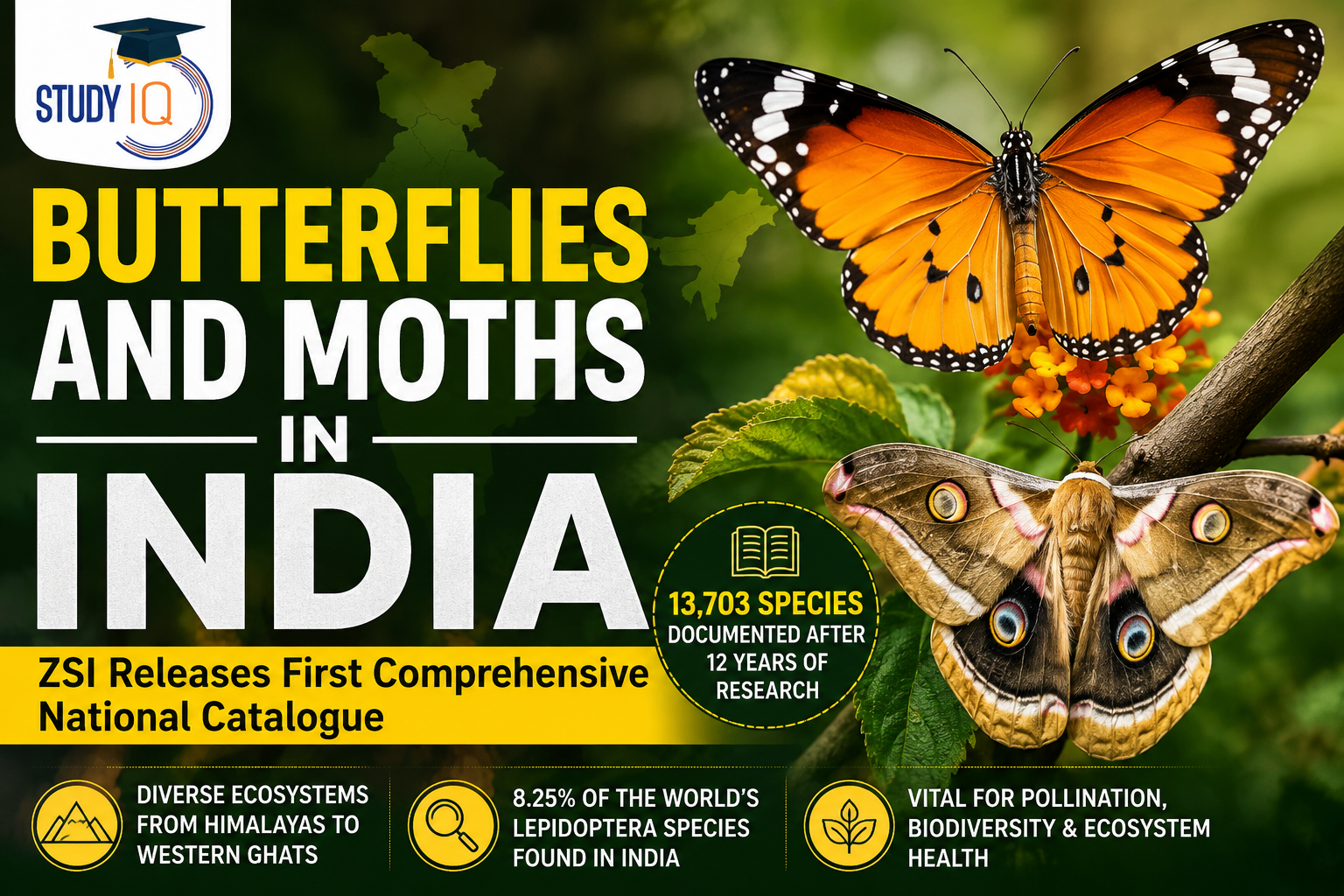
India has achieved a major milestone in biodiversity documentation with the Zoological Survey of India (ZSI) releasing the country’s first comprehensive national catalogue of butterflies and moths. Compiled over 12 years, the catalogue documents 13,703 species of Lepidoptera found across India and provides a standardized scientific reference for biodiversity research, conservation planning, and ecological monitoring.
The catalogue consolidates more than a century of scattered taxonomic records into a single authoritative database, making it one of the most significant contributions to India’s biodiversity documentation in recent years.
Why is it in News?
The Zoological Survey of India (ZSI) has completed India’s first-ever comprehensive catalogue of butterflies and moths. Published in 22 volumes, with the final volume appearing in the international journal Zootaxa, the catalogue establishes an updated national baseline for Lepidoptera diversity.
What is the National Catalogue of Butterflies and Moths?
The catalogue is a scientific inventory of all known butterfly and moth species recorded in India. It standardizes species names, updates taxonomic classifications, and resolves ambiguities that accumulated over decades of independent research.
It is expected to become the primary national reference for:
- Biodiversity assessment
- Species identification
- Ecological monitoring
- Conservation planning
- Climate change research
- Pest management
Key Highlights of India’s Butterfly and Moth Catalogue
| Particular | Details |
|---|---|
| Lead Institution | Zoological Survey of India (ZSI) |
| Time Taken | 12 Years |
| Total Species Recorded | 13,703 |
| Total Genera | 3,705 |
| Subfamilies | 240 |
| Families | 102 |
| Superfamilies | 31 |
| Catalogue Volumes | 22 |
| Final Publication | Zootaxa |
| India’s Share of Global Lepidoptera | 8.25% |
Major Findings of the Catalogue
The survey highlights India’s exceptional insect diversity.
Geometroidea Dominates the Records
The final volume documents:
- 2,205 species belonging to the Geometroidea superfamily.
- Distributed across 479 genera.
- Represents 8.8% of the world’s known Geometridae species.
Family-wise Distribution
| Family | Number of Species |
|---|---|
| Geometridae | 2,100 |
| Uraniidae | 95 |
| Epicopeiidae | 9 |
| Pseudobistonidae | 1 |
India’s Rich Lepidoptera Diversity
The catalogue reveals India’s remarkable butterfly and moth diversity.
India currently has:
- 13,703 species
- 3,705 genera
- 240 subfamilies
- 102 families
- 31 superfamilies
These species are distributed across diverse ecosystems, including:
- Himalayan mountains
- Western Ghats
- Northeast India
- Tropical rainforests
- Dry deciduous forests
- Grasslands
- Coastal ecosystems
- Island ecosystems
What is Lepidoptera?
Lepidoptera is one of the largest insect orders, comprising butterflies and moths.
Characteristics
- Wings covered with microscopic scales
- Complete metamorphosis (egg–larva–pupa–adult)
- Long coiled feeding tube (proboscis)
- Mostly herbivorous larvae (caterpillars)
- Adults primarily feed on nectar
Globally, Lepidoptera is among the most diverse insect groups and plays an essential role in ecosystem functioning.
Ecological Importance of Butterflies and Moths
Butterflies and moths are indispensable to healthy ecosystems.
Pollination
Many butterfly and moth species pollinate flowering plants.
While butterflies are active during the day, many moths act as important nocturnal pollinators, supporting plant reproduction after sunset.
Food Chain
They serve as food for numerous animals, including:
- Birds
- Bats
- Reptiles
- Amphibians
- Small mammals
- Predatory insects
Their abundance helps maintain balanced ecosystems.
Bio-indicators of Environmental Health
Butterflies are highly sensitive to environmental changes.
Their population trends help scientists monitor:
- Habitat degradation
- Climate change
- Pollution
- Deforestation
- Ecosystem health
Importance in Agriculture
Several moth species are agricultural pests affecting food crops and forests.
Accurate species identification supports:
- Pest management
- Crop protection
- Biological control
- Sustainable agriculture
Significance of the Catalogue
The catalogue is expected to become a critical scientific resource for India.
Its importance includes:
- Establishing a national biodiversity baseline.
- Standardizing taxonomic records.
- Supporting conservation strategies.
- Facilitating climate change research.
- Improving Environmental Impact Assessments (EIA).
- Strengthening ecological monitoring.
- Assisting species discovery and future research.
- Supporting international biodiversity reporting under global environmental agreements.
Zoological Survey of India (ZSI)
The Zoological Survey of India is India’s premier institution for faunal research and taxonomy.
| Particular | Details |
|---|---|
| Established | 1916 |
| Headquarters | Kolkata |
| Ministry | Ministry of Environment, Forest and Climate Change |
| Nature | National faunal survey and taxonomic research organization |
Functions of ZSI
- Survey and exploration of India’s fauna
- Taxonomic research
- Biodiversity documentation
- Species discovery
- Wildlife conservation research
- Maintenance of National Zoological Collections
- Publication of scientific monographs and catalogues
Importance for Biodiversity Conservation
India is recognized as one of the world’s 17 megabiodiverse countries, hosting a vast variety of flora and fauna.
The national Lepidoptera catalogue will help policymakers and researchers to:
- Identify threatened species
- Prioritize conservation efforts
- Monitor ecosystem changes
- Assess the impacts of climate change
- Develop evidence-based biodiversity policies
Read Also: UPSC Daily Current Affairs 2026
 Species in News: Asian Wild Pig- Habitat...
 BRICS AI Open-Source Community: China’...
 India’s Artificial Sun: New 82.6 GHz G...














 WhatsApp