
Table of Contents
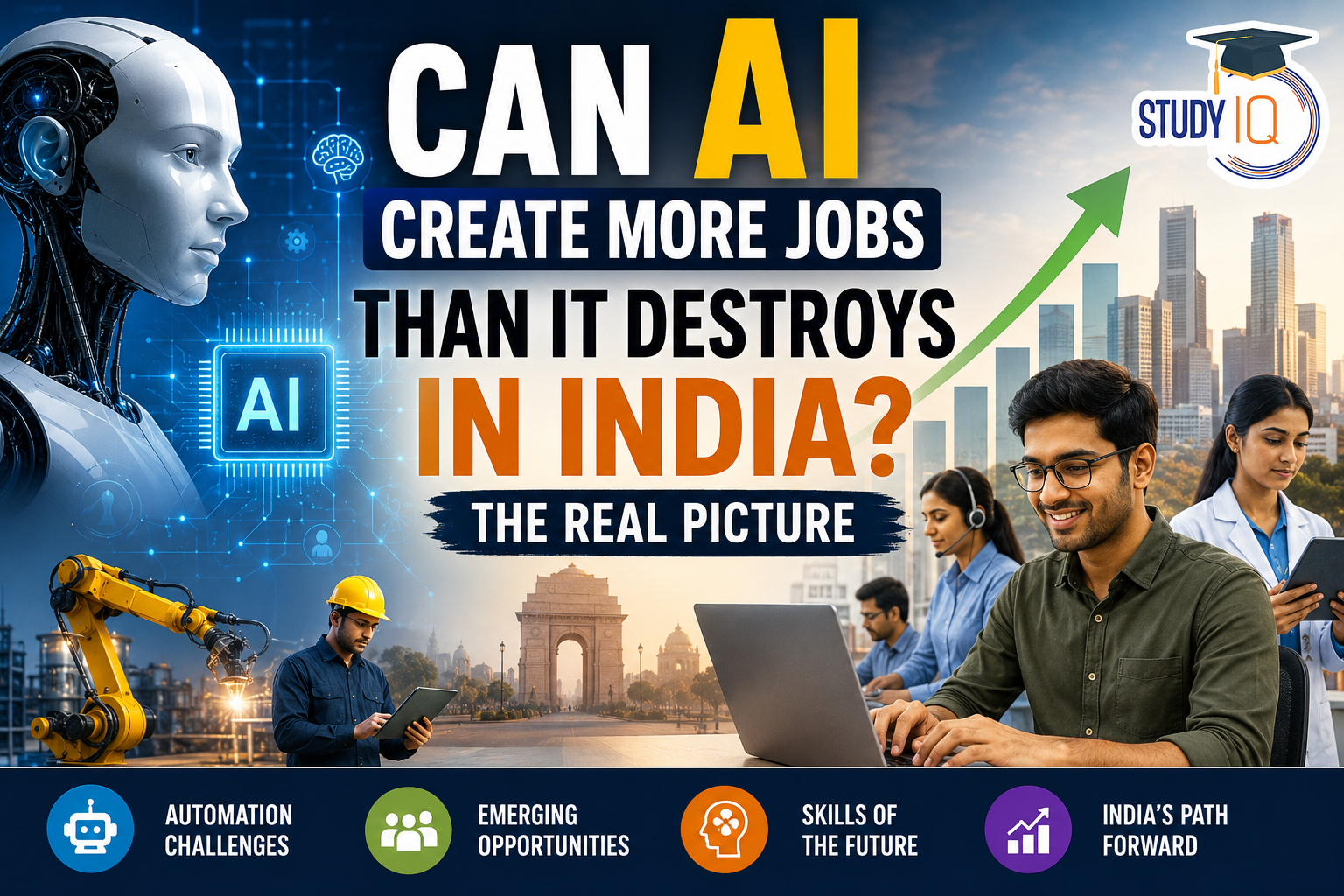
Artificial Intelligence (AI) has become one of the most transformative technologies of the 21st century. From generating content and writing code to diagnosing diseases and automating business processes, AI is reshaping industries at an unprecedented pace. As AI adoption accelerates across India, a crucial question dominates public discourse: Will AI destroy jobs, or will it create even more opportunities?
The answer is neither simple optimism nor fear. History shows that technological revolutions rarely eliminate work altogether. Instead, they redefine the nature of work, create new industries, and demand new skills. The real challenge for India is not whether AI will replace jobs, but whether the country can prepare its workforce for the opportunities AI will create.
Why Are People Worried About AI?
The concern stems from AI’s ability to perform tasks traditionally handled by humans. Modern AI systems can:
- Generate reports and documents
- Analyze large datasets
- Answer customer queries
- Write software code
- Create designs and presentations
- Automate administrative work
Many entry-level and routine jobs are particularly vulnerable because AI can complete repetitive tasks faster and at lower cost.
Industries such as:
- Customer support
- Data entry
- Back-office processing
- Basic accounting
- Content moderation
- Routine software testing
are already witnessing significant automation.
For a country like India, where millions of young people enter the workforce annually, such changes naturally generate anxiety.
The Historical Lesson: Technology Creates New Work
Every major technological revolution has triggered fears of mass unemployment.
During the Industrial Revolution, machines replaced many manual jobs. Yet industries expanded, productivity increased, and entirely new occupations emerged.
Similarly:
- Computers reduced paperwork but created IT careers.
- The internet transformed communication but generated millions of jobs in e-commerce, digital marketing, and software development.
- Smartphones created app economies employing millions worldwide.
Technology generally eliminates specific tasks rather than human relevance itself.
AI appears to be following the same pattern.
AI Is More Likely to Transform Jobs Than Replace Them
Most occupations consist of multiple tasks rather than a single activity.
For example, a customer service executive may:
- Answer routine queries
- Handle complaints
- Understand customer emotions
- Resolve complex issues
- Build customer relationships
AI can manage routine queries efficiently, but emotional intelligence and nuanced problem-solving remain difficult to automate.
This phenomenon is often called the “human-AI partnership model.”
In many professions:
- AI performs repetitive tasks.
- Humans focus on judgment, creativity, communication, and decision-making.
The future workforce will increasingly consist of people who know how to work alongside AI.
India’s Unique Position in the AI Era
India occupies a distinctive position globally.
Advantages
India possesses:
- The world’s largest youth population
- A rapidly expanding digital economy
- Strong IT and software capabilities
- A vibrant startup ecosystem
- Growing digital public infrastructure
The country has already demonstrated its ability to leverage technological shifts through:
- UPI
- Aadhaar
- Digital governance platforms
- Large-scale digital inclusion programs
These strengths can help India become a major beneficiary of the AI revolution.
Challenges
At the same time, India faces:
- Skill gaps
- Unequal access to quality education
- Informal employment
- Regional disparities
- Low digital literacy in some areas
The outcome of the AI revolution will depend largely on how these challenges are addressed.
Jobs Most Vulnerable to AI
AI is expected to affect jobs involving predictable and repetitive tasks.
High-Risk Roles
- Data entry operators
- Routine clerical workers
- Basic bookkeeping staff
- Call center executives handling repetitive queries
- Low-complexity coding roles
- Documentation processing personnel
These jobs may shrink significantly as AI systems become more capable.
However, automation does not necessarily imply unemployment. Workers can transition into higher-value functions with appropriate training.
Jobs That AI Is Likely to Create
The AI economy is generating entirely new employment categories.
Emerging AI Careers
AI Trainers
AI models require training using large datasets and human feedback.
Prompt Engineers
Professionals who design effective instructions for AI systems.
AI Auditors
Experts who evaluate AI systems for bias, fairness, accuracy, and compliance.
AI Ethics Specialists
Professionals responsible for ensuring responsible AI deployment.
AI Product Managers
Individuals who bridge technology, business strategy, and user needs.
Human-AI Workflow Managers
Specialists who coordinate collaboration between humans and AI tools.
Data Governance Experts
Professionals managing data quality, privacy, and security.
Many of these professions barely existed a few years ago.
The Real Opportunity: Human Skills Become More Valuable
One paradox of AI is that as machines become smarter, uniquely human abilities become even more valuable. Future employers will increasingly prioritize:
Critical Thinking
Evaluating information and making sound judgments.
Creativity
Generating original ideas and innovative solutions.
Communication
Explaining complex concepts effectively.
Leadership
Managing teams and organizational change.
Emotional Intelligence
Understanding human behavior and emotions.
Ethical Decision-Making
Navigating complex social and technological dilemmas.
These capabilities remain difficult for machines to replicate.
India’s Demographic Dividend Can Become an AI Dividend
India adds millions of young workers every year.
Traditionally, many entered the workforce through:
- Call centers
- Business process outsourcing
- Administrative jobs
- Entry-level service positions
AI is changing this pathway.
Instead of routine work, future entrants may need to begin with:
- AI supervision
- Data validation
- Digital operations
- Customer relationship management
- Human-centered service delivery
If supported by effective training systems, this transition can produce a more productive and skilled workforce.
Education Must Change Faster Than Technology
One of India’s biggest challenges is ensuring that education keeps pace with technological change.
Many institutions still emphasize:
- Memorization
- Examination performance
- Static knowledge
AI is reducing the value of memorized information while increasing the value of application-oriented skills.
Educational reforms should focus on:
- Problem-solving
- Analytical reasoning
- Digital literacy
- Coding and computational thinking
- Communication skills
- Interdisciplinary learning
Lifelong learning will become a necessity rather than an option.
Startups Could Become India’s Biggest Job Creators
Historically, technological revolutions create opportunities for entrepreneurs.
AI lowers barriers to innovation by enabling:
- Faster product development
- Automated operations
- Lower business costs
- Greater scalability
Indian startups are already applying AI in:
- Healthcare
- Agriculture
- Education
- Financial services
- Logistics
- Climate technology
As AI reduces operational costs, new businesses can emerge faster, creating fresh employment opportunities.
Governance Will Play a Critical Role
The transition to an AI-driven economy cannot be left entirely to market forces. Public policy must focus on:
Skill Development
Large-scale reskilling initiatives are essential.
Worker Transition Support
Workers displaced by automation need pathways into new occupations.
Digital Infrastructure
Universal digital access remains crucial.
Ethical AI Regulation
Trustworthy AI systems encourage broader adoption and investment.
Innovation Ecosystem
Research institutions, startups, and industry must collaborate to drive innovation.
Countries that successfully manage workforce transitions will gain a competitive advantage in the global AI economy.
The Global Race for AI Talent
The world’s leading economies are investing heavily in AI capabilities.
Countries such as:
- United States
- China
- United Kingdom
- Singapore
- South Korea
are racing to build AI talent pipelines.
For India, the challenge is not merely adopting AI but becoming a global supplier of AI talent, innovation, and digital solutions.
With its large population and strong technology base, India has the potential to emerge as a major AI powerhouse.
Will AI Create More Jobs Than It Destroys?
The evidence suggests that AI will eliminate certain jobs, transform many others, and create entirely new categories of employment.
The final balance depends on three factors:
- Speed of workforce reskilling
- Quality of education and training systems
- Ability of businesses and governments to support transition
Countries that adapt quickly are likely to see net job creation.
Countries that fail to prepare their workforce may experience greater disruption.
For India, AI is not merely a technological challenge—it is a developmental opportunity.
Latest UPSC Updates
| Resource | Link |
|---|---|
| UPSC Prelims Result 2026 | Check Here |
| UPSC Exam Calendar 2027 | View Calendar |
| UPSC Question Paper 2026 | Download PDF |
| UPSC Prelims Answer Key 2026 | Check Answer Key |
| UPSC Cut Off 2026 | View Cut Off |
| UPSC Syllabus 2026 | Read Syllabus |
| Daily Current Affairs 2026 | Read Updates |
| StudyIQ UPSC IAS Foundation 2027 (English) | Join Course |
| StudyIQ UPSC IAS Foundation 2027 (Hindi) | Join Course |
| StudyIQ UPSC IAS Foundation 2027 (Bilingual) | Join Course |
Conclusion
The debate should not be framed as “AI versus humans.” The real future lies in humans empowered by AI. While automation may reduce demand for routine work, it simultaneously increases demand for creativity, judgment, leadership, and specialized expertise.
India’s young population, digital infrastructure, entrepreneurial energy, and expanding innovation ecosystem provide a strong foundation for success. If education, skilling, industry, and governance align effectively, AI could become one of the greatest employment and productivity engines in India’s modern history.
The real question is not whether AI will take jobs. The real question is whether India can equip its people to thrive in an AI-powered economy. If it succeeds, the AI revolution may create far more opportunities than it destroys.
Sharing is caring!
 World Ozone Day 2026: Ozone Layer, Montr...
 Places in News: Mayun Island- Why Is Per...
 UPI MDR Charges 2026: Who Will Pay How M...













 WhatsApp





