
Table of Contents
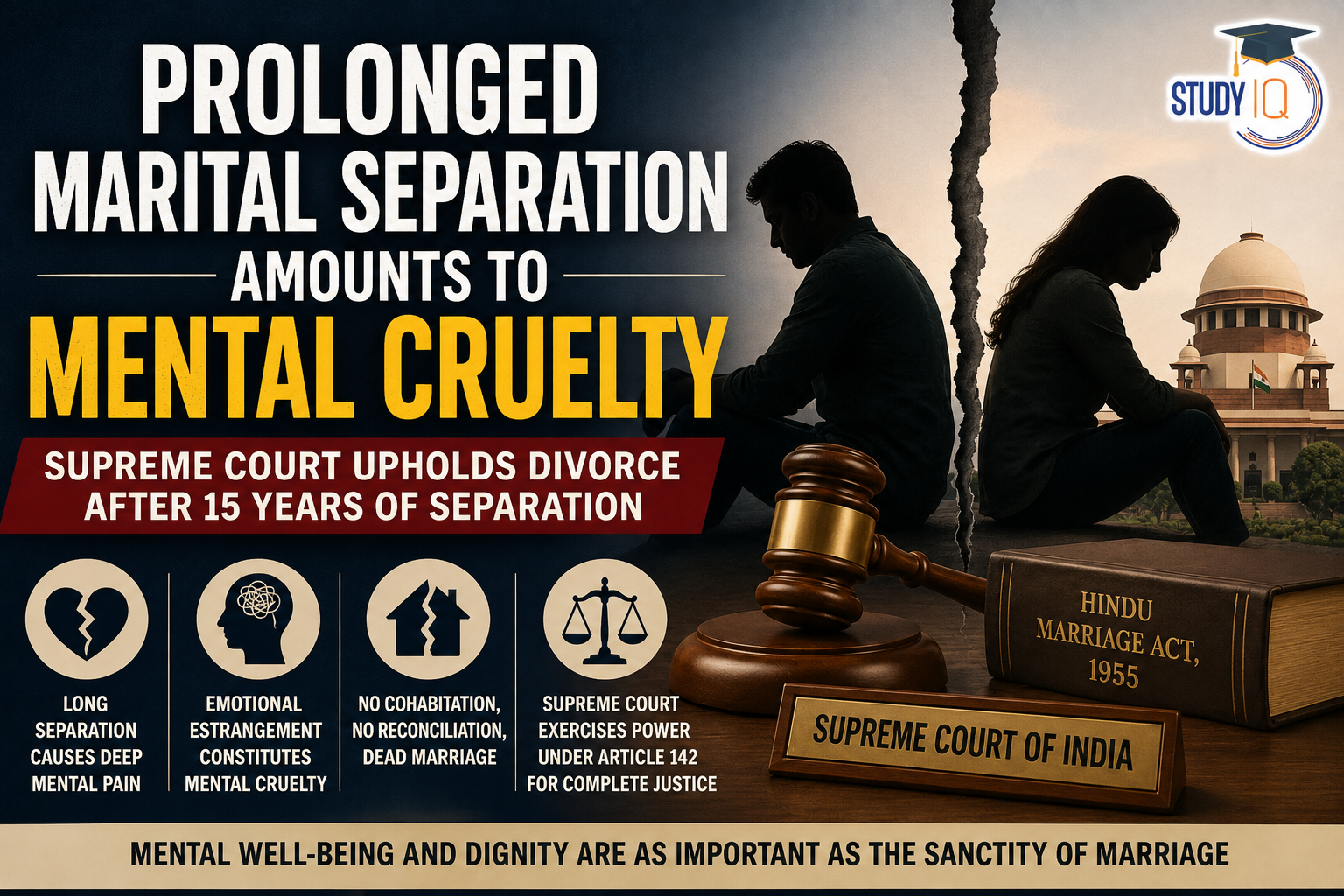
In a significant ruling that further develops India’s divorce jurisprudence, the Supreme Court has held that prolonged marital separation, emotional estrangement, absence of cohabitation, and failure of reconciliation efforts may amount to mental cruelty under Section 13(1)(ia) of the Hindu Marriage Act, 1955.
The judgment was delivered by a Bench comprising Justice Sanjay Karol and Justice Augustine George Masih in SLP (C) No. 10422 of 2025. The Court upheld a divorce decree granted to a husband whose marriage had effectively ceased to exist after nearly fifteen years of separation.
The ruling reinforces the principle that matrimonial law cannot compel parties to remain trapped in a relationship that has lost its emotional, social, and marital foundation.
Read Also: Judiciary Current Affairs
Background of the Case
The dispute originated when the husband filed a divorce petition in 2009 under Section 13(1)(ia) of the Hindu Marriage Act, alleging cruelty.
Initially, the Family Court dismissed the petition, holding that the grounds for divorce had not been sufficiently established. However, the Rajasthan High Court reversed the decision and granted a decree of divorce.
The wife subsequently challenged the High Court’s decision before the Supreme Court.
While hearing the appeal, the Supreme Court examined several crucial facts:
- The spouses were both medical professionals.
- Both were financially independent.
- The marriage was childless.
- The parties had lived separately for nearly fifteen years.
- Multiple opportunities for reconciliation had failed.
- Court-directed mediation in 2025 was unsuccessful.
These circumstances convinced the Court that the marriage had irretrievably broken down.
Marriage Is More Than a Legal Relationship
One of the most important observations in the judgment concerns the nature of marriage itself.
The Supreme Court emphasized that marriage cannot be viewed merely as a legal status or contractual arrangement. Instead, it is a partnership founded on:
- Mutual respect
- Emotional companionship
- Trust
- Shared responsibilities
- Physical and emotional intimacy
- Support during life’s challenges
The Court observed that when these essential elements disappear permanently, the marriage loses its substantive meaning even if it continues to exist legally.
According to the Bench, a marital relationship cannot survive solely on legal formalities when emotional and social bonds have long ceased to exist.
Can Long Separation Amount to Mental Cruelty?
The central legal issue before the Court was whether prolonged separation could constitute mental cruelty under Section 13(1)(ia) of the Hindu Marriage Act.
The Supreme Court answered in the affirmative.
The Court noted that matrimonial disputes cannot always be evaluated through rigid technical categories. Human relationships evolve, and courts must consider the totality of circumstances.
The Bench observed that:
- Long periods of separation create emotional isolation.
- Continued absence of cohabitation causes psychological distress.
- Lack of reconciliation efforts demonstrates a complete breakdown of the marital bond.
- Prolonged estrangement can inflict mental suffering comparable to other recognized forms of cruelty.
The Court held that where spouses have lived apart for several years and have effectively abandoned the marital relationship, such circumstances may constitute mental cruelty.
Importantly, the Court stated that the parties had not merely abandoned each other; they had abandoned the marriage itself.
Mental Cruelty Under Section 13(1)(ia) of the Hindu Marriage Act
Indian courts have consistently expanded the understanding of mental cruelty beyond physical violence.
Mental cruelty may include:
- Emotional neglect
- Continuous humiliation
- False allegations
- Persistent verbal abuse
- Unreasonable suspicion
- Denial of companionship
- Refusal of marital obligations
- Long-term emotional abandonment
The Supreme Court reiterated that mental cruelty must be assessed on a case-by-case basis, considering the social, emotional, and psychological impact on the affected spouse.
The judgment reflects the modern judicial approach that recognizes mental well-being as an essential component of marital life.
Denial of Conjugal Rights and Sexual Intimacy
Another important aspect of the judgment concerns the denial of marital intimacy.
The husband testified that during the brief period they lived together, the wife consistently locked her room from inside and avoided marital intimacy. Notably, this assertion was not effectively disputed.
The Court observed that:
- Sexual intimacy is an important aspect of marriage.
- Persistent denial of conjugal relations without reasonable justification can amount to mental cruelty.
- Emotional and physical companionship are integral components of a healthy marital relationship.
The Bench held that prolonged deprivation of marital intimacy may cause severe emotional frustration and psychological suffering.
Relationship Between Desertion and Mental Cruelty
The Court also clarified the distinction between desertion and mental cruelty.
Under Section 13(1)(ib) of the Hindu Marriage Act, desertion is an independent ground for divorce. Traditionally, it requires proof that one spouse abandoned the other without reasonable cause and intended to permanently terminate cohabitation.
In the present case, desertion was not specifically pleaded.
Nevertheless, the Supreme Court held that prolonged separation remains a relevant factor while determining mental cruelty.
The Court explained that appellate courts can consider events occurring during the pendency of matrimonial litigation. Therefore, continued separation over many years can strengthen allegations of mental cruelty even where desertion itself is not formally pleaded.
Irretrievable Breakdown of Marriage
A major feature of the judgment is the Court’s discussion of the doctrine of irretrievable breakdown of marriage.
The Supreme Court observed that:
- The parties had lived apart for approximately fifteen years.
- Reconciliation efforts had failed.
- Mediation had not succeeded.
- Emotional, social, and marital bonds had disappeared.
Under such circumstances, the marriage had become effectively “dead.”
The Court stated that compelling parties to remain in a legally existing but emotionally defunct marriage serves no useful purpose.
A marriage that survives only on paper while lacking any genuine relationship cannot be preserved merely because one spouse opposes divorce.
Supreme Court Invokes Article 142
Although an irretrievable breakdown of marriage is not yet a statutory ground for divorce under the Hindu Marriage Act, the Supreme Court exercised its extraordinary powers under Article 142 of the Constitution.
Article 142 empowers the Supreme Court to pass orders necessary to do “complete justice” in any matter before it.
The Court observed that forcing parties to continue in a dead marriage results in:
- Emotional stagnation
- Psychological suffering
- Frustration
- Loss of personal autonomy
- Inability to move forward in life
To prevent further injustice, the Court dissolved the marriage under Article 142 and dismissed the wife’s appeal.
Key Supreme Court Precedents Relied Upon
The judgment draws support from several landmark matrimonial law decisions.
Samar Ghosh v. Jaya Ghosh (2007)
The Supreme Court provided a broad framework for understanding mental cruelty and recognized that prolonged separation may be relevant in determining cruelty.
Naveen Kohli v. Neelu Kohli (2006)
The Court recommended recognizing the irretrievable breakdown of marriage as a statutory ground for divorce.
K. Srinivas Rao v. D.A. Deepa (2013)
The Court held that conduct causing prolonged mental suffering can amount to cruelty even in the absence of physical violence.
Shilpa Sailesh v. Varun Sreenivasan (2023)
A Constitution Bench confirmed that the Supreme Court may dissolve marriages under Article 142 where the relationship has irretrievably broken down.
The present judgment builds upon these precedents and further strengthens the legal recognition of prolonged separation as evidence of mental cruelty.
Why the Judgment Matters
The ruling has important implications for matrimonial disputes across India.
Recognition of Emotional Reality
The Court acknowledged that a marriage is not sustained merely by legal status but by actual emotional and social relationships.
Mental Health-Centric Approach
The judgment reflects growing judicial recognition of psychological well-being and emotional dignity.
Practical Approach to Divorce
The Court emphasized substance over form by examining the real condition of the relationship rather than focusing solely on technical legal grounds.
Strengthening Individual Dignity
The ruling recognizes that forcing individuals to remain in a dysfunctional marriage may itself be unjust and contrary to constitutional values.
Conclusion
The Supreme Court’s decision in SLP (C) No. 10422 of 2025 marks another important milestone in the evolution of Indian family law. By recognizing prolonged separation, emotional estrangement, denial of cohabitation, and failed reconciliation efforts as indicators of mental cruelty, the Court has adopted a humane and realistic approach to matrimonial disputes.
The judgment reiterates that marriage is not merely a legal bond but a living relationship based on companionship, intimacy, trust, and mutual commitment. When these foundations disappear irreversibly, the law cannot insist on preserving a hollow legal relationship.
By invoking Article 142 and dissolving a marriage that had effectively ceased to exist for fifteen years, the Supreme Court has reaffirmed that matrimonial justice must ultimately serve human dignity, emotional well-being, and substantive fairness.
Key Takeaways
- Prolonged separation can amount to mental cruelty under Section 13(1)(ia) of the Hindu Marriage Act.
- Fifteen years of non-cohabitation and emotional estrangement justified divorce.
- Denial of marital intimacy may constitute mental cruelty.
- Courts can consider subsequent events occurring during matrimonial litigation.
- The Supreme Court can dissolve irretrievably broken marriages under Article 142.
- A marriage that exists only legally should not be preserved at the cost of individual dignity and mental well-being.
 Supreme Court Dowry Enforcement Order 20...
 Supreme Court Modifies 3-Year Practice R...
 Doctrine of Per Incuriam Explained: Supr...





 WhatsApp





