Table of Contents
Context
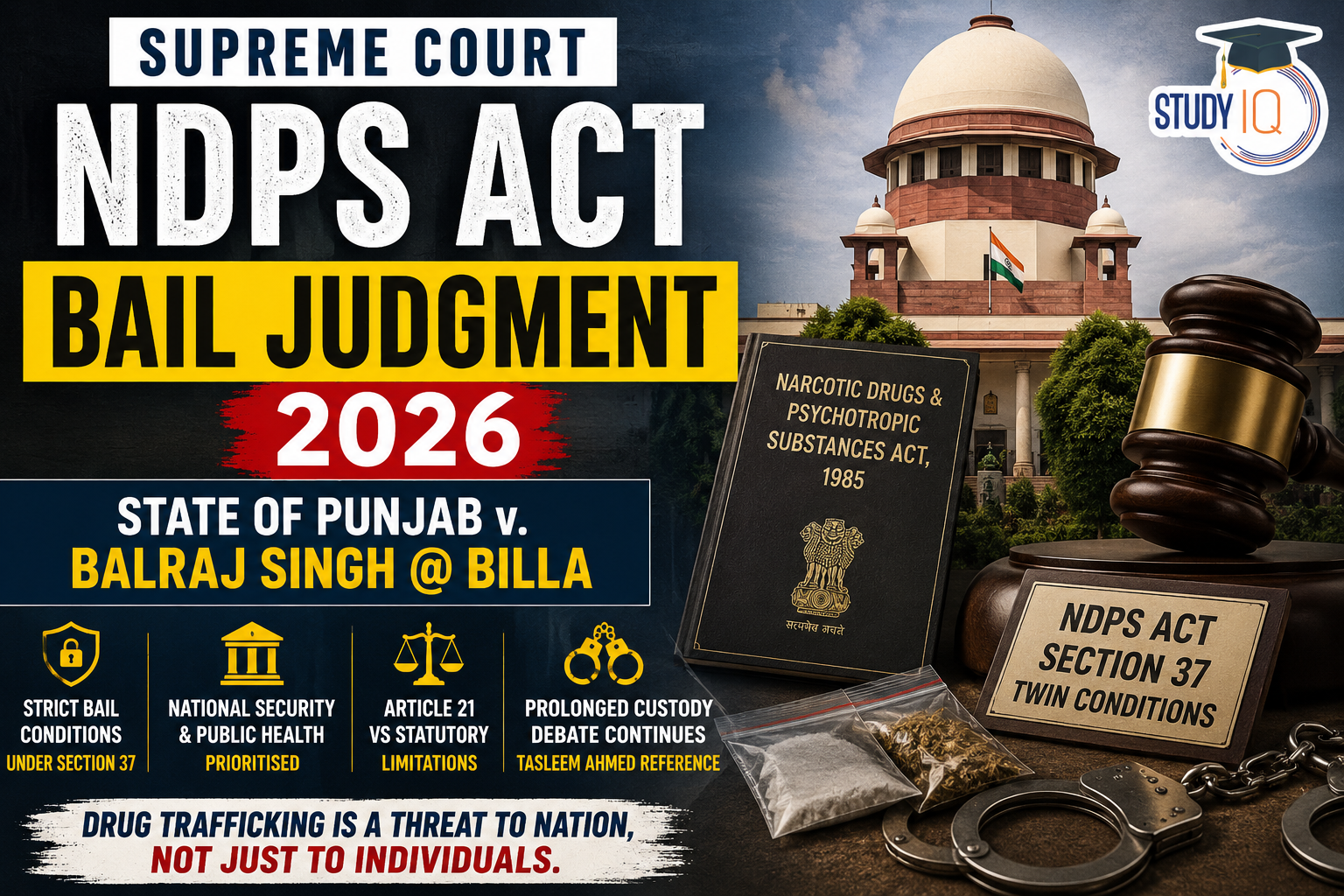
The Supreme Court of India, in State of Punjab v. Balraj Singh @ Billa (SLP (Crl.) No. 896 of 2026), reaffirmed the rigorous criteria for granting bail under the Narcotic Drugs and Psychotropic Substances Act, 1985 (NDPS Act), highlighting the critical nexus between national security, public health, criminal justice, and personal liberty. The Court underscored that in the face of challenges from organised drug trafficking, considerations of sovereignty and public good may supersede assertions of individual liberty.
The decision issued by a Bench consisting of Justice Sanjay Karol and Justice N. Kotiswar Singh emphasises the legislative purpose of Section 37 of the NDPS Act and illustrates the judiciary’s ongoing challenge to reconcile constitutional safeguards under Article 21 with the pressing state interest in addressing narcotics-related offences.The decision gains further importance as it addresses a wider constitutional discourse presently before the Supreme Court regarding the interpretation of “prolonged incarceration” and the degree to which constitutional courts can authorise bail under specific statutes despite statutory limitations.
Read Also: UPSC Daily Current Affairs 2026
Case Background
The dispute stemmed from a purported heroin trafficking operation in Punjab, a province that has historically had significant issues related to narcotics abuse and transnational drug smuggling. The prosecution said that police intercepted a Mahindra XUV 300 near Village Veeram in Punjab and seized around 1.465 kilograms of heroin, a quantity classified as commercial under the NDPS Act.
During the investigation, two arrested individuals purportedly revealed that the narcotic substance was procured under the instructions of Balraj Singh, also known as Billa, who was incarcerated at Central Jail, Goindwal Sahib, at the time. The prosecution asserts that Balraj Singh was not only linked to the consignment but was also actively managing a drug trafficking operation from within prison using unlawfully held mobile phones. The inquiry indicated that he instructed accomplices beyond the prison to acquire, preserve, and distribute narcotic substances.
The defendant was subsequently charged with:
- Section 21(c) of the Narcotic Drugs and Psychotropic Substances Act
- Section 29 of the Narcotic Drugs and Psychotropic Substances Act
- Section 61 of the Narcotic Drugs and Psychotropic Substances Act
- Section 85 of the Narcotic Drugs and Psychotropic Substances Act
The charges involved substantial amounts of narcotic drugs, so invoking the rigorous bail requirements outlined in Section 37 of the Act.
Proceedings Before the Special Court
The defendant requested regular bail from the Special Court in Tarn Taran. The Special Court denied the application on 3 July 2025, determining that the statutory criteria under Section 37 were not met and that the gravity of the offence militated against release. The Court evaluated the gravity of the offence and the defendant’s criminal record while denying relief.
High Court Grants Bail
The defendant subsequently petitioned the Punjab and Haryana High Court. The High Court granted bail on 15 October 2025, primarily based on:
- The duration of imprisonment experienced by the defendant.
- The protracted advancement of the trial.
- Only two of the twenty-four prosecution witnesses had been examined.
- The idea is that prior criminal history alone cannot warrant the refusal of bail.
The High Court noted that extended detention without the resolution of a trial may invoke issues pertaining to Article 21 of the Constitution. The State of Punjab contested this order before the Supreme Court.
Observations of the Supreme Court
The Supreme Court granted the State’s appeal, identifying significant flaws in the High Court’s rationale. The Court observed that the High Court neglected to assess the obligatory criteria outlined in Section 37 of the NDPS Act prior to granting bail. The Bench articulated a significant remark concerning the socioeconomic ramifications of narcotics trafficking:
In the event of a confrontation between national sovereignty and individual liberty, the former shall unequivocally take precedence, especially during wartime, including scenarios involving medication supplies that significantly impact the national economy and public health. The Court therefore classified organised drug trafficking as a menace not only to individual victims but to the nation as a whole.
Understanding Section 37 of the NDPS Act
The NDPS Act is among the most rigorous criminal statutes in India. In acknowledgement of the severe socioeconomic repercussions of drug trafficking, Parliament instituted certain limitations on the provision of bail via Section 37. The regulation deviates from conventional criminal law norms. Prior to granting bail in cases with substantial quantities of narcotics, judges must ascertain that:
First Condition
There are justifiable reasons to assert that the accused is innocent of the purported crime.
Second Condition
The defendant is unlikely to perpetrate any offence when released on bail.
These stipulations are frequently termed the “twin conditions” of Section 37.
Bail is typically not granted until both conditions are satisfied. The Supreme Court underscored that these statutory protections are mandatory and cannot be disregarded solely due to the accused’s period of detention.
Criminal History and Its Importance
A significant element evaluated by the Supreme Court was the respondent’s criminal record. The State indicated that Balraj Singh has three prior criminal records of the same kind under the NDPS Act. The Court noted that such prior instances are directly pertinent when evaluating the second aspect of Section 37. When an accused has been consistently involved in narcotics offences, it becomes challenging for a judge to determine that he is unlikely to perpetrate a similar offence if granted bail. The Court determined that the respondent’s criminal background substantially undermined his bail application.
Article 21 and the Issue of Extended Detention
The reply contended that he had previously spent around one year and seven months in detention. He asserted that the trial was progressing at a sluggish pace and that prolonged imprisonment infringed upon his constitutional right to personal liberty under Article 21. The Supreme Court dismissed this argument based on the unique circumstances of the case.
The Court noted that:
- The maximum penalty may be twenty years.
- The duration of custody was merely one year and seven months.
- The duration cannot be considered too lengthy in relation to significant NDPS crimes.
Thus, the Court determined that Article 21 could not be applied in this context to circumvent the statutory limitations established by Section 37.
Drug Trafficking as a National Problem
The Court’s remarks indicate increasing apprehension about the magnitude of drug trafficking in India. India holds a strategically critical location between two prominent worldwide narcotics-producing areas:
The Golden Crescent Comprising:
- Afghanistan
- Pakistan
- Iran
The Golden Triangle Comprising:
- Myanmar
- Laos
- Thailand
India’s geographic position renders it susceptible to transnational smuggling networks that operate beyond its borders. Regions include Punjab, Rajasthan, Jammu & Kashmir, Manipur, Mizoram, and segments of the northeastern area have encountered escalating difficulties due to cross-border trafficking. Drug trafficking is no longer perceived solely as a law enforcement issue. It has become associated with:
- Structured criminal enterprises
- Money laundering
- Financing of terrorism
- Transnational criminal organisations
- Public health emergencies
This overarching framework elucidates the rationale behind Parliament’s enactment of particularly rigorous bail terms under the NDPS Act.
Divergent Judicial Perspectives on Bail and Incarceration
A significant element of the judgement is the Court’s recognition that there is presently no established criterion defining “prolonged incarceration” in NDPS proceedings. In the course of the arguments, Senior Advocate Shadan Farasat exhibited a chart delineating disparate outcomes in analogous situations. The subsequent table encapsulates the overarching pattern previously mentioned before the Court:
| Case | Approximate Custody Period | Outcome |
| Harpreet Singh Talwar @ Kabir Talwar v. State of Gujarat (2025) | Around 2 years 9 months | Bail refused |
| Union of India v. Vigin K. Varghese (2025) | More than 3 years | Bail order set aside |
| Union of India v. NamdeoAshruba Nakade (2025) | More than 2 years | Bail order set aside |
| Rabi Prakash v. State of Odisha (2023) | Around 3 years 6 months | Bail granted |
| Ankur Chaudhary v. State of Madhya Pradesh (2024) | More than 2 years | Bail granted |
| Narcotics Control Bureau v. Lakhwinder Singh (2025) | Around 4 years 6 months | Bail granted |
| Badsha Sk. v. State of West Bengal (2023) | Around 2 years 4 months | Bail granted |
The Constitutional Discourse: Article 21 in Contrast to Statutory Limitations
The decision of the Supreme Court in State of Punjab v. Balraj Singh @ Billa notably addresses the overarching constitutional issue of the interplay between personal liberty and legislative limitations on bail. Article 21 of the Constitution ensures that no one shall be deprived of life or personal liberty unless in accordance with a procedure established by law. Throughout the decades, the Supreme Court has broadened the interpretation of Article 21 to encompass rights such as:
- Equitable adjudication
- Expedited trial
- Human dignity
- Access to legal recourse
- Safeguarding against capricious detention
Typically, extended detention without the resolution of a trial may warrant the approval of bail. Nevertheless, certain statutes such as the NDPS Act, the Unlawful Activities (Prevention) Act (UAPA), and the Prevention of Money Laundering Act (PMLA) place further constraints that hinder the implementation of traditional bail concepts. The Supreme Court noted that the legal status is ambiguous concerning the degree to which constitutional courts may apply Article 21 to grant bail when statutory requirements are unmet. This unresolved question currently holds a vital role in modern criminal law.
The Pending Reference in Tasleem Ahmed
The Court explicitly mentioned the ongoing case of Tasleem Ahmed v. State (Government of NCT of Delhi). The reference is to a significant constitutional issue:
What is the appropriate judicial approach to bail in the context of special statutes when Article 21, extended detention, and statutory limitations converge? The problem occurs due to varying conclusions made by various benches of the Supreme Court in similar scenarios. In many instances, extended imprisonment has been deemed adequate to warrant release notwithstanding legal limitations.
In other instances, courts have mandated rigorous adherence to statutory standards irrespective of the duration of possession. The reference aims to establish doctrinal uniformity in this legal domain.
The Issue of Inconsistent Bail Jurisprudence
The Court openly recognised apprehensions about inconsistent results. It was noted:
“Similarly situated persons in custody may receive different outcomes depending upon the approach adopted by the respective bench.”
This point is notably important as equality before the law under Article 14 necessitates uniformity in court rulings. The comparative chart submitted to the Court illustrated that individuals held for similar durations have experienced significantly disparate outcomes.
Illustrative Pattern of Judicial Decisions
| Category | Typical Custody Period | Judicial Outcome |
| Commercial quantity NDPS cases with custody exceeding 2 years | Mixed outcomes | Some granted bail, some denied |
| Custody exceeding 3 years | Mixed outcomes | Courts have differed |
| Custody exceeding 4 years | Greater likelihood of bail | Not uniformly applied |
| Cases involving criminal antecedents | Bail generally difficult | Courts apply stricter scrutiny |
| Cases with delayed trials and no antecedents | Bail more likely | Article 21 considerations become stronger |
Judicial Exegesis of Section 37: Significant Jurisprudential Precedents
The Supreme Court’s decision should be contextualised within the broader scope of precedents regarding Section 37 of the NDPS Act.
State of Kerala v. Rajesh (2020)
This significant decision confirmed that the dual requirements under Section 37 are mandatory.The Court determined that lenient bail practices cannot supersede legislative intent in narcotics instances involving substantial quantities. The decision continues to be a principal authority underscoring stringent adherence to Section 37.
Union of India v. Shiv Shanker Kesari (2007)
The Court emphasised that “reasonable grounds” as per Section 37 necessitate significant and reliable evidence indicating that the accused may be innocent. Arguments or speculative statements alone are inadequate.
Narcotics Control Bureau v. Mohit Aggarwal (2022)
The Supreme Court emphasised that courts must document satisfaction with both statutory requirements prior to granting bail. The court’s decision emphasised that the gravity of the offence and its societal repercussions must be paramount factors.
Rabi Prakash v. State of Odisha (2023)
This judgement was a significant advancement. The Court granted bail following extended detention, underscoring that constitutional courts cannot perpetually disregard Article 21. The decision became pivotal in acknowledging that extraordinary delays may warrant constitutional intervention, even within the confines of specific statutes.
Badsha Sk. v. State of West Bengal (2023)
The Court subsequently granted bail following an extended duration of detention and sluggish trial advancement. The decision advanced the developing legal principles acknowledging extended imprisonment as a significant constitutional consideration.
Innovative Patterns in Narcotics Trafficking
Contemporary narcotics syndicates increasingly employ:
- Secure communication platforms
- Transactions using cryptocurrency
- Illicit online marketplaces
- Global courier services
- Criminal enterprises within correctional facilities
- Transnational trafficking syndicates
The accusations in the Balraj Singh case regarding the operation of a trafficking network from within prison illustrate this evolving criminal landscape.
Consequences of Drug Trafficking on Society
The Supreme Court’s focus on sovereignty and public welfare underscores the dire repercussions of drug trafficking.
Public Health Emergency
- Substance misuse contributes to:
- Dependency
- Psychological health disorders
- Fatalities due to overdose
- Augmented healthcare responsibilities
- Adolescent demographics continue to exhibit significant susceptibility.
Financial Implications
Drug trafficking produces:
- Illicit funds
- Illicit financial networks
- Decreased workforce efficiency
- Augmented law enforcement funding
The Court explicitly addressed the influence of narcotics on the national economy.
Effects on Families and Communities
Substance dependence frequently leads to:
- Familial disintegration
- Intimate partner violence
- Neglect of a child
- Disruption in education
- Entire communities may endure prolonged societal repercussions.
Association with Organised Crime
Drug trafficking often converges with:
- Illicit arms trafficking
- Human trafficking
- Money laundering
- Financing of terrorism
This elucidates why courts are progressively perceiving narcotics offences as threats that transcend individual criminal acts.
The Judiciary’s Function in Addressing Narcotics Offences
The judiciary holds a precarious position.Courts are obligated to safeguard constitutional rights.Conversely, they must adhere to statutory policies aimed at combating major criminal activity.The Supreme Court has consistently asserted that judges must not regard NDPS violations as equivalent to ordinary criminal offences. Nonetheless, constitutional courts serve as protectors of freedom and must interfere when:
- Trials are excessively postponed.
- The prosecution gets burdensome.
- Fundamental rights are imperilled.
- Statutory protocols have been breached.
- The difficulty resides in reconciling these conflicting issues.
Consequences for Subsequent Bail Requests
The decision entails numerous significant ramifications:
- Fortification of Section 37
Courts must thoroughly assess the dual statutory criteria prior to granting bail.
Neglecting to comply may lead to appellate intervention.
- Criminal History Remains Pertinent
Prior engagement in analogous offences will substantially influence bail determinations.
- Brief Intervals of Detention May Prove Insufficient
Custody for one or two years, especially in circumstances involving substantial commercial quantities, may not inherently warrant release.
- Pending Elucidation from Expanded Panel
The forthcoming reference in Tasleem Ahmed may ultimately delineate more explicit standards regarding extended detention under specific statutes.
- Increased Focus on National Interest
Judicial authorities are expected to persist in regarding extensive narcotics offences as issues impacting public welfare and national security.
Conclusion
The decision of the Supreme Court in State of Punjab v. Balraj Singh @ Billa constitutes a notable reaffirmation of the rigorous bail framework instituted by the NDPS Act. By nullifying the High Court’s order, the Court emphasised that the legislative protections under Section 37 are not merely procedural formalities but essential measures aimed at addressing a significant national issue.
The decision acknowledges that drug trafficking is not merely a criminal act against individual victims; it is a systematic endeavour that can jeopardise public health, social stability, economic progress, and national security. Therefore, judges must proceed with prudence prior to approving bail in cases involving substantial amounts of narcotics. The Court simultaneously recognised the ongoing constitutional discourse over prolonged imprisonment and Article 21. The forthcoming reference in Tasleem Ahmed is anticipated to elucidate the equilibrium between individual freedom and legal limitations imposed by special criminal statutes.
The decision ultimately embodies the ongoing endeavour of Indian constitutional jurisprudence to harmonise two fundamental principles: the safeguarding of individual liberty and the maintenance of community security. The Supreme Court has reiterated the intricate function of the judiciary in protecting constitutional rights and the overarching interests of society.
 Supreme Court on Plaint Amendment After ...
 Supreme Court on Children's Right to Int...
 Supreme Court Dowry Enforcement Order 20...








 WhatsApp