Table of Contents
Context
DPIIT-recognised startups increased from 288 in 2016 to cover 77% of all startups in 2025, reflecting the increasing formalisation of the Indian startups ecosystem.
Read Also: UPSC Daily Current Affairs 2026
Why Are Startups Significant for India?
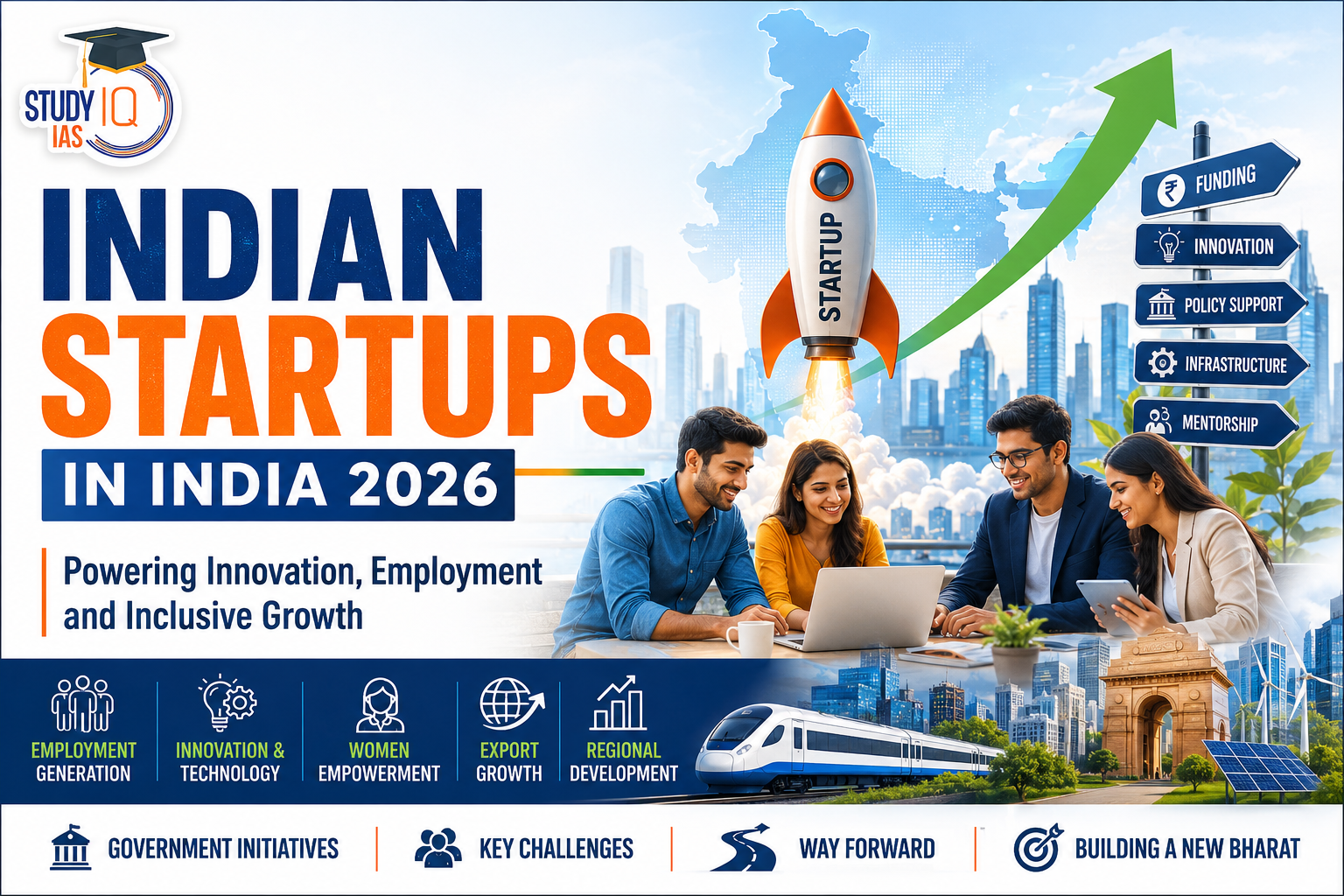
- Employment Generation: Unlike capital-intensive heavy industries, startups generate employment at relatively low capital cost per job, critical for absorbing ~12 million new entrants annually.
- The DPIIT estimates that recognised startups have directly created over 15 lakh jobs.
- Fostering Innovation and Technology Diffusion: Fintech ventures such as Razorpay and PhonePe democratised digital payments while agri-tech platforms like DeHaat and Ninjacart have compressed supply chains, reducing post-harvest losses.
- Harnessing Demographic Dividend: With 66% of male founders and 59% of female founders below 40 years of age, startups are transforming India’s youth from job seekers into job creators.
- Promoting Balanced Regional Development: Startup activity has shifted from Tier-I cities (65% in 2016 to 18% in 2025) to Tier-III towns (15% to 71%), reflecting the democratization of entrepreneurship and innovation across India.
- Women Empowerment: Women founders are growing at a faster pace (20% CAGR compared to 14% for men), with their share rising to 33% among founders aged 50+, highlighting the increasing role of women-led entrepreneurship in inclusive growth.
- Export Earnings: IT and SaaS startups constitute a growing share of services exports, which crossed $338 billion in FY2024.
- Import Substitution and Strategic Autonomy: In strategic sectors like semiconductors, defence electronics, space technology, deep-tech, etc startups are reducing import dependence.
- Agnikul Cosmos (semi-cryogenic launch vehicles), Pixxel (hyperspectral earth observation satellites), and Sagar Defence Engineering (autonomous naval platforms)
|
Important Government Initiatives |
| 1. Startup India Initiative (2016): Flagship DPIIT initiative to build a strong ecosystem for innovation, entrepreneurship, funding, mentorship and startup growth.
2. Credit Guarantee Scheme for Startups (CGSS): Provides collateral-free loans to startups through eligible financial institutions. 3. Startup India Seed Fund Scheme (SISFS): ₹945 crore scheme providing early-stage funding for proof of concept, prototype development and commercialization. 4. Atal Innovation Mission (AIM): NITI Aayog’s flagship programme to foster a nationwide culture of innovation and entrepreneurship. 5. GENESIS (Gen-Next Support for Innovative Startups): MeitY’s ₹490 crore deep-tech startup programme focused on Tier-II and Tier-III cities. 6. Technology Incubation and Development of Entrepreneurs (TIDE 2.0): Supports ICT startups working in AI, IoT, blockchain, robotics and emerging technologies. 7. NIDHI (National Initiative for Developing and Harnessing Innovations): DST umbrella programme nurturing knowledge-based and technology-driven startups. 8. Startup Village Entrepreneurship Programme (SVEP): DAY-NRLM sub-scheme promoting rural entrepreneurship and local enterprises. 9. ASPIRE (A Scheme for Promotion of Innovation, Rural Industries and Entrepreneurship): MSME scheme promoting rural innovation, incubation and micro-enterprise development. 10. Innovations for Defence Excellence (iDEX): Supports startups developing innovative solutions for defence and aerospace sectors (mentioned in Startup India ecosystem initiatives). |
What Are the Key Challenges Facing India’s Startup Ecosystem?
- Funding Constraint: India’s startup funding landscape remains skewed at multiple levels. Geographically, Maharashtra, Karnataka, and Delhi-NCR account for over 70% of total venture investment.
- Sectorally, consumer tech and fintech attract disproportionate capital while deep-tech, climate-tech, and agri-tech remain undercapitalised.
- The Indian startup ecosystem witnessed a 55% year-on-year fall in total funding till May 2026.
- Regulatory Complexity: Startups in sectors like healthtech, edtech, and fintech navigate overlapping jurisdictions between Central government (SEBI, RBI, etc) and state governments with no unified regulatory framework.
- Talent Scarcity: Despite producing around 1.5 million engineering graduates annually, India faces shortages of skilled professionals in AI, Machine Learning, Quantum Computing, Chip Design and Cybersecurity.
- Limited Exit Opportunities: India’s startup ecosystem still lacks mature exit avenues such as IPOs, mergers & acquisitions (M&A), and secondary markets, limiting liquidity for founders and investors.
- Gender and Social Inclusion Gaps: Despite rapid growth in women-led startups, women and entrepreneurs from marginalized communities continue to face barriers in accessing funding, mentorship and investor networks.
- Weak Intellectual Property enforcement: India’s startup ecosystem continues to face challenges in patent generation, commercialization of research and industry-academia collaboration.
What Is the Way Forward for India’s Startup Ecosystem?
- Unified Regulatory Sandbox: A unified National Innovation Sandbox (NIS), operated by an inter-ministerial body under DPIIT.
- For example, UK’s Financial Conduct Authority (FCA) Regulatory Sandbox, Singapore’s MAS Sandbox Express, etc
- Sovereign Deep-Tech Fund: A dedicated Sovereign Deep-Tech Fund can provide early-stage financial support and accelerate innovation in strategic technologies.
- Strengthening Technology Transfer Ecosystem: Stronger industry-academia linkages through Technology Transfer Offices (TTOs) in premier institutions to facilitate the commercialization of research and innovation.
- Deepen Public Procurement: Institutionalise dedicated procurement budgets (beyond the existing 25% MSME/startup reservation on GeM) at every Central Ministry and CPSE for startups, with simplified tender conditions under ₹5 Crore.
- For example, US Small Business Innovation Research (SBIR) programme and UK’s GovTech Catalyst.
- Build an Inclusive Startup Pipeline: Provide collateral-free debt and equity to women-led startups; reserve 15% of Startup India Seed Fund tranches for SC/ST-led ventures; mandate that at least 30% of government-funded incubators operate in Tier-2/3 geographies.
|
Prelims Fact Box: Startups |
| 1. Official Definition (DPIIT Criteria): An entity is recognized as a startup up to 10 years from its date of incorporation. It must be incorporated as a Private Limited Company, Partnership Firm, or Limited Liability Partnership (LLP) with an annual turnover not exceeding ₹100 crore in any financial year since incorporation.
2. Core Mandate: The entity must work towards innovation, development, or improvement of products, processes, or services, or have a scalable business model with a high potential for employment generation or wealth creation. 3. Tax Holiday (Section 80-IAC): Eligible recognized startups can claim a 100% tax rebate on profits for 3 consecutive years out of their first 10 years, subject to certification by the Inter-Ministerial Board of Certification. 4. Angel Tax Relief (Section 56(2)(viib)): Capital raised by DPIIT-recognized startups from investors (including foreign investors and non-residents) is exempted from Angel Tax, easing early-stage equity funding. 5. National Startup Day: Celebrated annually on January 16th to mark the anniversary of the launch of the Startup India Initiative in 2016. |
|
Read More Notes |
|
| Environment Notes | Art and Culture Notes |
| Science and Tech | History Notes |
| Geography Notes | Indian Polity Notes |
| General Knowledge | International Relation |
|
Explore StudyIQ Courses |
|
 Supreme Court on Plaint Amendment After ...
 Supreme Court on Children's Right to Int...
 UPSC CDS 2 Result 2026 Out: Download Wri...














 WhatsApp