Home   »   Allahabad High Court RO ARO Syllabus...
Top Performing

Allahabad High Court RO ARO Syllabus 2026 PDF, Latest Exam Pattern and Subject-wise Topics

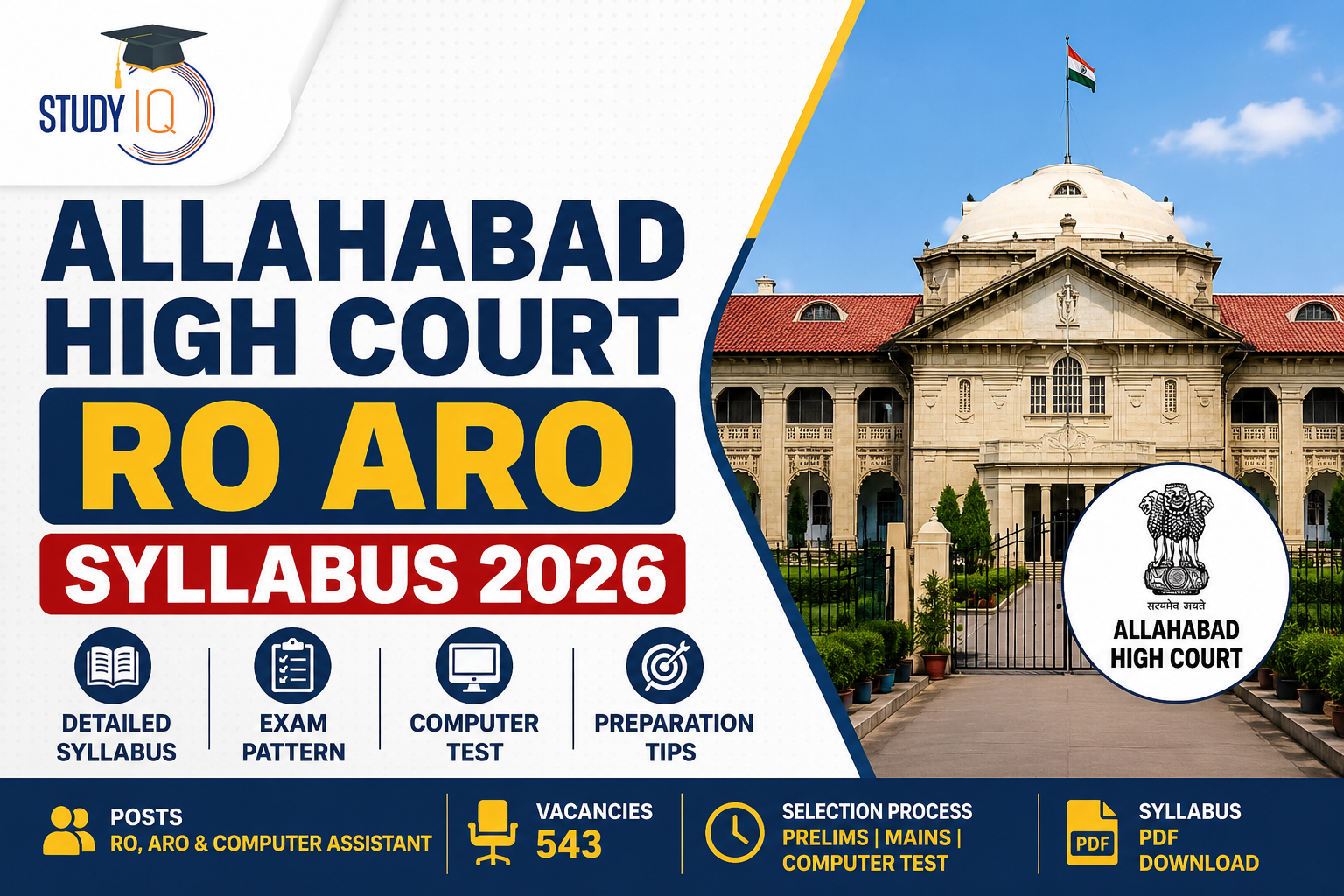
The Allahabad High Court RO ARO Syllabus 2026 serves as an important guide for candidates aspiring to sit for the Recruitment Examination for the Review Officer (RO) and Assistant Review Officer (ARO). Allahabad High Court has issued a notice regarding the recruitment of 543 vacancies through Advertisement No. 02/Review Officer/Assistant Review Officer/Computer Assistant/2026.

The Selection procedure involves a Computer-Based Test (CBT) along with a Computer Knowledge (English Typing) Test. Candidates need to have complete knowledge about the pattern, marking scheme, and syllabus of subjects for the examination.

Allahabad High Court RO ARO Notification 2026

Allahabad High Court RO ARO Syllabus 2026 Overview

Particulars Details
Organization Allahabad High Court (AHC)
Posts Review Officer (RO), Assistant Review Officer (ARO), Computer Assistant
Vacancies 543
Selection Process Prelims, Mains, Computer Knowledge Test
Mode of Exam Online/Offline
Prelims Questions 200
Prelims Marks 200
Mains Marks 150
Computer Test Marks 50
Official Language Hindi & English

Allahabad High Court RO ARO Exam Pattern 2026

Stage 1: Preliminary Examination

The Preliminary Examination is objective in nature and serves as the first screening stage.

Particulars Details
Type of Questions Multiple Choice Questions (MCQs)
Total Questions 200
Total Marks 200
Duration 3 Hours
Marking Scheme +1 for each correct answer
Negative Marking No Negative Marking

Subjects Included

  • General Science
  • History of India
  • Indian National Movement
  • Indian Polity, Economy & Culture
  • Indian Agriculture, Commerce & Trade
  • Population, Ecology & Urbanization
  • Geography of India and World Geography
  • Current National & International Events
  • General Aptitude
  • Uttar Pradesh Special Knowledge
  • General English & Hindi
  • Computer Knowledge

Stage 2: Mains Examination

The Mains Examination is descriptive in nature and evaluates writing, translation, and comprehension skills.

Section Marks
Essay Writing in English 30
Precis Writing 30
English to Hindi Translation 25
Hindi to English Translation 25
English Comprehension 40
Total 150

Duration: 2 Hours

Stage 3: Computer Knowledge Test

Particulars Details
Mode Practical Test
Marks 50
Duration 20 Minutes
Qualifying Marks 25 Marks

Topics include:

  • Typing
  • Data Entry
  • Word Processing
  • Computer Operations

Allahabad High Court RO ARO Syllabus 2026

The Allahabad High Court RO ARO Written Examination comprises 200 objective-type questions covering General Studies, Uttar Pradesh General Knowledge, Languages, Reasoning, Current Affairs, and Computer Knowledge. Candidates who qualify the written examination will appear for the Computer Knowledge (English Typing) Test.

Allahabad High Court RO ARO Subject-wise Syllabus 2026

Subject Detailed Topics
General Science Physics: Motion, Force, Energy, Work & Power, Heat, Light, Sound, Electricity, Magnetism, Units & Measurements, Everyday Physics.

Chemistry: Matter, Elements & Compounds, Metals & Non-Metals, Acids, Bases & Salts, pH Scale, Chemical Reactions, Everyday Chemistry, Environmental Chemistry.

Biology: Cell Structure, Human Body Systems, Nutrition, Vitamins, Diseases, Blood, Genetics, Ecology, Human Health, Microorganisms, Plant & Animal Kingdom.

History of India Ancient India (Indus Valley Civilization, Vedic Period, Mauryan Empire, Gupta Empire), Medieval India (Delhi Sultanate, Mughal Empire, Bhakti & Sufi Movements), Modern India (British Rule, Governor Generals, Social & Religious Reform Movements), Revolt of 1857, Constitutional Developments, Post-Independence India, History of Uttar Pradesh.
Indian National Movement Formation of INC, Moderate & Extremist Phase, Partition of Bengal, Swadeshi Movement, Home Rule Movement, Champaran Satyagraha, Non-Cooperation Movement, Civil Disobedience Movement, Simon Commission, Round Table Conferences, Government of India Acts, Quit India Movement, INA, Cabinet Mission, Partition of India, Freedom Struggle Leaders.
Indian Polity, Economy & Culture Polity: Constitution, Preamble, Fundamental Rights, DPSP, Fundamental Duties, President, Vice-President, Prime Minister, Parliament, Judiciary, Election Commission, CAG, Constitutional Bodies, Panchayati Raj, Local Government.

Economy: GDP, Inflation, Banking, RBI, Budget, Taxation, GST, Economic Planning, NITI Aayog, Financial Inclusion, Poverty, Unemployment, Government Schemes.

Culture: Classical Dances, Music, Architecture, Paintings, UNESCO Heritage Sites, Festivals, Literature, Religion, Cultural Institutions.

Indian Agriculture, Commerce & Trade Cropping Patterns, Irrigation, Green Revolution, Soil Types, Fertilizers, Agricultural Schemes, Horticulture, Dairy, Animal Husbandry, Internal Trade, Foreign Trade, MSMEs, Banking, Export-Import, Handicrafts, Cottage Industries.
Population, Ecology & Urbanisation Census, Population Growth, Population Policies, Demography, Migration, Biodiversity, Wildlife Conservation, Climate Change, Global Warming, Environmental Pollution, Sustainable Development, Urban Planning, Smart Cities, Waste Management.
World Geography & Geography of India Solar System, Continents, Oceans, Mountains, Plateaus, Rivers, Climate, Monsoon, Natural Vegetation, Soils, Minerals, Industries, Agriculture, Transportation, Resources of India, River Systems, Ganga-Yamuna Basin, Dams, Hydroelectric Projects, El Niño, La Niña.
National & International Current Affairs National Events, International Organizations, Government Schemes, Economy, Science & Technology, Defence, Sports, Awards & Honours, Books & Authors, Important Days, Appointments, Summits, Reports & Indices, Recent Judgments, International Relations (last 12–18 months).
General Intelligence (Reasoning) Coding-Decoding, Blood Relations, Direction Sense, Alphabet Series, Number Series, Analogy, Classification, Statement & Conclusion, Statement & Assumption, Syllogism, Seating Arrangement, Puzzles, Calendar, Clock, Ranking, Data Interpretation, Arithmetic Reasoning, Decision Making, Logical Reasoning.
Special Knowledge of Uttar Pradesh History of Uttar Pradesh, Geography, Rivers, Climate, Soil, Agriculture, Irrigation, Economy, Industries, Government Schemes, Education, Folk Dances, Music, Festivals, Tourism, Wildlife Sanctuaries, National Parks, Literature, Art & Culture, Census, Literacy, Social Traditions, Important Personalities.
General English Reading Comprehension, Grammar, Parts of Speech, Tenses, Articles, Prepositions, Subject-Verb Agreement, Vocabulary, Synonyms, Antonyms, Idioms & Phrases, One Word Substitution, Sentence Rearrangement, Error Detection, Sentence Improvement, Active & Passive Voice, Direct & Indirect Speech, Cloze Test, Spelling Correction.
General Hindi पर्यायवाची, विलोम शब्द, संधि, समास, कारक, उपसर्ग-प्रत्यय, मुहावरे एवं लोकोक्तियाँ, वाक्य शुद्धि, अशुद्धि संशोधन, शब्द रचना, वाक्यांश के लिए एक शब्द, अपठित गद्यांश, पत्र लेखन, अनुवाद (हिन्दी-अंग्रेज़ी एवं अंग्रेज़ी-हिन्दी), संज्ञा, सर्वनाम, विशेषण, क्रिया का प्रयोग।
Computer Knowledge Computer Fundamentals, History of Computers, Hardware & Software, Input & Output Devices, CPU, Memory, Storage Devices, Operating Systems, Windows, MS Word, MS Excel, MS PowerPoint, Internet, Email, Networking, Database Basics, Shortcut Keys, Computer Security, Cyber Security, Computer Viruses, Hacking Basics, Internet Protocols, Cloud Computing (Basics).

Computer Knowledge Test (Typing Test)

Particular Details
Passage Approximately 500 English words
Duration 20 Minutes
Maximum Marks 50 Marks
Qualifying Marks 25 Marks
Minimum Speed 25 Words Per Minute (WPM)
Error Penalty 0.1 mark deducted for every typing mistake
Errors Considered Omitted words, spelling mistakes, extra characters/words, incorrect symbols, and formatting errors are treated as mistakes.

Allahabad High Court RO ARO Syllabus 2026 PDF

Preparation Strategy for Allahabad High Court RO ARO 2026

  1. Complete the entire syllabus once before attempting mock tests.
  2. Give special attention to Uttar Pradesh General Knowledge.
  3. Strengthen English and Hindi grammar as both are crucial for Prelims and Mains.
  4. Practice essay writing and precis writing regularly.
  5. Improve typing speed and MS Office skills for the Computer Test.
  6. Solve previous-year judiciary and high court recruitment papers.

Read Also: UPSC Daily Current Affairs 2026
Sharing is caring!