Table of Contents
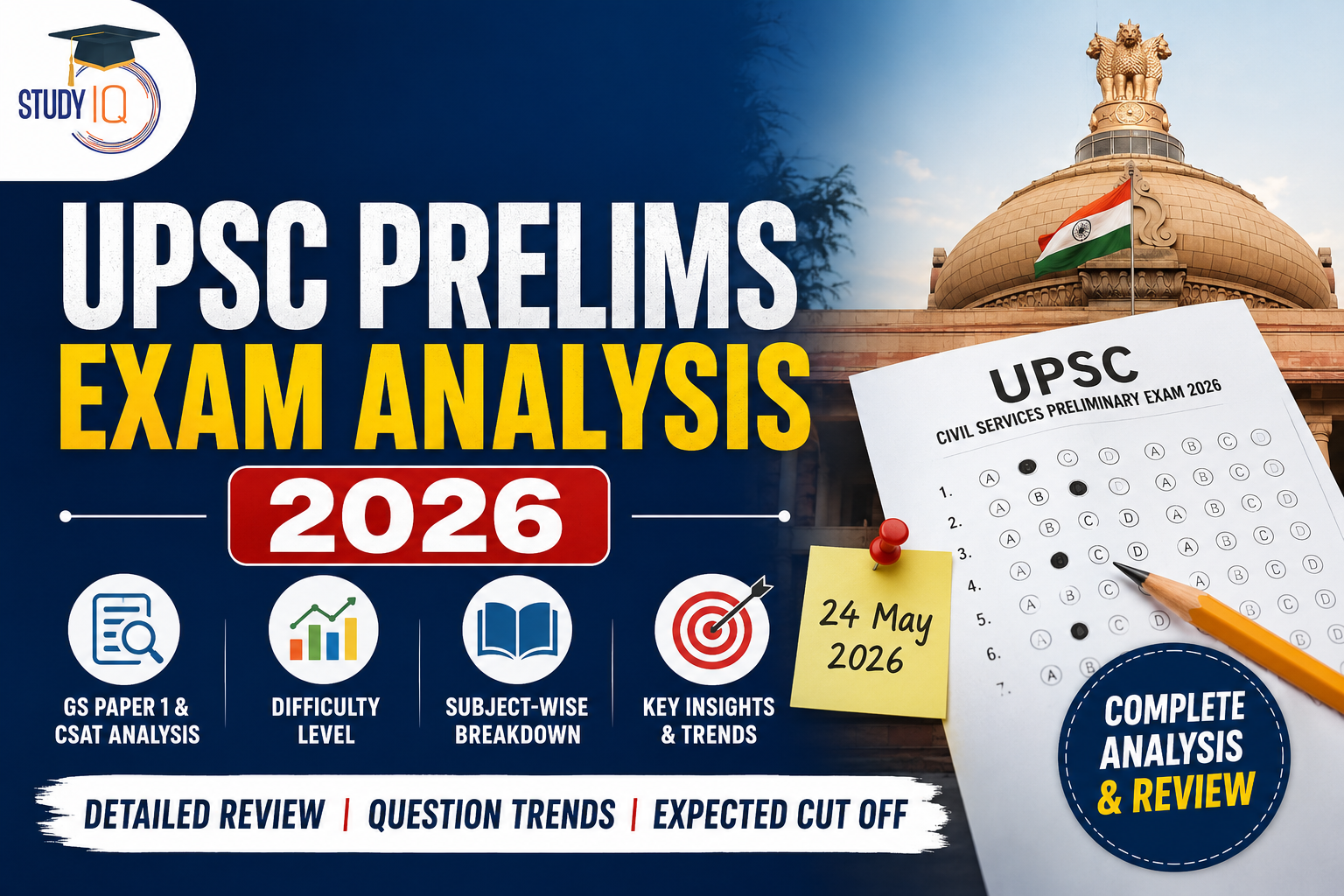
UPSC Prelims Exam Analysis 2026: The Union Public Service Commission (UPSC) held the Civil Services Preliminary Examination 2026 on 24 May 2026 at all the examination centres across the country.
Based on student feedback, expert opinions, and a comprehensive analysis of the UPSC GS Paper 1 PDF of this year, it can be concluded that the UPSC Prelims 2026 Exam followed the pattern of the Commission of asking analytical/conceptual/elimination questions instead of direct factual questions.
This year, the GS Paper 1 was rated difficult, and the Economy, Science & Technology, Environment, and Polity were the most important topics.
UPSC Prelims 2026 Exam Overview
| Particulars | Details |
|---|---|
| Exam Name | UPSC Civil Services Preliminary Examination 2026 |
| Conducting Authority | Union Public Service Commission |
| Exam Date | 24 May 2026 |
| GS Paper 1 Timing | 9:30 AM – 11:30 AM |
| CSAT Timing | 2:30 PM – 4:30 PM |
| Total Vacancies | 933 |
| Exam Mode | Offline (OMR Based) |
| Nature of Questions | Objective Type |
UPSC Prelims Exam Analysis 2026
The UPSC Prelims 2026 paper clearly demonstrated UPSC’s growing emphasis on:
- Analytical ability
- Conceptual understanding
- Statement-based elimination
- Governance-oriented thinking
- Current affairs integration
Unlike earlier patterns where factual memorisation could fetch decent marks, UPSC 2026 required candidates to:
- Apply concepts logically
- Understand interconnected topics
- Interpret statements carefully
- Eliminate close options intelligently
The examination tested not only knowledge but also decision-making ability and exam temperament.
UPSC Prelims Question Paper 2026
Overall Difficulty Level of UPSC Prelims 2026
| Paper | Difficulty Level |
|---|---|
| GS Paper 1 | Difficult |
| CSAT |
Why Was the Paper Difficult?
Several factors increased the difficulty level:
- Multi-statement questions dominated
- Close answer choices created confusion
- Conceptual clarity became essential
- Current affairs were deeply integrated with static subjects
- Many questions required elimination rather than direct recall
Most aspirants reported that the paper was lengthy and mentally exhausting because even familiar topics contained tricky options.
Major Trends Observed in UPSC Prelims 2026
1. Analytical and Statement-Based Questions Dominated
A significant number of questions followed:
- Multiple statement formats
- Assertion-style logic
- Conceptual elimination
- Interdisciplinary framing
Examples from the paper included:
- LT-LEDS and climate targets
- Large Language Models (LLMs)
- Real World Asset tokenisation
- Genome India Project
- Digital Rupee interoperability
This confirms UPSC’s clear preference for testing understanding over rote memorisation.
2. Current Affairs Were Integrated with Static Subjects
One of the biggest observations in UPSC Prelims 2026 was:
“Static + Current Affairs Integration”
UPSC did not ask isolated current affairs questions. Instead:
- Economy was linked with digital governance
- Technology was connected with national security
- Environment was linked with climate policy
- International relations were connected with strategic geography
This trend indicates that reading current affairs separately without conceptual understanding is no longer sufficient.
UPSC Prelims 2026 Subject-Wise Analysis
History & Culture Analysis
History questions were fewer in number but conceptually deeper.
Areas Covered
- Sangam literature
- Buddhism
- Mauryan period
- British administration
- Indian classical music
- Ancient trade and inscriptions
Important Questions
- Carnatic vs Hindustani music
- Pali texts and urbanisation
- Amaravati Stupa
- Forward Bloc formation
Difficulty Level
Moderate
Key Observation
Questions were interpretation-based rather than purely factual. UPSC focused more on understanding historical context.
Geography Analysis
Geography questions were conceptual and map-oriented.
Major Themes
- Rivers and drainage systems
- Western Ghats
- Climate systems
- Ports and logistics
- International maritime geography
Important Questions
- Antecedent drainage
- Strait of Hormuz
- Western Ghats geomorphology
- Andaman & Nicobar climate
Difficulty Level
Moderate
Key Observation
UPSC combined physical geography with economic and strategic geography.
Polity Analysis
Polity remained analytical with strong emphasis on constitutional interpretation and governance.
Topics Covered
- Fundamental Rights
- Constitutional provisions
- Parliament procedures
- Disabilities Act
- SC/ST protections
- Governance ethics
Important Questions
- Article 13 and custom as law
- Starred and unstarred parliamentary questions
- Rights of Persons with Disabilities Act
Difficulty Level
Moderate to Difficult
Key Observation
Static polity was heavily linked with governance, ethics, and real administrative functioning.
Economy Analysis
Economy emerged as one of the toughest sections this year.
Areas Covered
- Inflation
- Digital Rupee
- Financial inclusion
- MSMEs
- Fiscal policy
- NBFCs
- Sovereign bonds
Important Questions
- UPI interoperability
- Crowding out effect
- Financial Inclusion Index
- MSME financing
Difficulty Level
Difficult
Key Observation
Economy questions were highly conceptual and policy-driven. Candidates with superficial preparation struggled significantly.
Environment & Ecology Analysis
Environment once again carried strong weightage in UPSC Prelims 2026.
Areas Covered
- Mangrove ecosystems
- Biodiversity
- Migratory birds
- REDD+
- Climate resilience
- Wildlife conservation
Important Questions
- Western Hoolock Gibbon
- Amur Falcons
- Mangrove resilience
- REDD+ projects
Difficulty Level
Moderate
Key Observation
UPSC focused heavily on applied ecology, conservation governance, and climate adaptation.
Science & Technology Analysis
Science & Technology became one of the most dynamic sections this year.
Major Areas
- Artificial Intelligence
- Large Language Models
- Genomics
- National Quantum Mission
- Drone warfare
- Green Hydrogen
- Semiconductors
Important Questions
- LLMs
- Genome India Project
- Quantum Mission
- Green Hydrogen
Difficulty Level
Moderate to Difficult
Key Observation
Questions required both scientific understanding and awareness of recent technological developments.
International Relations Analysis
IR questions were closely linked with current geopolitical developments.
Areas Covered
- BIMSTEC
- Maritime security
- Connectivity projects
- Indo-Pacific
- Global governance
Important Questions
- Colombo Process
- Abu Dhabi Dialogue
- BIMSTEC institutions
Difficulty Level
Moderate
Key Observation
UPSC integrated international relations with strategic geography and global trade.
Expected Good Attempts in UPSC Prelims 2026
Due to the analytical nature of the paper, safe attempts are expected to remain lower than previous years.
The UPSC Prelims 2026 paper was lengthy and concept-heavy, making accuracy more important than the number of attempts. Candidates who avoided guesswork and applied strong elimination techniques are expected to perform better.
| Category | Expected Safe Attempts |
|---|---|
| General | 78–85 |
| OBC | 75–82 |
| EWS | 76–83 |
| SC | 65–72 |
| ST | 60–68 |
Expected Cut Off UPSC Prelims 2026
Based on student reactions and expert analysis, the expected cut-off may remain moderate.
| Category | Expected Cut Off |
|---|---|
| General | 90–98 |
| OBC | 88–94 |
| EWS | 89–95 |
| SC | 75–84 |
| ST | 70–78 |
The actual cut-off will depend on:
- Difficulty level
- Number of vacancies
- Candidate performance
- Overall attempts and accuracy
Comparison with Previous UPSC Trends
Compared to UPSC 2024 and 2025:
- Statement-based questions increased further
- Economy and Environment gained more weightage
- Direct factual history questions reduced
- AI and technology became more prominent
- Current affairs integration deepened significantly
UPSC continues moving toward:
- Interdisciplinary learning
- Governance-oriented preparation
- Analytical problem solving
StudyIQ: RAMP Course | Advance P2I | Target 2027

 UPSC EPFO APFC Exam Date 2026 Out: Check...
 UPSC Forest Service Mains Exam Date 2026...
 UPSC EPFO APFC Notification 2026 OUT for...



 WhatsApp