
Table of Contents
Context
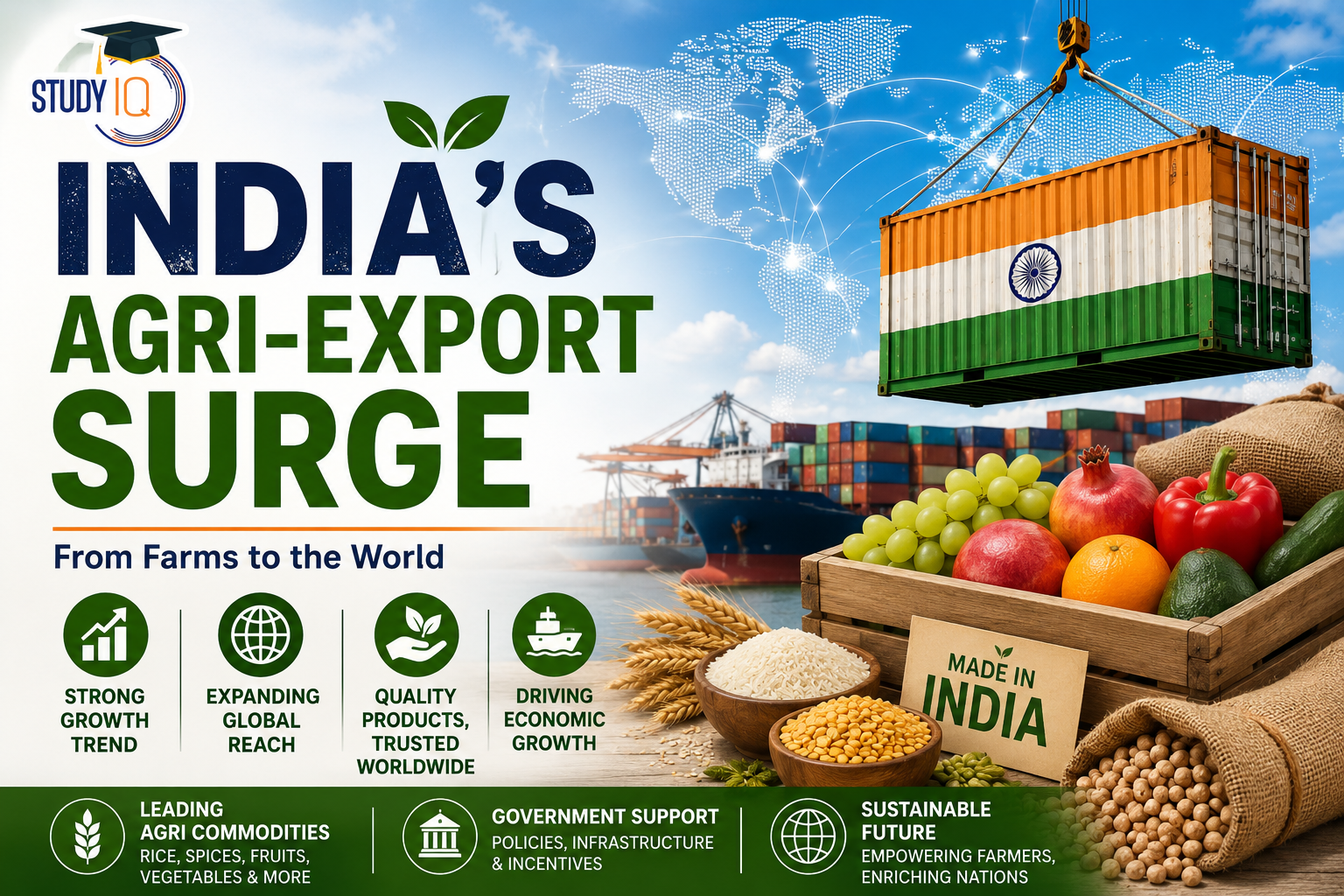
The financial year 2025-26 has emerged as a landmark period for Indian agriculture. Despite the geopolitical and economic headwinds triggered by a more protectionist United States under the Trump administration, India’s farm sector has demonstrated remarkable agility.
Read Also: UPSC Daily Current Affairs 2026
|
Factsheet |
| ● Total Agri-Exports: $53.1 billion (a 2.3% year-on-year increase).
● Growth Benchmark: Agri-exports outpaced India’s overall merchandise export growth (0.9%). ● Market Shifts: Marine exports to the US dropped by $400 million, while exports to China and Vietnam rose by a combined $660 million+. ● Star Performers: ○ Marine Products: $8.4 billion (up 13.9%). ○ Buffalo Meat: $5.1 billion (up 25.6% – a new record). ○ Coffee: $2.0 billion+ (nearly trebled since 2020-21). ● Import Concentration: Vegetable oils remained the top import ($19.5 billion), followed by pulses ($3.6 billion). |
Why did Farm Exports grow despite US Tariffs?
- Aggressive Market Diversification:When the US imposed tariffs (peaking at 50% before settling at 10%), Indian exporters didn’t wait for a policy reversal. Marine exporters pivoted toward Southeast Asia (Vietnam, Thailand) and Europe (Belgium, Italy), effectively neutralizing the “Trump shock.”
- Capitalizing on Global Supply Shocks:India’s coffee exports surged because major competitors like Brazil (Arabica) and Vietnam (Robusta) faced subpar harvests. India stepped in to meet the demand of the European and Russian markets.
- Strategic Demand in Emerging Markets: The buffalo meat industry tapped into high demand from Egypt, Vietnam, and West Asian countries. New markets like Uzbekistan saw a massive jump from $97 million to $307 million in just one year.
- Favorable Commodity Prices:High global prices for specific commodities helped maintain value growth even when quantity growth was modest in certain sectors.
Persistent Challenges
- “Tree Nut” Dependency:India remains heavily reliant on the US for fresh fruit and nut imports (almonds/walnuts), which saw a value increase to $1.4 billion, worsening the trade balance in that specific sub-sector.
- Decline in Traditional Staples: Exports of basmati rice, spices, and processed fruits/vegetables actually declined, suggesting that tariff impacts were felt more heavily in these high-value, branded categories.
- Import Vulnerability:India still lacks self-sufficiency in edible oils and pulses, meeting only 40% of its oil demand domestically. This leaves the economy vulnerable to global price volatility.
- Cotton Crisis:Once a major exporter, India is now seeing an import surge in raw cotton, indicating a potential decline in domestic yield or quality compared to global textile requirements.
Way Ahead: A Roadmap for 2027 and Beyond
- Strengthening Value Chains:Focus on processed agri-products rather than raw commodities to insulate exports from direct tariff shocks on primary goods.
- Expanding the “Look East” Policy:Given the success in China and Vietnam, India should formalize deeper agricultural trade agreements with ASEAN nations to create a permanent buffer against Western protectionism.
- Investing in Edible Oil & Pulses:To reduce the massive $23 billion import bill, a mission-mode approach to domestic oilseed production is critical for “Atmanirbharta” (self-reliance).
- Logistics and Cold Chain Infrastructure:To maintain the record-breaking streak in marine and fresh produce, India must invest in state-of-the-art cold storage at ports to reduce wastage and meet the stringent phytosanitary standards of the EU and Japan.
- Cotton Rejuvenation:Research into high-yielding, pest-resistant cotton varieties is needed to reverse the trend of becoming a net importer of fiber.
|
Read More Notes |
|
| Environment Notes | Art and Culture Notes |
| Science and Tech | History Notes |
| Geography Notes | Indian Polity Notes |
| General Knowledge | International Relation |
|
Explore StudyIQ Courses |
|
 UAPA Act 1967: Key Provisions, Supreme C...
 Sarus Crane: Habitat, Features, Conserva...














 WhatsApp





