Table of Contents
Context
Prime Minister Narendra Modi has called on citizens to adopt austerity measures, urging them to cut back on gold purchases, foreign travel, and petroleum consumption.
Read Also: UPSC Daily Current Affairs 2026
Measures Suggested
- Use public transport: Increase use of metros, buses and other public systems to reduce petrol and diesel consumption.
- Switch to electric vehicles: Adopt EVs to reduce dependence on imported petroleum and the foreign currency spent on it.
- Revive work-from-home: Bring back Covid-era WFH arrangements to cut fuel demand and ease pressure on forex reserves.
- Avoid foreign travel: Curtail non-essential international trips to reduce outward remittances and dollar outflows.
- Pause gold purchases: Avoid buying gold for at least one year to reduce the import bill and dollar outflows.
- Prioritise local goods: Choose domestically made products over imports to reduce demand for foreign currency.
Rationale behind the measures
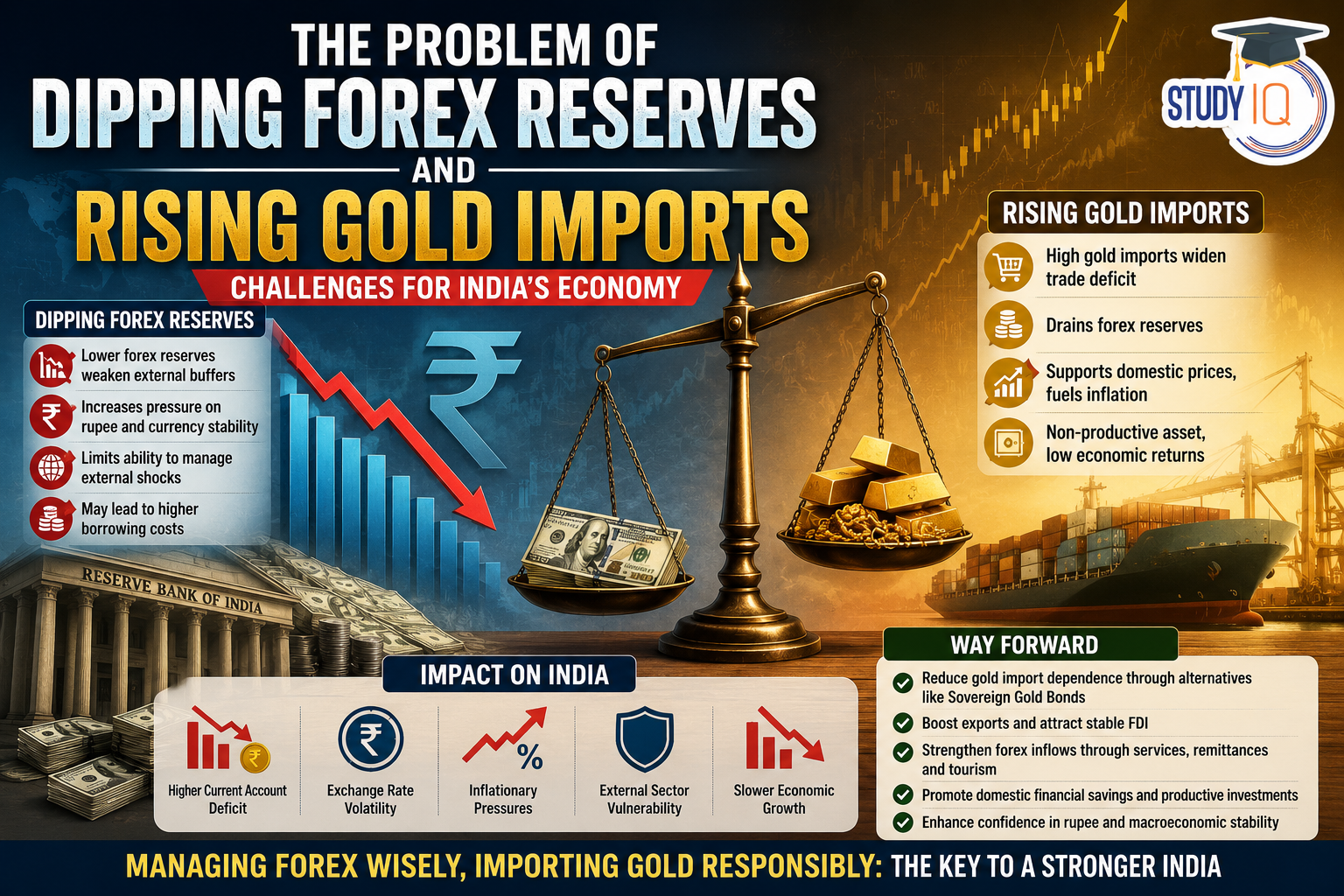
- Forex reserves under stress: India’s foreign exchange reserves have declined to nearly $691 billion. FII withdrawals of around ₹1.97 lakh crore between January and May 2026, combined with the rupee crossing 95 to the dollar, have intensified pressure on the external sector.
- Gold: a pure dollar drain: The annual gold import bill reached $72 billion in 2025-26, nearly double the $35 billion of 2022-23.
- Every household purchase sends dollars out of the economy, widens the current account deficit, and weakens the rupee making the next gold purchase even more expensive in rupees.
- Current Account Deficit: According to RBI data cited in the report, India’s CAD widened to $13.2 billion, equivalent to 1.3% of GDP, during the December quarter of 2025.
- Oil: 89% import dependency: India imports 89% of its crude oil, and prices have surged from around $70 per barrel a year ago to over $113 now.
|
Why India Demands So Much Gold |
| India is one of the world’s largest consumers of gold, second only to China. Unlike most commodities, gold demand in India is not purely financial — it is deeply embedded in social, religious and cultural life, making it uniquely difficult to suppress through policy appeals alone.
● Cultural importance: Gold is a symbol of prosperity, status and auspiciousness across communities. Gifting gold is a social obligation at major life events. ● Religious significance: Gold is integral to religious rituals, temple offerings and festivals like Dhanteras and Akshaya Tritiya, which drive seasonal demand spikes. ● Investment value: Gold is seen as a safe-haven asset and inflation hedge, especially in rural households with limited access to formal financial instruments. |
Economic impact of the Measures
- Reduced current account deficit: A narrower CAD reduces pressure on forex reserves and stabilises the rupee.
- Rupee stabilisation: Reduced dollar outflows from gold and petroleum imports would ease dollar demand in the market, helping arrest the rupee’s slide beyond the 95 mark and break the vicious cycle where a weak rupee makes imports costlier, further weakening the rupee.
- Forex reserve conservation: A combination of reduced gold imports, lower foreign travel, and higher use of local goods would collectively slow the drawdown of India’s $691 billion reserves.
- Inflationary spillover from fuel prices: Regardless of consumption behaviour, a petrol and diesel price hike is widely expected. Since most freight in India runs on diesel, any revision will feed into grocery, transport and everyday goods prices within days
Way forward
- Gold Monetisation Scheme: Industry experts have suggested strengthening the Gold Monetisation Scheme (GMS) to reduce dependence on imported gold. The scheme aims to mobilise idle household gold and channel it into the formal economy.
- Travel Deficit: Invest in inbound tourism infrastructure such as airports, heritage sites, and hospitality capacity need urgent upgrades.
- Electric Vehicles: Mandate government EV fleet transition.
- FII Outflows: Deepen sovereign bond markets make Indian securities accessible to long-term foreign capital.
 UAPA Act 1967: Key Provisions, Supreme C...
 Sarus Crane: Habitat, Features, Conserva...














 WhatsApp