
Table of Contents
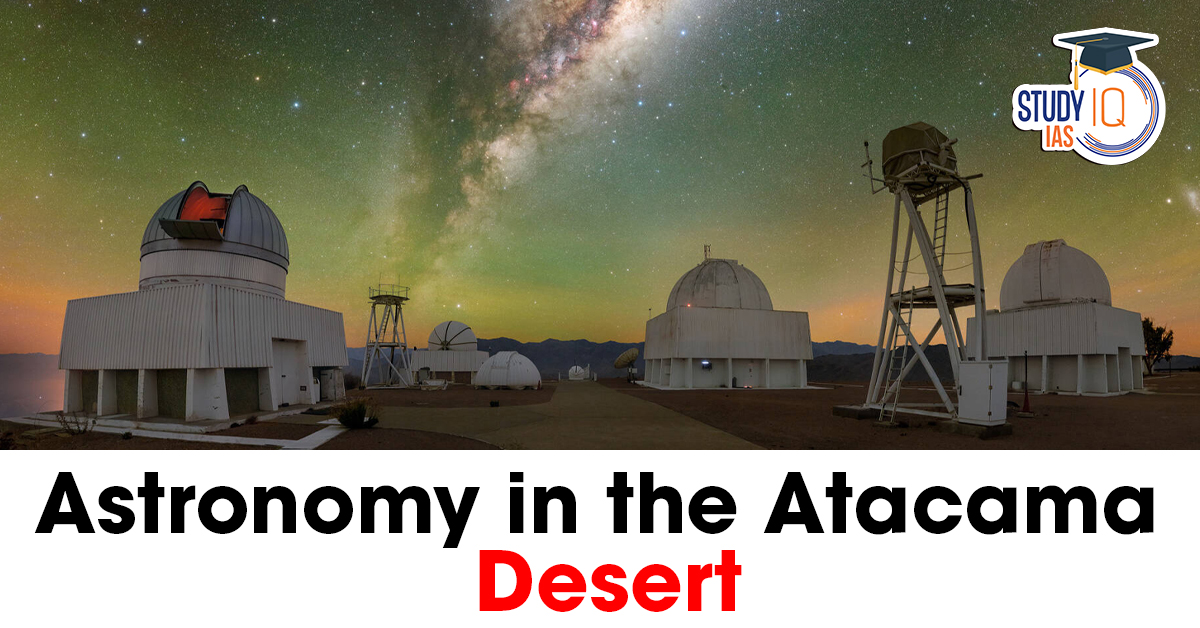
Context: While the Atacama Desert remains the premier global hub for deep-space observation, increasing industrial development and light pollution are forcing a re-evaluation of environmental laws to protect “dark sky” corridors.
Key Facts
- Dark Sky Reserve: An area kept free of artificial light pollution.
- Paranal Observatory: Operated by the European Southern Observatory (ESO), it is one of the most advanced optical facilities on the planet.
- Extremely Large Telescope (ELT): A $1.5 billion project scheduled for 2030. It will feature 798 mirrors and be 15 times sharper than the Hubble Space Telescope, allowing for unprecedented light-gathering capability.
Leading Observatories in India
- India’s first Dark Sky Reserve is located at Hanle, Ladakh, within the Changthang Wildlife Sanctuary.
- ARIES: Located in Nainital, home to the 3.6m Devasthal Optical Telescope (DOT), India’s largest.
About Atacama Desert
- Located in northern Chile between the Andes Mountains and the Chilean Coast Range,
- Globally recognized as the driest non-polar place on Earth.
- Despite its proximity to the equator, it is a cold desert. Average temperatures range from 0°C to 25°C, and it lacks the scorching heat typical of the Sahara.
- The Atacama is part of the “Lithium Triangle” (along with Bolivia and Argentina), containing some of the world’s largest reserves of lithium
- It houses major projects like the ALMA (Atacama Large Millimeter/submillimeter Array) and the upcoming Extremely Large Telescope (ELT)
| Light Pollution |
|

 Skyroot Vikram-1 Mission Aagaman: India'...
 Oor Pare Prehistoric Site: Location, Roc...
 Assam Election 2026: Exit Poll, Result D...













 WhatsApp





