Table of Contents
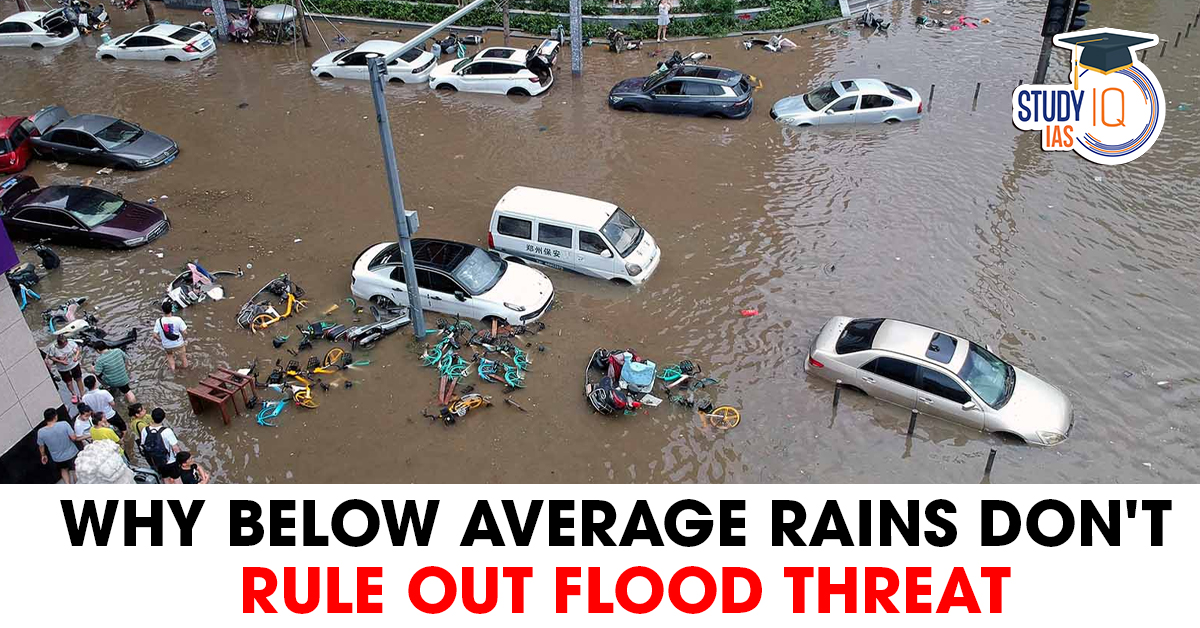
Context: While the IMD has forecast 92% of normal monsoon rainfall, new climate patterns reveal that overall below-average rains do not eliminate the high risk of devastating localised flooding due to an increase in extreme rainfall events.
Rising Trend of Extreme Heavy Rainfall
- Defining Extreme Events: The IMD classifies any rainfall exceeding 21 cm within a 24-hour period as “extremely heavy rainfall.”
- Consistently High Frequency: Historically, such events were rare, accounting for less than 0.1% of total incidents.
- However, IMD’s Annual Monsoon Reports show a consistent rise. For over a decade, India has averaged one major rainfall-induced disaster per year.
- Key Statistics from Image: The frequency has consistently exceeded 100 events per year since 2017, with 160 extremely heavy rainfall events recorded as recently as 2025.
Major Historical Triggers
- 2013 Kedarnath Tragedy: Sparked the decade-long rising trend.
- 2015 Chennai Floods: Highlighted urban vulnerability.
- 2018 Kerala Floods: Exceptional rainfall, the maximum since 1931.
Challenges in Prediction and Forecasting
- High Uncertainty in Granularity: Increased computational capabilities and a denser observation network are improving broad forecasts.
- However, identifying exactly where 250 mm vs. 500 mm will fall within a small radius is extremely difficult to achieve with certainty.
- Intra-Seasonal Volatility: The forecast of overall normal or below-normal rain does not capture the intra-seasonal and regional variations, which are the main drivers of catastrophic localised events.
Urban Flooding: A Governance-Driven Crisis
- Shift in Policy Focus: From drought management to handling localised extreme rainfall events.
- Urban Vulnerability: Cities like Delhi, Mumbai, and Bengaluru are increasingly disaster-prone.
- Rising Fiscal Burden: The Sixteenth Finance Commission noted floods accounted for 58% of state disaster expenditure (2019–24).
- Governance Failure: Urban flooding is largely a result of poor planning rather than purely natural causes.
- Encroachment Issues: Floodplains and drainage channels are obstructed by unregulated development.

 Skyroot Vikram-1 Mission Aagaman: India'...
 Oor Pare Prehistoric Site: Location, Roc...
 Assam Election 2026: Exit Poll, Result D...














 WhatsApp