Table of Contents
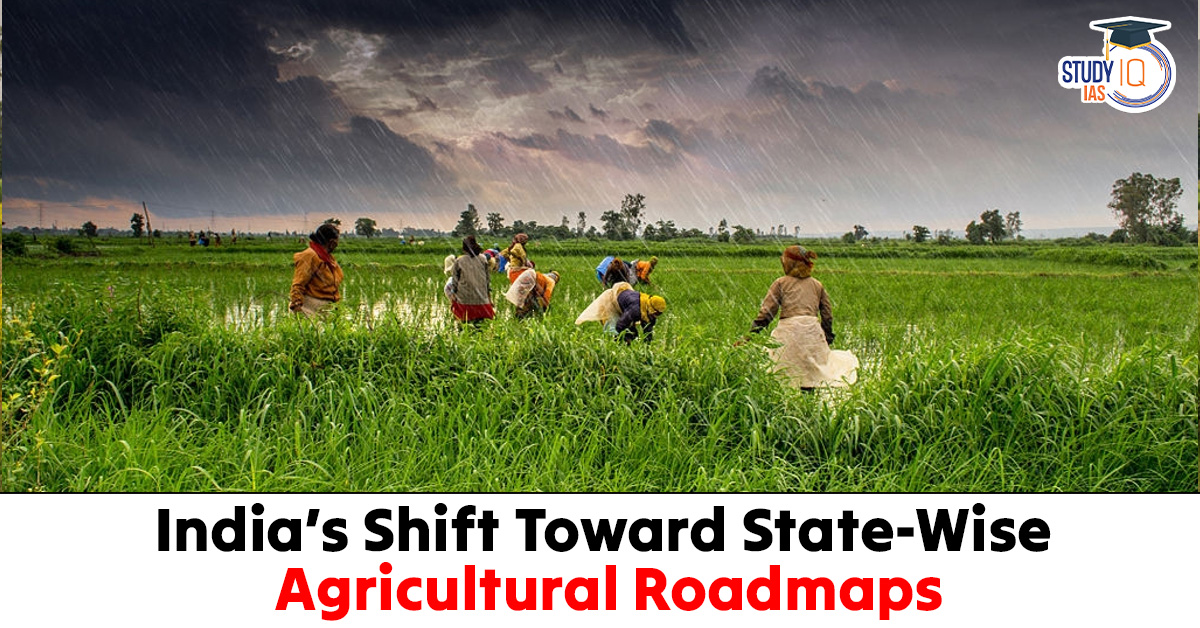
Context: India is shifting from a one-size-fits-all agricultural policy to state-wise agricultural roadmaps to improve regional productivity, climate resilience, and implementation.
| Significance of India’s Agriculture Sector |
|
Need for State-Specific Interventions
- Agro-Climatic Diversity: India’s 15 agro-climatic zones vary in soils and rainfall, making uniform cropping strategies unviable.
- Resource Disparity: Different regional resource pressures require tailored interventions; Punjab faces groundwater depletion, Assam faces floods, and Vidarbha faces droughts.
- Climate Vulnerability: Local extremes require region-specific resilient seeds and micro-irrigation systems for erratic monsoons and heatwaves.
- Market Alignment: State roadmaps better address local infrastructure needs like Andhra Pradesh’s cold storage and Goa’s cashew processing units.
Key Features of the New Roadmap
- Customised Strategies: States can now develop local farm strategies around crop diversification, resource availability, and market demand.
- Team Approach: The Centre provides funding and scientific experts from ICAR, while the states lead ground-level implementation.
- Financial Flexibility: States can now choose priorities from a menu of schemes, such as fencing or drip irrigation, according to local needs.
- Tech Integration: Centre deploys Farmer IDs for transparent loans and subsidies, while Bharat-VISTAAR offers real-time weather and crop advisories.
Key Challenges of State-Specific Interventions
- Data Gaps: Weak district-level real-time data and digital divides limit the effectiveness of AI-driven advisory tools like Bharat-VISTAAR.
- Operational Deficits: Bureaucratic delays, fragmented land holdings, and poor last-mile delivery diminish the impact of state-level policy.
- Farmer Reluctance: Farmers hesitate to grow high-value crops due to price volatility and limited local cold storage infrastructure.
- Capacity Constraints: Gram Panchayats often lack the technical capacity to effectively manage decentralised budgets and advisory systems.
| Key State Initiatives & Regional Roadmaps |
|

 Circular Economy in India: Benefits, Cha...
 India Forex Reserve 2026: Record $785.7 ...
 Index of Service Production (ISP): Need,...














 WhatsApp