

Table of Contents
Context: Enforcement Directorate has intensified action in West Bengal, conducting raids, seizures, and issuing summons in multiple money laundering and corruption cases in the run-up to the State Assembly elections.
Enforcement Directorate (ED)
The Enforcement Directorate (ED) is a key investigative agency in India responsible for probing money laundering and foreign exchange violations. Over the years, its mandate has expanded to tackling a broader range of economic offences and safeguarding financial integrity. However, the agency has drawn criticism for the extensive scope of its powers and the potential for misuse, underlining the urgent need for reforms to ensure investigations are both fair and accountable.
- The Enforcement Directorate was founded on May 1st, 1956, and is based in New Delhi. It is also known as ED, a law enforcement organisation tasked with enforcing economic laws and combating economic crime in India, such as money laundering and foreign exchange irregularities.
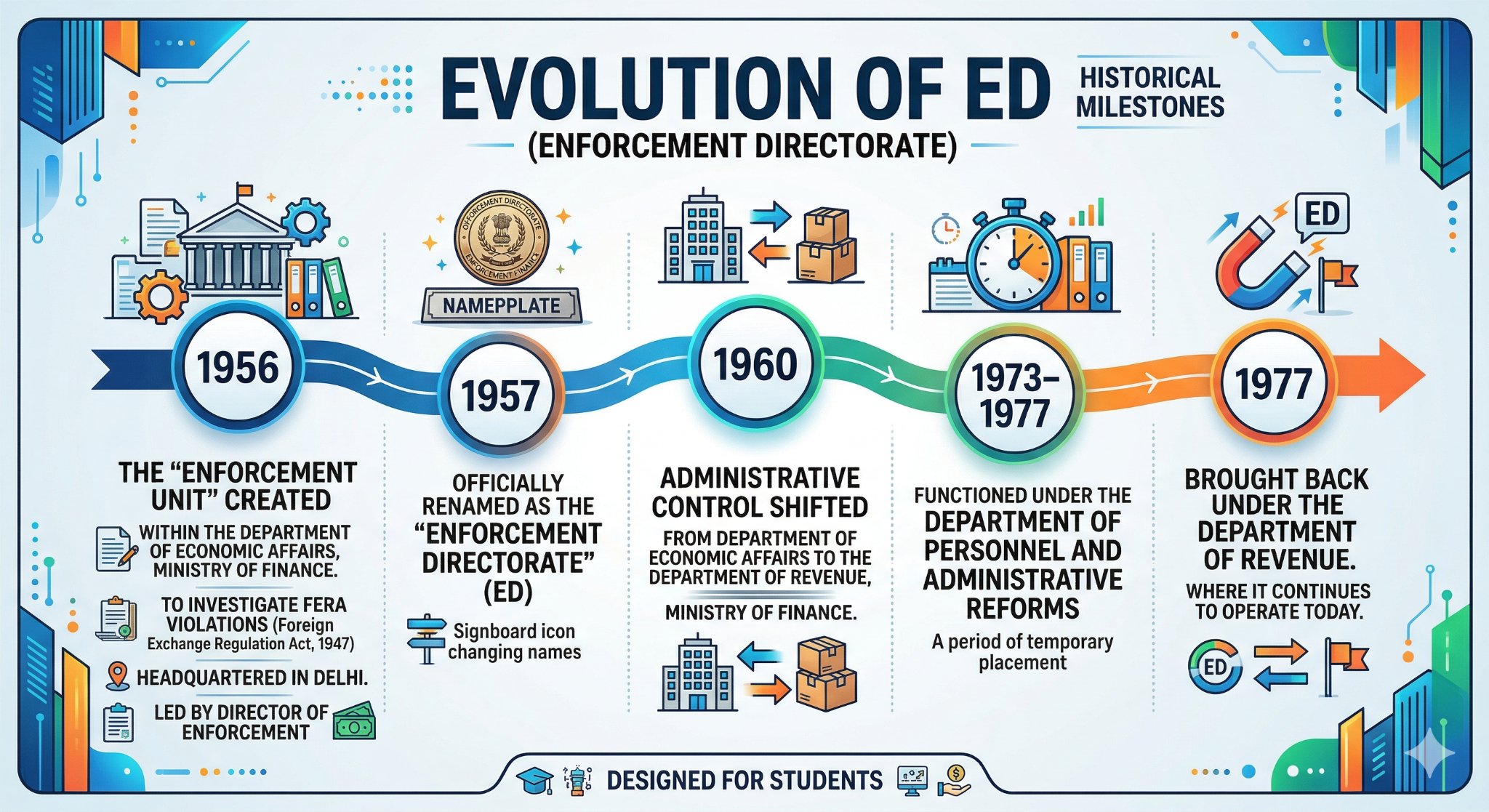
Key Facts About Enforcement Directorate (ED)
| Title | Description |
| Purpose | For handling the exchange control law violation under the Foreign Exchange Regulation Act of 1947. |
| Department |
|
| Headquarters | New Delhi, India |
| Head | The Director of Enforcement is an Indian Revenue Service officer. |
| Regional offices | Chandigarh, Kolkata, Chennai, and Mumbai. |
Objectives of ED
The primary goal of the ED is to uphold the provisions of the following two special fiscal laws:
- Foreign Exchange Management Act of 1999 (FEMA)
- Prevention of Money Laundering Act, 2002 (PMLA)
Check here: FERA and FEMA
Composition and Structure of the ED
The Enforcement Directorate is structured with a hierarchy of officials to ensure smooth and efficient functioning.
Key positions include
- Director of Enforcement (ED)
- Special Directors
- Joint Directors
- Deputy Directors
- Other investigative and administrative officers
Recruitment of ED Officials
The ED recruits officers through two main channels:
- Direct recruitment
- Deputation from other government services, particularly:
- Indian Revenue Service (IRS)
- Indian Police Service (IPS)
Indian Administrative Service (IAS)
Director of Enforcement Directorate
- The Director is the head of the ED and is responsible for overall administration, supervision, and strategic direction of the agency.
Appointment of the Director
- The appointment is governed by the Central Vigilance Commission Act, 2003 (CVC Act)
- The Central Government appoints the Director based on the recommendation of a high-level committee comprising:
- Central Vigilance Commissioner (CVC)
- Vigilance Commissioners
- Secretaries from the Ministries of Home Affairs, Personnel, and Finance
- Under the CVC Act, 2003, the Director has a fixed tenure of 2 years.
Key Functions of ED
- Enforcement of Laws: Implements the provisions of key financial legislations, including the Foreign Exchange Management Act (FEMA), the Prevention of Money Laundering Act (PMLA), and the Fugitive Economic Offenders Act (FEOA)
- Investigation of Financial Offences: Conducts investigations into a range of economic crimes, such as money laundering, foreign exchange violations, and banking frauds.
- Exercise of Investigative Powers: Has the authority to arrest individuals, conduct searches and seizures, and summon documents and individuals for questioning during the course of its investigations.
- Inter-agency Coordination: Collaborates with other enforcement and regulatory bodies, including the Central Bureau of Investigation (CBI), Income Tax Department, and Customs Department, to address complex economic offences.
Statutory functions of ED
Prevention of Money Laundering Act, 2002 (PMLA)
- A criminal statute aimed at curbing money laundering and enabling the confiscation of assets derived from such activities.
- The ED is entrusted with investigating the origin and movement of illicit assets.
- Provisionally attaching properties linked to the proceeds of crime
- Assisting in the prosecution of offenders and facilitating confiscation of assets through designated Special Courts.
Foreign Exchange Management Act, 1999 (FEMA)
- A civil law enacted to regulate foreign exchange transactions, facilitate external trade and payments, and promote a stable foreign exchange market.
- The ED’s responsibilities under FEMA include:
- Investigating suspected violations of foreign exchange rules.
- Conducting adjudication proceedings.
- Imposing penalties on individuals or entities found guilty of contravention.
Fugitive Economic Offenders Act, 2018 (FEOA)
- Enacted to prevent economic offenders from evading legal proceedings by remaining outside Indian jurisdiction.
- Under the Fugitive Economic Offenders Act, 2018 (FEOA), the ED is empowered to:
- Identify and attach properties of declared Fugitive Economic Offenders (FEOs).
- Facilitate the confiscation of such assets and ensure they are transferred to the Central Government.
ED’s Power to Arrest
The Prevention of Money Laundering Act (PMLA) gives the ED the authority to detain those who are accused of committing economic crimes. The ED has the authority to conduct searches and seizures of assets and real estate that have been obtained unlawfully. Individuals and organizations whose bank accounts are suspected of being used for money laundering or other economic crimes may have their accounts frozen by the Enforcement Directorate. Properties and assets that were acquired illegally may be seized by the ED.
Generally speaking, the Enforcement Directorate agency is essential to upholding law and order in India’s financial system and safeguarding the rights of the populace.
Key Legal Provisions and Interpretations
- Section 19 of PMLA: Allows an ED officer to arrest a person if there is “reason to believe” that they are guilty of an offence under the Act.
- The SC expressed doubts about the ED’s broad interpretation of “reason to believe,” viewing it as subjective.
- Court’s Clarification: The phrase “material in possession” vs “evidence in possession” was debated.
- The SC asserted that an arrest should be based on admissible evidence and not on inadmissible evidence.
Rigid and Restrictive Arrest Powers
- High Bar for Bail: Given the stringent bail conditions under PMLA, the Court stated that the power to arrest must be rigid and restrictive.
- Purpose of Arrest: The power to arrest under Section 19(1) should not be used for investigation purposes.
- An arrest should occur only when sufficient material enables the officer to form a written opinion of the arrestee’s guilt.
- Safeguards Against Pre-Trial Arrest: The language of Section 19(1) provides stringent safeguards against pre-trial arrests during pending investigations.
- Charge vs. Arrest:
- The Court differentiated between framing charges and arresting individuals.
- An individual can face charges and a trial even while on bail.
Enforcement Directorate Jurisdiction
- Either FEMA or PMLA provide coverage for all of India. Therefore, any person to whom this Act applies may be subject to action by the ED. Cases involving FEMA might be heard in civil court, but those involving PMLA would be heard in criminal court.
- The agency has authority over anyone who commits a crime, whether they are a person or a business. All public personnel who participate in a money laundering offence fall under the authority of the agency.
- ED is unable to make decisions on his own. One must first submit a complaint to any other agency or the police before ED looks into the situation and identifies the culprit.
- The ED will investigate the matter, seize any alleged offender’s property, make an arrest, and start legal proceedings for breaking the PMLA and FEMA acts. The matter will be resolved by adjudication by a court under the PMLA.
Enforcement Directorate Special Court
In cooperation with the Chief Justice of the High Court, the Central Government appoints one or more Sessions Courts as Special Courts to hear cases involving crimes punishable under Section 4 of the PMLA. The Central Government shall, by notification, establish an Appellate Tribunal to hear appeals from decisions of the Adjudicating Authority and the authorities under this Act.
Within sixty days of the day the judgement or order was notified to him, anyone who feels wronged by an Appellate Tribunal decision or order may file an appeal with the High Court. With the proviso that, if it decides that the appellant was prevented from doing so for a valid reason, the High Court may grant an extension of time to submit the appeal of no more than sixty days. The Special Court is also known as the PMLA Court.
Associated Challenges
- Scope and Overreach: The ED has been accused of stretching its jurisdiction to cover ordinary crimes beyond its legal mandate.
- Impact: This dilutes the agency’s core function and raises concerns over the arbitrary use of power.
- Lack of Transparency in Investigations: The Enforcement Case Information Report (ECIR) is treated as an internal document, with little public disclosure or clarity on how cases are chosen.
- Impact: Erodes trust in the investigative process and raises questions about fairness.
- Alleged Political Misuse: The ED is often accused of being used as a tool to target political opponents under the pretext of financial scrutiny.
- Impact: Undermines the agency’s neutrality and damages public confidence.
- Harsh Penalties for False Complaints: High penalties for filing false or frivolous complaints, particularly against public servants.
- Impact: Discourages even genuine complainants from coming forward due to fear of retaliation.
- Ban on Anonymous Complaints: Only formally identified complaints are allowed.
- Impact: Limits whistleblowing and inhibits reporting of sensitive issues like corruption.
- Lack of Transparency in Handling Complaints Against the PM: The process for investigating complaints against the Prime Minister lacks public transparency.
- Impact: Raises concerns about accountability at the highest levels of government,
- No Suo Motu Powers: The ED cannot initiate investigations on its own without an external complaint or referral.
- Procedural Formalism in Complaint Filing: A greater focus on the technicalities of complaint filing rather than the substance of the issue.
- Impact: Creates barriers for complainants and diverts attention from addressing the core problems.
Criticism of the Enforcement Directorate
The Supreme Court (SC) is looking into claims that the government and the Enforcement Directorate frequently violated the PMLA. The main accusations are that even “common” crimes are investigated by the PMLA, and real victims’ assets have been taken.
In particular, as it relates to the trafficking of illegal substances, the PMLA was a comprehensive penal code created to address the possibility of money laundering. The list of crimes currently covered by the Act’s schedule is extraordinarily broad and, in some cases, has nothing to do with organized crime or drugs.
Way Forward
- Enhance Clarity and Transparency: Introduce clear, standardised guidelines for case selection and investigation procedures.
- Uphold Due Process: Ensuring fairness and procedural integrity in investigations is essential. Accused individuals should be granted access to the Enforcement Case Information Report (ECIR) or equivalent documentation to enable a fair defense and promote an equitable legal process.
- Establish Independent Oversight: To address concerns about political misuse or overreach, an independent oversight body should be created or strengthened.
- Focus on Training and Ethical Conduct: Regular training and capacity-building for ED personnel are vital to promote a multidisciplinary and legally sound approach.
- Promote Data Transparency and Public Reporting: Publishing comprehensive data and performance metrics – including case numbers, conviction rates, asset recoveries, and investigation timelines would significantly improve transparency and allow public scrutiny of the agency’s effectiveness.

 Anti-Defection Law: Origin, Provisions o...
 Central Information Commission (CIC): Ap...
 Panchayati Raj Institutions (PRI): Evolu...














 WhatsApp





