Table of Contents
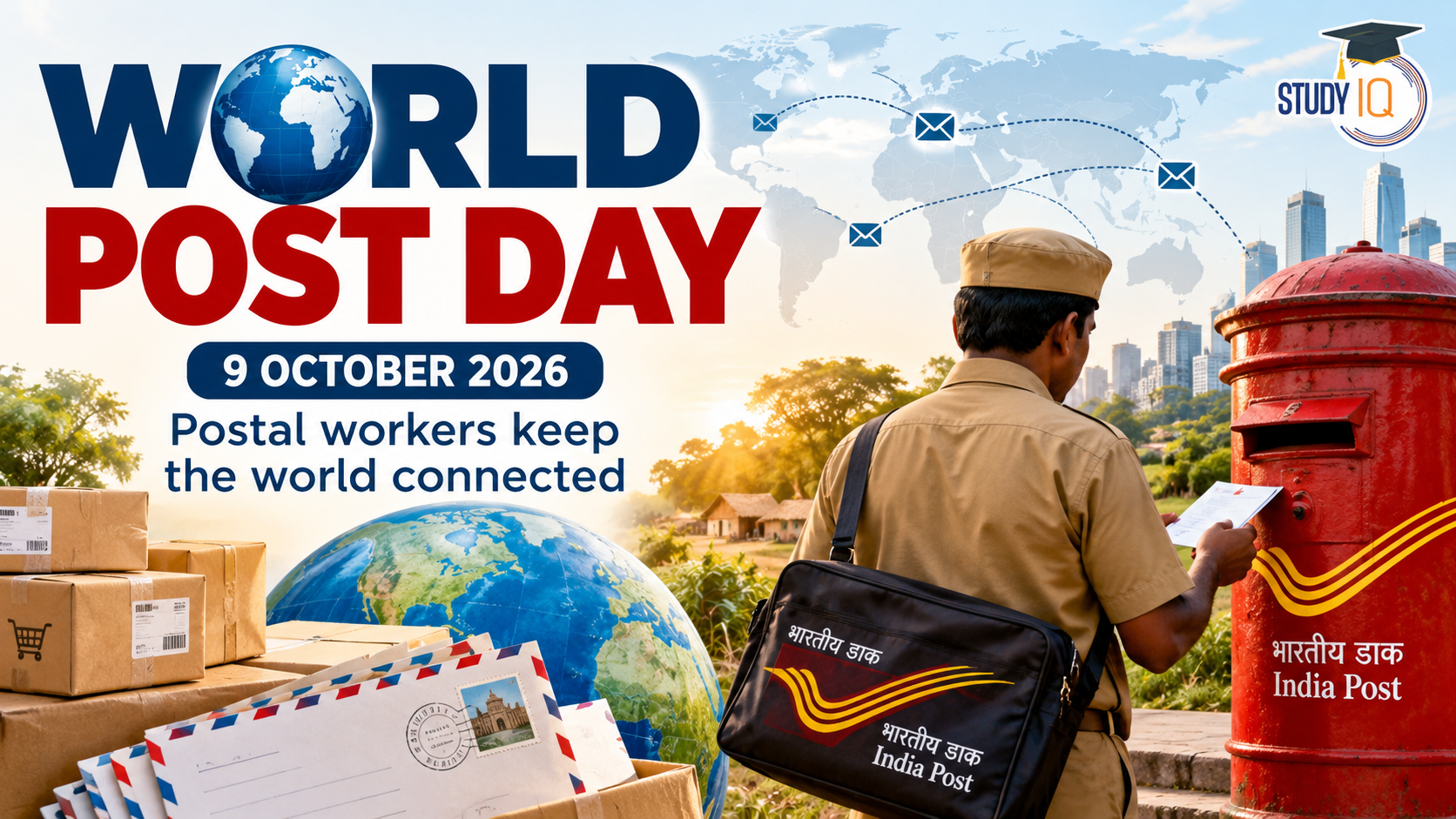
World Post Day 2026 is observed on October 9 to recognise the contribution of postal services and millions of postal workers in connecting people, communities and economies. The day highlights the importance of accessible postal networks in communication, e-commerce, financial inclusion and public service delivery.
In India, the occasion is particularly significant because India Post connects urban centres, villages, remote regions and underserved communities through one of the country’s most extensive public service networks.
World Post Day 2026: Key Highlights
- Date: October 9, 2026
- Established by: Universal Postal Union (UPU) member countries designated the observance in 1969.
- Historical significance: Commemorates the establishment of the UPU on October 9, 1874.
- UPU headquarters: Bern, Switzerland.
- Global significance: Promotes awareness of the role of postal services in social and economic development.
- Indian institution: Department of Posts, Ministry of Communications.
- Related observance in India: National Postal Week, traditionally celebrated around World Post Day.
What Is World Post Day?
World Post Day is an annual international observance that recognises the importance of postal services in facilitating communication, trade and social development. It commemorates the establishment of the Universal Postal Union through the Treaty of Bern on October 9, 1874.
The UPU became a specialised agency of the United Nations in 1948. It works to improve international postal cooperation and facilitate the exchange of mail across national boundaries.
World Post Day also highlights the need to modernise postal networks as digital communication, online shopping and private logistics companies transform the traditional postal industry.
Theme of World Post Day 2026
The UNI Global Union article published on October 8, 2026, carries the headline “Postal workers keep the world connected.” It emphasises the contribution of postal workers and the need to build accessible, financially sustainable and inclusive postal services.
This headline should not automatically be treated as the official UPU theme for 2026. The official theme should be confirmed through the UPU’s World Post Day announcement.
Why Is World Post Day Important?
1. Connecting People and Communities
Postal services remain essential for delivering letters, official documents, parcels and other items. They are particularly important in rural and remote areas where private delivery services may have limited coverage.
2. Supporting E-Commerce and Trade
The expansion of online shopping has increased demand for parcel delivery, warehousing, tracking and reverse logistics. Postal networks can support small businesses, artisans and local entrepreneurs by connecting them with national and international markets.
3. Promoting Financial Inclusion
Postal networks can provide access to savings, payment services and other financial facilities, especially for people who face barriers to accessing conventional banking infrastructure.
4. Creating Employment
Postal systems employ workers across sorting centres, delivery networks, customer service operations and logistics facilities. Their modernisation must also address job security, working conditions and workforce training.
5. Advancing Sustainable Development
Postal networks can contribute to sustainability through electric delivery vehicles, efficient logistics, recycling initiatives and the collection of discarded electronic equipment.
India’s Postal Network: Why It Matters
India Post, operating under the Department of Posts, Ministry of Communications, is a critical component of India’s public service infrastructure. Its importance extends beyond conventional mail delivery.
Major Contributions of India Post
-
Rural connectivity: Facilitates access to postal services in villages and geographically remote regions.
-
Financial inclusion: Provides Post Office Savings Schemes and other small-savings facilities.
-
Digital financial services: India Post Payments Bank supports banking access through its digital and assisted-service model.
-
Government service delivery: Supports the delivery of official communications and access to selected government services.
-
E-commerce logistics: Provides parcel and delivery services that can help businesses reach customers across India.
-
Social security: Postal and banking infrastructure can facilitate access to eligible beneficiaries of welfare and pension-related services.
India Post is especially important for senior citizens, small depositors, rural households and people who may have limited access to conventional banking or commercial logistics services.
India Post and Financial Inclusion
Financial inclusion is one of the most important dimensions of India’s postal network.
Post offices provide access to savings products and other financial services, helping households save money and access formal financial infrastructure. India Post Payments Bank further extends banking access through services designed to reach customers beyond conventional bank branches.
Postal infrastructure can complement initiatives such as the Pradhan Mantri Jan Dhan Yojana by improving last-mile access to financial services. However, post offices and India Post Payments Bank have distinct institutional roles and should not be treated as identical systems.
Challenges Facing Postal Services in the Digital Era
Despite their importance, postal networks face several structural challenges.
Declining letter volumes: Email, messaging applications and digital documents have reduced demand for traditional letter mail.
Competition from private logistics companies: Private operators have expanded their presence in e-commerce deliveries and express parcel services.
Financial sustainability: Maintaining affordable services in remote areas can be expensive, requiring efficient operations and sustainable funding models.
Technological transformation: Postal organisations need modern tracking systems, automated sorting, digital customer services and improved logistics infrastructure.
Employment concerns: Modernisation must balance operational efficiency with fair wages, worker protections and collective bargaining.
Global Initiatives to Modernise Postal Services
The UNI Global Union article highlights several initiatives aimed at expanding the role of postal networks.
-
Bangladesh: A pilot project allows people to deposit discarded mobile phones and IT equipment at local post offices for collection, recycling and refurbishment.
-
Canada: Postal workers have proposed community-oriented services, affordable banking and electric delivery fleets.
-
Europe: The Save Our Post campaign advocates stronger universal postal services and greater responsibility for private e-commerce operators that rely on public postal infrastructure.
These initiatives illustrate how postal networks can evolve into broader platforms for logistics, environmental action and community services.
Way Forward for India Post
India can strengthen its postal infrastructure through the following measures:
-
Digital transformation: Expand real-time parcel tracking, digital customer interfaces and automated sorting systems.
-
Logistics modernisation: Improve last-mile delivery, warehousing and e-commerce integration.
-
Financial inclusion: Strengthen access to savings, payments and assisted digital financial services.
-
Green postal services: Adopt electric vehicles and energy-efficient infrastructure where operationally viable.
-
Circular economy: Explore collection points for e-waste, repairable electronics and recyclable materials in partnership with authorised recyclers.
-
Worker welfare: Provide reskilling opportunities and protect decent working conditions during technological transformation.
Universal service: Preserve affordable access to essential postal services, including in remote and commercially underserved areas.

 Nobel Prize in Literature 2026: Anne Car...
 BPSC 72nd CCE Prelims 2026 Postponed: Ne...
 Daily Mains Articles 2026 – Updated Da...














 WhatsApp