Table of Contents
Wildlife Sanctuaries in India are specially declared zones to preserve wild animals, plants, and their natural habitats. They ensure that biodiversity prospers without too much human intervention. As of 2026, there are 573 Wildlife Sanctuaries in India, which comprise 1,23,762.56 sq. km, which is close to 3.76% of the total area of the country.
Wildlife Sanctuaries are very relevant for UPSC aspirants in terms of Environment & Ecology, Geography, and Current Events because many questions are often asked in this topic in both the prelims and mains exams.
What is a Wildlife Sanctuary?
A Wildlife Sanctuary is a protected area notified by the State Government under the Wildlife (Protection) Act, 1972, where wildlife and their habitats are safeguarded.
Human activities like hunting, poaching, tree felling, and exploitation of forest resources are strictly regulated or prohibited.
Key points:
- Declared under Section 18 of Wildlife (Protection) Act, 1972
- Managed by State Forest Departments
- Falls under IUCN Category IV
- Limited human activity allowed
- Focus on in-situ conservation
Constitutional & Legal Provisions for Wildlife Sanctuary
-
Article 48A – Directs the State to protect and improve forests and wildlife.
-
Article 51A(g) – Makes it the fundamental duty of every citizen to protect wildlife.
-
Wildlife (Protection) Act, 1972 – Main legislation governing sanctuaries.
-
Chief Wildlife Warden – Overall authority of sanctuary management.
-
Eco-Sensitive Zones (ESZs) may be declared around sanctuaries.
How Many Wildlife Sanctuaries are in India?
As of 2026, there are 573 Wildlife Sanctuaries in India.
They together cover an area of about 1,23,762.56 square kilometres, which is nearly 3.76% of India’s total geographical area. This figure is officially used in most government and exam-oriented sources and is very important for UPSC Prelims. Quick facts for revision:
| Parameter | Data |
|---|---|
| Total Wildlife Sanctuaries | 573 |
| Total Area | 1,23,762.56 sq km |
| % of India’s Area | 3.76% |
| IUCN Category | IV |
| Largest Concentration | Andaman & Nicobar Islands |
| Largest Sanctuary | Kutch Desert Wildlife Sanctuary (Gujarat) |
List of Wildlife Sanctuaries in India 2026
We have provided the updated list of Wildlife Sanctuaries in India in the table below, which includes the state and UT name and area covered:
| S.No | State / UT | No. of Wildlife Sanctuaries | Area (km²) | % of State Area |
|---|---|---|---|---|
| 1 | Andhra Pradesh | 13 | 6,771.40 | 4.23 |
| 2 | Arunachal Pradesh | 13 | 7,614.56 | 9.09 |
| 3 | Assam | 17 | 1,728.95 | 2.20 |
| 4 | Bihar | 12 | 2,851.67 | 3.03 |
| 5 | Chhattisgarh | 11 | 3,760.28 | 2.78 |
| 6 | Goa | 6 | 647.91 | 17.50 |
| 7 | Gujarat | 23 | 16,618.42 | 8.48 |
| 8 | Haryana | 7 | 118.21 | 0.27 |
| 9 | Himachal Pradesh | 28 | 6,115.97 | 10.99 |
| 10 | Jharkhand | 11 | 1,955.82 | 2.45 |
| 11 | Karnataka | 38 | 8,216.69 | 4.28 |
| 12 | Kerala | 18 | 2,156.21 | 5.55 |
| 13 | Madhya Pradesh | 24 | 7,046.19 | 2.29 |
| 14 | Maharashtra | 49 | 7,861.70 | 2.55 |
| 15 | Manipur | 7 | 708.14 | 3.17 |
| 16 | Meghalaya | 4 | 94.11 | 0.42 |
| 17 | Mizoram | 9 | 1,359.75 | 6.45 |
| 18 | Nagaland | 4 | 43.91 | 0.26 |
| 19 | Odisha | 19 | 7,094.65 | 4.56 |
| 20 | Punjab | 13 | 326.60 | 0.65 |
| 21 | Rajasthan | 25 | 5,592.38 | 1.63 |
| 22 | Sikkim | 7 | 399.10 | 5.62 |
| 23 | Tamil Nadu | 33 | 7,096.54 | 5.46 |
| 24 | Telangana | 9 | 5,672.70 | 4.94 |
| 25 | Tripura | 4 | 603.64 | 5.76 |
| 26 | Uttar Pradesh | 26 | 5,822.20 | 2.42 |
| 27 | Uttarakhand | 7 | 2,690.12 | 5.03 |
| 28 | West Bengal | 16 | 1,440.18 | 1.62 |
| 29 | Andaman & Nicobar Islands | 97 | 395.60 | 4.80 |
| 30 | Chandigarh | 2 | 26.01 | 22.82 |
| 31 | Dadra & Nagar Haveli | 1 | 92.17 | 18.77 |
| 32 | Daman & Diu | 1 | 2.19 | 1.96 |
| 33 | Delhi | 1 | 19.61 | 1.32 |
| 34 | Jammu & Kashmir | 14 | 1,815.04 | 1.11 |
| 35 | Ladakh | 2 | 9,000.00 | 15.22 |
| 36 | Lakshadweep | 1 | 0.01 | 0.03 |
| 37 | Puducherry | 1 | 3.90 | 0.81 |
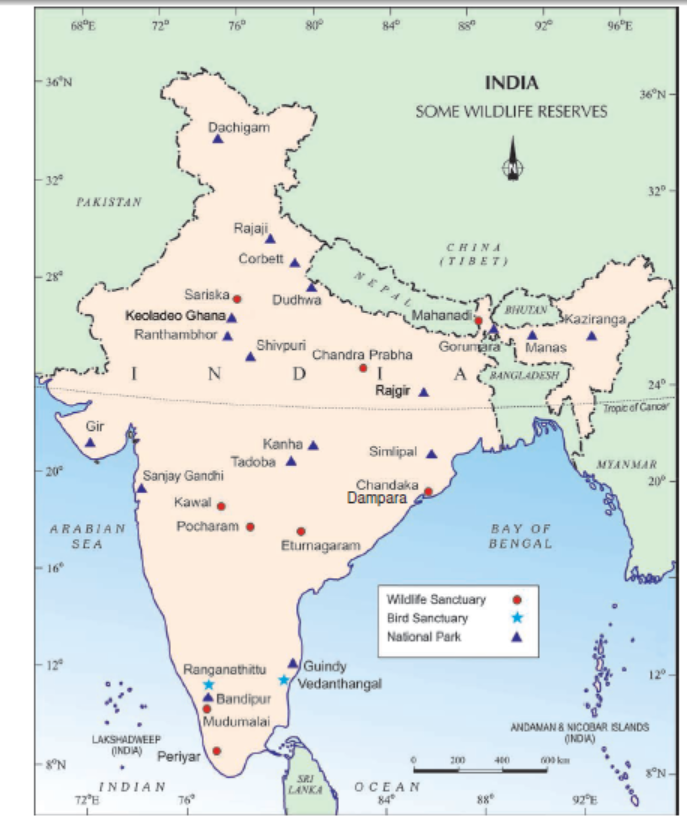
Wildlife Sanctuary in India MAP
10 Largest Wildlife Sanctuaries in India
| Rank | Sanctuary | Area (sq km) | State |
|---|---|---|---|
| 1 | Kutch Desert WLS | 7,506.22 | Gujarat |
| 2 | Indian Wild Ass Sanctuary | 4,954 | Gujarat |
| 3 | Desert National Park | 3,162 | Rajasthan |
| 4 | Nagarjunsagar–Srisailam WLS | 3,568 | Andhra Pradesh |
| 5 | Great Indian Bustard Sanctuary | 1,222 | Maharashtra |
| 6 | Manas WLS | 950 | Assam |
| 7 | Achanakmar WLS | 914.02 | Chhattisgarh |
| 8 | Bhadra WLS | 492.46 | Karnataka |
| 9 | Koyna WLS | 423.55 | Maharashtra |
| 10 | Sundarbans WLS | 362.4 | West Bengal |
10 Smallest Wildlife Sanctuaries in India
The 10 smallest Indian Wildlife Sanctuaries have very little geographical area but play a great importance in the conservation of region-specific flora and fauna. These sanctuaries are extremely vital for the protection of bird species, wetlands, and fragile ecosystems. Their small areas notwithstanding, they are among the great contributors to biodiversity conservation and ecological balance.
| Rank | Sanctuary | Area (sq km) | State |
|---|---|---|---|
| 1 | Kutch Bustard Sanctuary | 2 | Gujarat |
| 2 | Nangal WLS | 3 | Punjab |
| 3 | Mayureshwar WLS | 5.14 | Maharashtra |
| 4 | Mahavir Swami WLS | 5.4 | Uttar Pradesh |
| 5 | Bondla WLS | 7.98 | Goa |
| 6 | Thol WLS | 7 | Gujarat |
| 7 | Chilika (Nalaban) WLS | 15.53 | Odisha |
| 8 | Pobitora WLS | 38.8 | Assam |
| 9 | Bor WLS | 61.1 | Maharashtra |
| 10 | Kinnerasani WLS | 635.4 | Telangana |
Wildlife Sanctuaries vs National Parks (Comparison)
Wildlife Sanctuaries and National Parks are significant protected areas in the context of the Wildlife (Protection) Act, 1972. These two have the same objective to conserve biodiversity, but there is some differences in the extent of human interference and management practices. National Parks receive greater protection, while in Wildlife Sanctuaries, human habitation and rights to the place persist.
| Feature | Wildlife Sanctuary | National Park |
|---|---|---|
| Human Rights | Some allowed | Completely prohibited |
| Boundaries | Flexible | Fixed |
| Grazing | Sometimes allowed | Not allowed |
| Protection Level | High | Very High |
State-wise Wildlife Sanctuaries of India List
Below is the complete List of Wildlife Sanctuaries in India according to the states.
| Wildlife Sanctuaries of India State Wise List | ||
| S No. | States | Wildlife Sanctuaries |
| 1. | Assam | Nambor Wildlife Sanctuary |
| Dihing Patkai Wildlife Sanctuary | ||
| East Karbi Anglong Wildlife Sanctuary | ||
| Chakrashila Wildlife Sanctuary | ||
| Amchang Wildlife Sanctuary | ||
| 2. | Bihar | Kaimur Wildlife Sanctuary |
| Gautam Budha Wildlife Sanctuary | ||
| Pant (Rajgir) Wildlife Sanctuary | ||
| Valmiki Wildlife Sanctuary | ||
| 3. | Chhatisgarh | Bhairamgarh Wildlife Sanctuary |
| Badalkhol Wildlife Sanctuary | ||
| Bhoramdev Wildlife Sanctuary | ||
| Udanti Wild Buffalo Wildlife Sanctuary | ||
| 4. | Goa | Bondla Wildlife Sanctuary |
| Madei Wildlife Sanctuary | ||
| 5. | Gujarat | Kutch Desert Wildlife Sanctuary |
| Porbandar Lake Wildlife Sanctuary | ||
| Jambugodha Wildlife Sanctuary | ||
| Wild Ass Wildlife Sanctuary | ||
| Ratanmahal Wildlife Sanctuary | ||
| Thol Lake Wildlife Sanctuary | ||
| Sasan Gir Sanctuary | ||
| Mitiyala Wildlife Sanctuary | ||
| 6. | Haryana | Bhindawas Wildlife Sanctuary |
| N Khaparwas Wildlife Sanctuary | ||
| Kalesar Wildlife Sanctuary | ||
| 7. | Himachal Pradesh | Bandli Wildlife Sanctuary |
| Daranghati Wildlife Sanctuary | ||
| Dhauladhar Wildlife Sanctuary | ||
| Talra Wildlife Sanctuary | ||
| Pong Dam Lake Wildlife Sanctuary | ||
| Nargu Wildlife Sanctuary | ||
| 9. | Jharkhand | Lawalong Wildlife Sanctuary |
| Parasnath Wildlife Sanctuary | ||
| Palkot Wildlife Sanctuary | ||
| 10. | Karnataka | Someshwara Wildlife Sanctuary |
| Bhadra Wildlife Sanctuary | ||
| Bhimgad Wildlife Sanctuary | ||
| Brahmagiri Wildlife Sanctuary | ||
| Cauvery Wildlife Sanctuary | ||
| Pushpagiri Wildlife Sanctuary | ||
| Sharavathi Valley Wildlife Sanctuary | ||
| 11. | Kerala | Periyar Wildlife Sanctuary |
| Chinnar Wildlife Sanctuary | ||
| Aralam Wildlife Sanctuary | ||
| Chimmony Wildlife Sanctuary | ||
| Idukki Wildlife Sanctuary | ||
| Malabar Wildlife Sanctuary | ||
| 12. | Madhya Pradesh | Bori Wildlife Sanctuary |
| Gandhi Sagar Wildlife Sanctuary | ||
| Ken Gharial Wildlife Sanctuary | ||
| National Chambal Wildlife Sanctuary | ||
| Orcha Wildlife Sanctuary | ||
| 13. | Maharashtra | Koyana Wildlife Sanctuary |
| Painganga Wildlife Sanctuary | ||
| Bhimashankar Wildlife Sanctuary | ||
| Tungareshwar Wildlife Sanctuary | ||
| Great Indian Bustard Wildlife Sanctuary | ||
| 14. | Manipur | Yangoupokpi-Lokchao Wildlife Sanctuary |
| 15. | Meghalaya | — |
| 16. | Mizoram | Dampa Wildlife Sanctuary (TR) |
| Ngengpui Wildlife Sanctuary | ||
| Baghmara Pitcher Plant Wildlife Sanctuary | ||
| 17. | Nagaland | Fakim Wildlife Sanctuary |
| Rangapahar Wildlife Sanctuary | ||
| 18. | Odisha | Baisipalli Wildlife Sanctuary |
| Chilika (Nalaban) Wildlife Sanctuary | ||
| Hadgarh Wildlife Sanctuary | ||
| Satkosia Gorge Wildlife Sanctuary | ||
| 19. | Punjab | Abohar Wildlife Sanctuary |
| Harike Lake Wildlife Sanctuary | ||
| Jhajjar Bacholi Wildlife Sanctuary | ||
| 20. | Rajasthan | Keoladeo Bird Sanctuary |
| Jawahar Sagar Wildlife Sanctuary | ||
| Mount Abu Wildlife Sanctuary | ||
| Ramsagar Wildlife Sanctuary | ||
| Shergarh Wildlife Sanctuary | ||
| 21. | Sikkim | Fambong Lho Wildlife Sanctuary |
| Kitam Wildlife Sanctuary (Bird) | ||
| Maenam Wildlife Sanctuary | ||
| 22. | Tamil Nadu | Indira Gandhi (Annamalai) Wildlife Sanctuary |
| Karaivetti Wildlife Sanctuary | ||
| Pulicat Lake Wildlife Sanctuary | ||
| Vedanthangal Wildlife Sanctuary | ||
| Kalakad Wildlife Sanctuary | ||
| 23. | Tripura | Gumti Wildlife Sanctuary |
| Rowa Wildlife Sanctuary | ||
| Trishna Wildlife Sanctuary | ||
| 24. | Uttarakhand | Askot Musk Deer Wildlife Sanctuary |
| Binsar Wildlife Sanctuary | ||
| Govind Pashu Vihar Wildlife Sanctuary | ||
| Kedarnath Wildlife Sanctuary | ||
| Sonanadi Wildlife Sanctuary | ||
| 25. | Uttar Pradesh | Hastinapur Wildlife Sanctuary |
| Ranipur Wildlife Sanctuary | ||
| Sohagibarwa Wildlife Sanctuary | ||
| Sur Sarovar Wildlife Sanctuary | ||
| Chandraprabha Wildlife Sanctuary | ||
| National Chambal Wildlife Sanctuary | ||
| 26. | West Bengal | Sunderbans Wildlife Sanctuary |
| Chintamani Kar Bird Sanctuary | ||
| Haliday Island Wildlife Sanctuary | ||
| Ballavpur Wildlife Sanctuary | ||
| Lothian Island Wildlife Sanctuary | ||
| Mahananda Wildlife Sanctuary | ||
Union Territories Wildlife Sanctuaries of India List
Here’s the complete list of Wildlife Sanctuaries in the Union Territories of India:
| S No. | UTs | Wildlife Sanctuary |
| 1. | Andaman and Nicobar Islands | Bamboo Island WLS |
| Barren Island WLS | ||
| Chanel Island WLS | ||
| Peacock Island WLS | ||
| Turtle Islands WLS | ||
| 2. | Jammu & Kashmir | Gulmarg WLS |
| Limber WLS | ||
| Nandini WLS | ||
| 3. | Lakshadweep | Pitti WLS (Bird) |
| 4. | Dadra Nagar Haveli and Daman and Diu | Dadra & Nagar Haveli WLS |
| Fudam WLS |
Importance of Wildlife Sanctuaries of India
- To protect endangered species.
- To keep animals in their natural habitats and protect them there.
- To monitor endangered species and help them reproduce and grow in number.
- To provide research opportunities to study these animals and plants.
- To help endangered animals live better lives.
- To understand more about the animals that live there, biologists are allowed to conduct activities and research in wildlife sanctuaries.
- A few sanctuaries take in injured and abandoned animals, heal them, and then release them back into the wild.
- Animal refuges safeguard threatened animals and shield them from predators and people.

 India Forex Reserve 2026: Record $785.7 ...
 Great Indian Bustard (GIB): Features, Th...
 Seshachalam Forest: Topography, Vegetati...














 WhatsApp