
Table of Contents
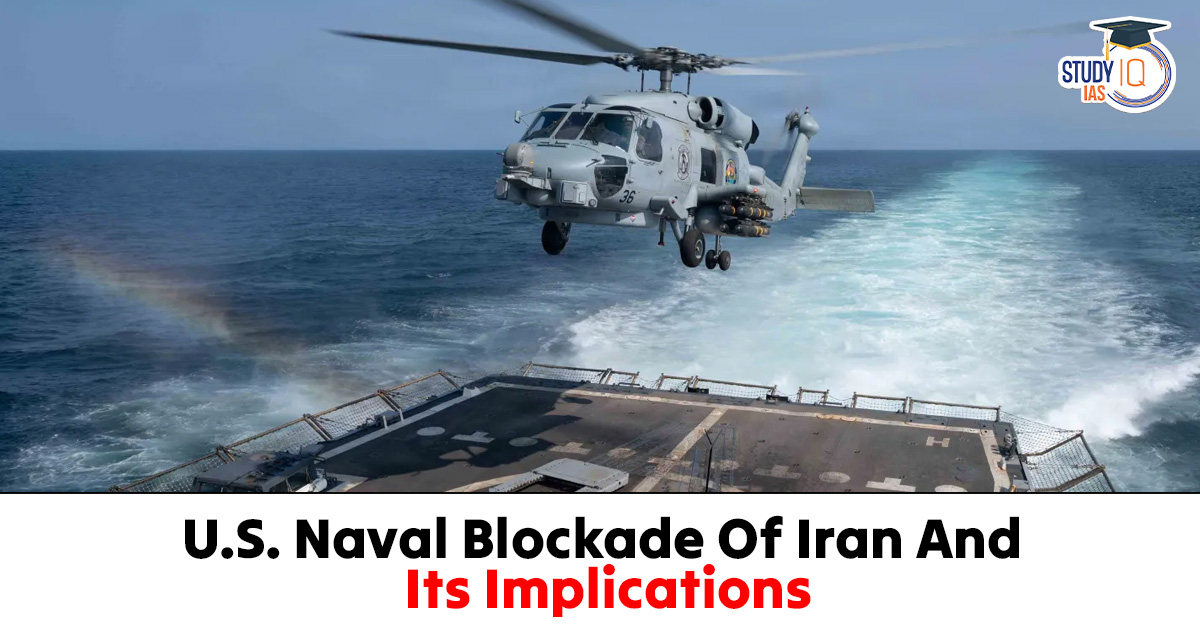
Context: After the collapse of U.S.–Iran negotiations, the United States announced a naval blockade targeting Iranian ports and shipping, increasing pressure in the ongoing West Asian conflict.
About the US Naval Blockade of Iran
- Definition: A naval blockade is a wartime maritime operation that prevents ships or aircraft from entering or leaving the ports of a belligerent state; under international law, it is generally treated as an act of war.
- Operational Mechanism: Naval forces deploy surface combatants, maritime patrol aircraft, and surveillance systems to intercept or inspect vessels suspected of trading with the blockaded state.
- Types of Blockade
- Close blockade: Naval forces positioned near the coastline of the targeted state.
- Distant blockade: Forces deployed farther away to avoid enemy missiles and coastal defence systems.
- Strategic Maritime Context:
- Strait of Hormuz: ~20 per cent of global oil trade passes through it.
- Roughly 150 vessels transit the strait daily in normal conditions.
International Law Debate on the US Naval Blockade
| Legal Principle / Treaty | Supports the Blockade | Challenges the Blockade |
| Law of Naval Warfare (San Remo Manual 1994) | Allows naval blockades during armed conflict if properly declared and effectively enforced. | Requires blockade to avoid the starvation of civilians and must allow humanitarian supplies. |
| UN Charter Article 51 (Self-Defence) | A state may take military measures if responding to an armed attack. | Blockade legality questioned if no direct Iranian attack triggered self-defence. |
| UN Security Council Authority (Chapter VII) | UNSC may authorise blockades to maintain international peace. | No explicit UNSC mandate currently authorising the blockade. |
| Freedom of Navigation (UNCLOS) | Blockade may still allow transit through international straits such as Hormuz. | Restricting neutral vessels may violate freedom of navigation principles. |
| Humanitarian Law (Geneva Conventions) | Military measures are allowed if they target legitimate military objectives. | Blockades causing humanitarian suffering or economic starvation may be illegal. |
| Neutrality Law | Neutral vessels may be inspected to enforce the blockade. | Seizing neutral ships trading peacefully may violate neutrality rights. |
Reasons for the US Naval Blockade of Iran
- Economic Pressure: Stopping Iranian oil exports to weaken Tehran’s war financing.
- Negotiation Leverage: Forcing Iran to return to negotiations after diplomatic talks failed.
- Nuclear Containment: Limiting Iran’s financial capacity to support nuclear enrichment activities.
- Control of Maritime Routes: Prevent Iran from controlling shipping or collecting transit tolls in the Strait of Hormuz.
- Alliance Assurance: Demonstrate commitment to Gulf allies concerned about Iranian regional influence.
Reversal and Policy Ambiguity
- Initial Hardline Announcement: The U.S. initially threatened to blockade all ships entering or leaving the Strait of Hormuz, raising fears of a global energy crisis.
- Subsequent Clarification: The U.S. military later clarified that the blockade would target vessels entering or leaving Iranian ports, while allowing transit through the Strait of Hormuz.
The shift was intended to avoid alarming Gulf allies and prevent a sudden spike in oil prices.
Challenges in Blockade
- Enforcement Challenges: Identifying vessels trading with Iran is difficult due to GPS spoofing, false port records, and complex shipping routes.
- Shipping and Insurance Risks: War-risk insurance costs could rise sharply, discouraging shipping companies from using Gulf routes.
- Escalation Risks: Iran could retaliate by targeting merchant vessels or disrupting maritime traffic in the Persian Gulf.
- Operational Complexity: Large maritime areas and heavy shipping traffic make full enforcement difficult.
- Proxy Conflict Risks: Iran-aligned groups such as Houthi militants in Yemen could target Red Sea shipping routes, widening the conflict.
- Policy Contradiction: The approach appears inconsistent with the United States’ historical role in protecting freedom of navigation in global sea lanes.
Impact of US Naval Blockade on India
- Energy Security Risks: India imports ~85 percent of its crude oil, much of it from West Asia; disruption could raise oil prices significantly.
- Maritime Trade Vulnerability: Around 60 percent of India’s oil imports pass through the Strait of Hormuz, making the region strategically critical.
- Trade with Iran: India exports rice, pharmaceuticals, machinery and chemicals to Iran and imports bitumen and petrochemical products, with bilateral trade around $1–1.2 billion annually.
- Inflationary Pressure: Higher crude prices may increase fuel, transport, and manufacturing costs, contributing to inflation.
- Connectivity Projects: Regional instability could affect India’s Chabahar Port and International North–South Transport Corridor (INSTC)
- Diaspora Impact: Economic instability in Gulf countries could indirectly affect millions of Indian workers in the region.

 State of India's Bats (SoIbats) 2024–2...
 Sijimali Hill Bauxite Conflict in Odisha...
 US Losing Ground in the Middle East? Isr...













 WhatsApp





