
Table of Contents
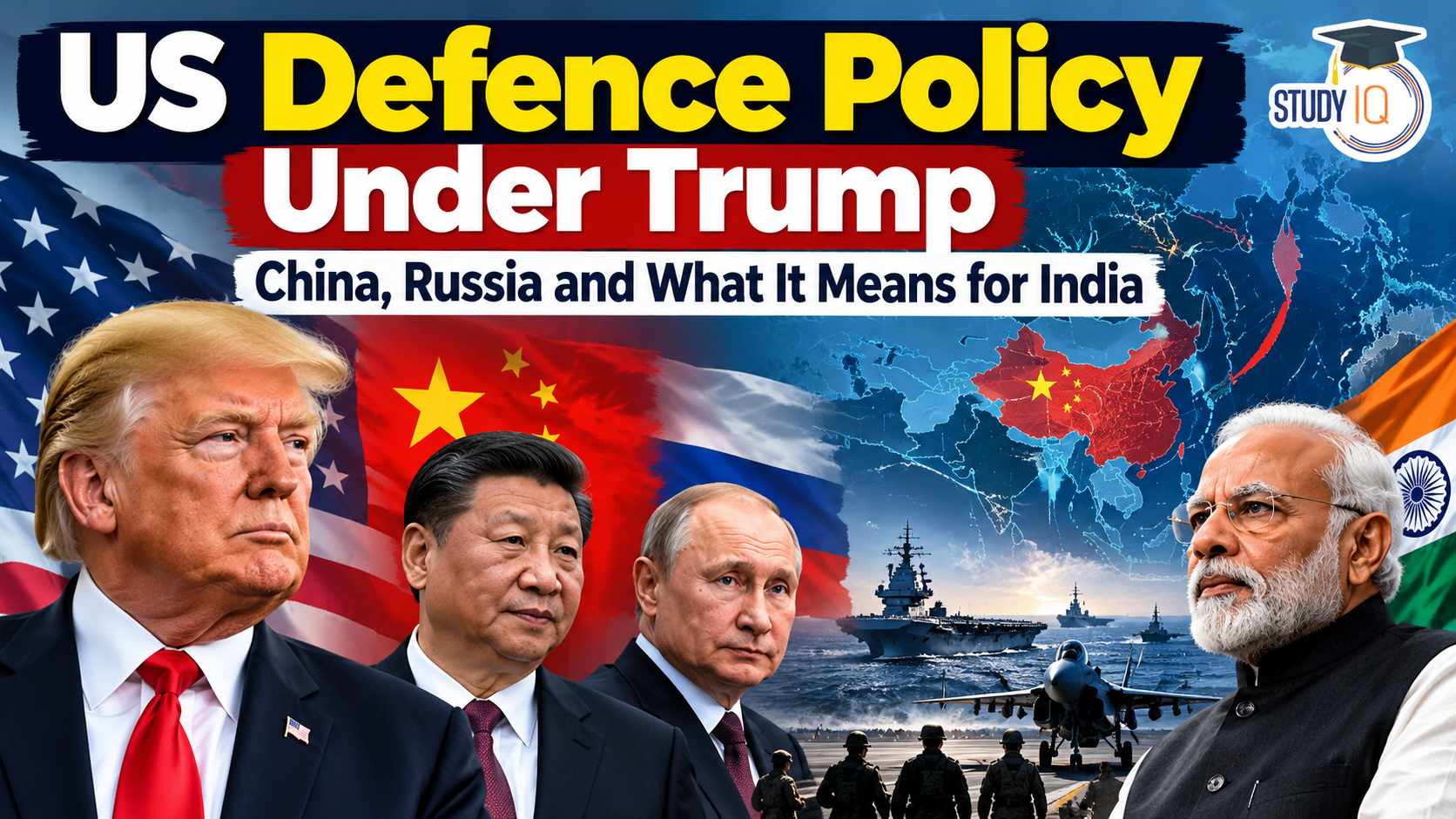
The US defence policy under President Donald Trump is undergoing a significant shift, with greater emphasis on China, regional deterrence, burden-sharing by allies and US strategic priorities. A mid-term assessment by Elbridge A. Colby, the US Under Secretary of War for Policy, highlights how Washington is adapting its defence strategy to a changing global security environment.
For India, these changes are important because the country occupies a crucial position in the Indo-Pacific, has growing defence cooperation with the US, and maintains significant strategic and economic ties with both Russia and other major powers.
Read Also: UPSC Daily Current Affairs 2026
Key Features of Trump’s US Defence Strategy
The emerging US defence approach focuses on four broad priorities:
- Defending the US homeland
- Deterring China
- Gaining greater support from allies and partners
- Rebuilding the US defence industry
The strategy seeks to make allies take greater responsibility for security in their respective regions while the US continues to provide advanced military capabilities, strategic coordination and extended deterrence.
1. China as the Major Strategic Challenge
China remains central to US defence planning.
Washington is particularly concerned about China’s growing:
- Military capabilities
- Technological strength
- Economic influence
- Maritime power
- Influence across the Indo-Pacific
The First Island Chain—stretching broadly from Japan and Taiwan through the Philippines and Southeast Asia—is particularly important to US strategic planning.
China’s growing technological and economic capabilities also give Beijing greater leverage in influencing US decisions.
2. Greater Burden-Sharing by Allies
A major feature of the evolving US strategy is the expectation that allies should contribute more to their own regional security.
Europe is being encouraged to take greater responsibility for European defence, while Japan and Australia are expected to play stronger roles in the Indo-Pacific.
This approach allows Washington to maintain advanced capabilities while reducing the expectation that the US alone will bear the cost of regional security.
3. Russia: Competition Alongside Negotiation
The US approach towards Russia is becoming more nuanced.
While Washington continues to view Russia as a security challenge, it is also attempting to negotiate with Moscow on issues such as Ukraine, energy and broader strategic stability.
This creates an important distinction between:
Strategic competition + selective cooperation
For India, this matters because India has longstanding defence, energy and strategic relations with Russia.
4. What Does the New US Strategy Mean for India?
India occupies a unique position in Washington’s evolving strategic framework because of its:
- Geographical location in the Indian Ocean
- Growing role in the Indo-Pacific
- Defence and technology potential
- Strategic relationship with the US
- Longstanding ties with Russia
- Partnerships with Japan, Australia, France and other countries
Washington increasingly expects India to contribute more actively to maintaining the regional balance of power.
Opportunities for India
The evolving US strategy can create several opportunities:
Defence cooperation:
Greater scope for military exercises, defence technology cooperation, intelligence sharing and co-production.
Technology partnerships:
India can benefit from cooperation in emerging technologies, semiconductors, space, artificial intelligence and advanced defence systems.
Indo-Pacific role:
India’s geographical position makes it an important partner in maintaining a free, open and stable Indo-Pacific.
Strategic autonomy:
At the same time, India’s growing partnerships with multiple countries provide it with greater strategic flexibility.
The Challenge of Balancing China and Russia
India must carefully manage two different strategic relationships.
On one side, India and the US share concerns about China’s growing military and economic influence.
On the other, India continues to maintain important defence, energy and diplomatic relations with Russia.
Therefore, India is unlikely to completely align itself with any single power bloc. Instead, strategic autonomy and issue-based partnerships will remain important.
Why India Matters to the US
India’s importance to Washington is not determined solely by whether India agrees with every US policy.
Its importance comes from its:
- Large economy and market
- Military capabilities
- Strategic location
- Technology sector
- Role in the Indian Ocean
- Diplomatic relationships with multiple major powers
This gives India bargaining power in negotiations with Washington.
Way Forward for India
India should adopt a multi-alignment strategy while strengthening its own capabilities.
Key priorities should include:
- Strengthen indigenous defence manufacturing.
- Deepen defence-technology cooperation with the US and other partners.
- Maintain strategic communication with Russia.
- Strengthen partnerships in the Indo-Pacific.
- Reduce excessive dependence on any single country.
- Build domestic technological and industrial capabilities.
Conclusion
The evolving US defence policy under Trump represents a shift towards greater burden-sharing, stronger deterrence against China and a more transactional approach to alliances.
For India, this presents both opportunities and challenges. New Delhi can benefit from deeper cooperation with Washington in defence, technology and the Indo-Pacific while preserving its strategic autonomy.
The central challenge for India will be to work more closely with the United States without becoming strategically dependent on it, while simultaneously maintaining important relationships with Russia and other major powers.

 Ramappa Temple: UNESCO World Heritage Si...
 Nobel Prize in Medicine 2026: Optogeneti...
 Daily Mains Articles 2026 – Updated Da...














 WhatsApp





