Table of Contents
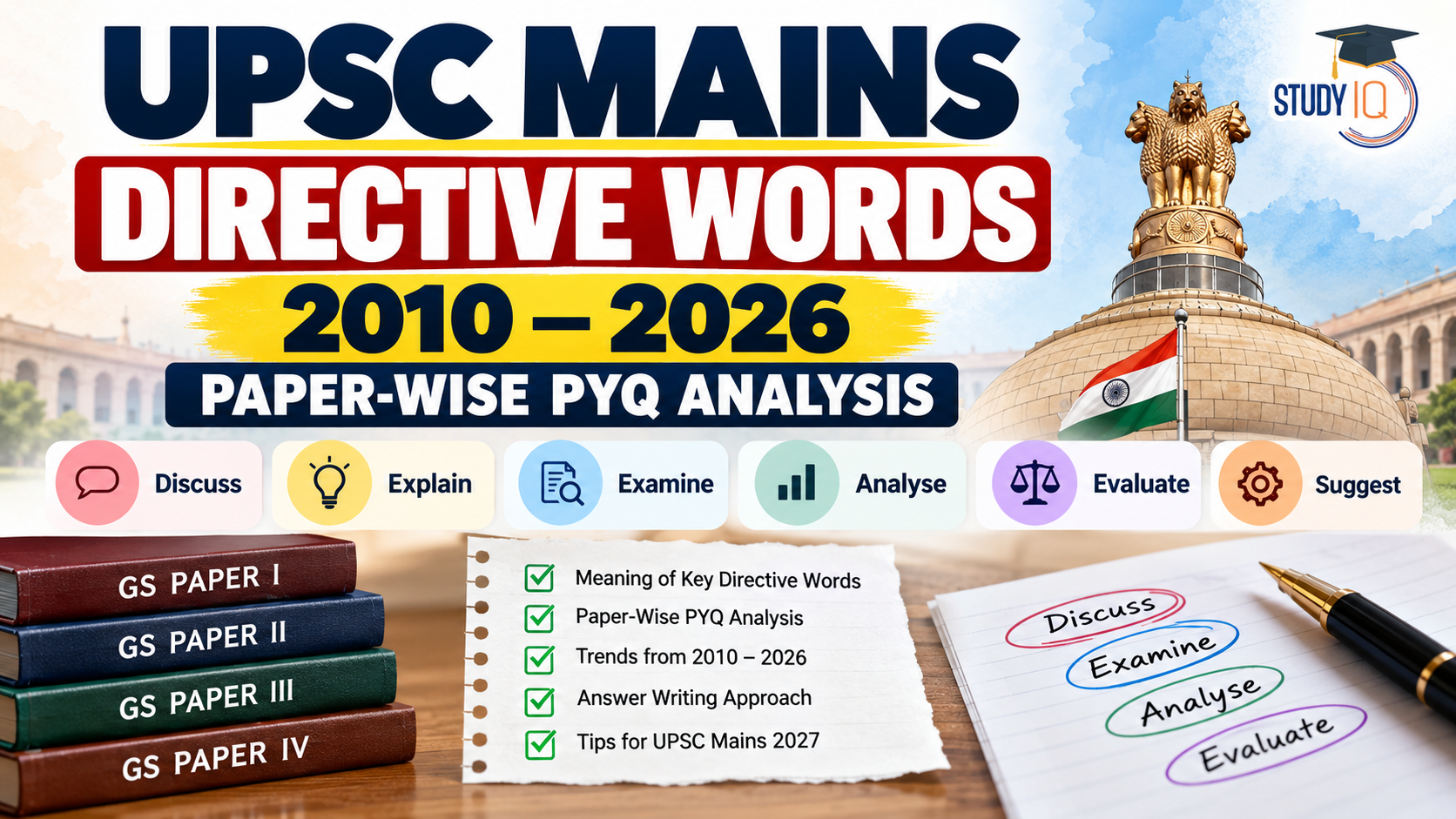
Understanding UPSC Mains directive words is an essential part of effective answer writing for the Civil Services Examination. Words such as Discuss, Examine, Analyse, Critically Evaluate, Comment and Explain tell candidates how to approach a question, structure their answers and present arguments.
Many aspirants prepare extensively for General Studies Papers I, II, III and IV but lose marks because they misunderstand what the question actually demands. For example, a question asking candidates to examine an issue requires a different approach from one asking them to critically evaluate it.
An analysis of UPSC Mains Previous Year Questions (PYQs) from 2010 to 2026 reveals recurring patterns in the use of directive words. This paper-wise analysis explains the most frequently used directives, their meanings, examples from previous year questions, and their implications for UPSC Mains 2027 preparation.
What Are Directive Words in UPSC Mains?
Directive words are action words or phrases in a question that indicate how candidates should organise and present their answers. They determine whether an answer should explain a concept, analyse causes, evaluate an argument, compare alternatives or suggest solutions.
For example:
-
Discuss: Present different dimensions of an issue, support arguments with evidence and arrive at a reasoned conclusion.
-
Examine: Investigate an issue closely and explain its implications.
-
Analyse: Break an issue into components and establish relationships between causes, effects and outcomes.
-
Critically evaluate: Assess strengths and weaknesses using evidence before reaching a balanced judgement.
-
Suggest: Recommend practical measures, reforms or solutions.
Recognising these directives helps aspirants avoid writing generic answers that contain relevant information but fail to address the precise demand of the question.
UPSC Mains Directive Words: Overall PYQ Analysis (2010–2026)
The paper-wise analysis of GS Papers I, II, III and IV shows that certain directives appear repeatedly across the examination. The following figures are based on the compiled directive analysis covering 2010–2026. Counts are approximate, and questions containing multiple directives may be counted more than once.
Most Repeated Directive Words in UPSC Mains
| Directive word | GS I | GS II | GS III | GS IV |
|---|---|---|---|---|
| Discuss | 66 | 96 | 100 | 95 |
| Explain | 30 | 30 | 46 | 32 |
| Comment | 18 | 23 | 47 | 4 |
| Critically examine/evaluate/analyse | 12 | 26 | 13 | 36 |
| Examine | 12 | 26 | 21 | 27 |
| Suggest | 2 | 15 | 18 | 39 |
| Do you agree/think | 13 | 21 | 10 | 22 |
| Analyse | 11 | 15 | 15 | 10 |
Source: Compiled UPSC Mains directive analysis, 2010–2026. Combined categories are retained as presented in the source.
The data highlights three important trends:
-
Discuss is the most frequently appearing directive across all four General Studies papers.
-
Explain and Examine are recurring directives that require conceptual clarity, logical presentation and relevant examples.
-
GS Paper IV demands a distinct approach, combining theoretical ethics questions with case studies involving ethical issues, available options and courses of action.
These patterns make directive-based preparation an important component of UPSC Mains answer writing.
UPSC Mains Directive Analysis: GS Paper I
GS Paper I covers Indian heritage and culture, history, geography and society. Questions require candidates to connect factual knowledge with historical interpretation, geographical processes and social analysis.
Most Important Directives in GS Paper I
| Directive | Total occurrences (2010–2026) | What UPSC expects |
|---|---|---|
| Discuss | 66 | Examine multiple dimensions and present a reasoned conclusion |
| Explain | 30 | Clarify concepts, processes and reasons |
| Comment | 18 | Give a balanced, reasoned opinion |
| Do you agree/think | 13 | Take a position and support it with arguments |
| Examine | 12 | Investigate an issue and explain its implications |
| Critically examine/evaluate/analyse | 12 | Assess strengths and weaknesses before reaching a judgement |
| Analyse | 11 | Break an issue into components and explain relationships |
| What do you understand/mean | 11 | Define the concept and explain it with examples |
Examples of GS Paper I Directives
1. Discuss
Example from the 2023 paper: “Discuss the consequences of climate change on the food security in tropical countries.”
A good answer should cover the effects of climate change on agricultural productivity, food availability, accessibility and nutritional security. It should also consider regional variations and conclude with suitable adaptation measures.
2. Examine
Example from the 2025 paper: “Examine the main aspects of Akbar’s religious syncretism.”
The answer should identify the major features of Akbar’s religious policies, explain their political and social context, and assess their broader significance.
3. Analyse
Example from the 2026 paper: “Analyze the importance of Ashokan inscriptions for reconstructing Mauryan history.”
The answer should explain how inscriptions help historians understand administration, political authority, Dhamma, territorial influence and the Mauryan state.
GS Paper I Preparation Strategy
For History, use timelines, cause-and-effect relationships and historical examples. For Geography, incorporate maps, diagrams, processes and spatial variations wherever relevant. For Indian Society, organise answers around social, economic, cultural and institutional dimensions.
The objective is to move beyond factual description and demonstrate analytical understanding.
UPSC Mains Directive Analysis: GS Paper II
GS Paper II covers the Constitution, polity, governance, social justice and international relations. Its questions frequently demand constitutional reasoning, institutional analysis, policy evaluation and practical recommendations.
Most Important Directives in GS Paper II
| Directive | Total occurrences (2010–2026) | What UPSC expects |
|---|---|---|
| Discuss | 96 | Present different perspectives and reach a reasoned conclusion |
| Explain | 30 | Clarify a concept, mechanism or provision |
| Examine | 26 | Investigate institutional functioning and implications |
| Critically examine/evaluate/analyse | 26 | Assess merits, limitations and evidence |
| Comment | 23 | Provide a balanced and reasoned assessment |
| Do you agree/think | 21 | Defend a position with supporting arguments |
| Analyse | 15 | Explain relationships, causes and consequences |
| Suggest | 15 | Recommend institutional or policy reforms |
Examples of GS Paper II Directives
1. Discuss
Example from the 2026 paper: “Discuss the position of the Governor in the federal polity of India.”
A strong answer should explain the Governor’s constitutional position, discretionary powers, relationship with the elected state government and implications for Centre–State relations. Relevant constitutional provisions and judicial developments can strengthen the analysis.
2. Examine
Example from the 2026 paper: “Examine whether the constitutional office of the Lok Sabha Speaker has become vulnerable to partisan politics.”
The answer should examine the Speaker’s constitutional responsibilities, concerns regarding neutrality, relevant institutional challenges and possible reforms.
3. Suggest
Example from the 2026 paper, paraphrased in the source: Suggest measures to strengthen the enforcement powers of the National Commission for Scheduled Castes (NCSC) and the National Commission for Scheduled Tribes (NCST).
The answer should identify existing institutional limitations and recommend practical measures relating to powers, resources, accountability and implementation.
GS Paper II Preparation Strategy
For Polity and Governance, use constitutional provisions, Supreme Court judgements, committee recommendations, institutional examples and government initiatives. For International Relations, connect bilateral relations with India’s strategic interests, regional developments and global governance.
When a question asks you to suggest, do not spend the entire answer describing the problem. Devote sufficient space to implementable solutions.
UPSC Mains Directive Analysis: GS Paper III
GS Paper III includes the economy, science and technology, environment, biodiversity, disaster management and internal security. Questions often require conceptual understanding, evidence-based analysis and practical policy recommendations.
Most Important Directives in GS Paper III
| Directive | Total occurrences (2010–2026) | What UPSC expects |
|---|---|---|
| Discuss | 100 | Explore different dimensions and present a reasoned conclusion |
| Comment | 47 | Assess a statement or policy with supporting arguments |
| Explain | 46 | Clarify a mechanism, process or concept |
| What do you understand/mean | 23 | Define the concept and explain it with examples |
| Examine | 21 | Investigate a problem and its implications |
| Suggest | 18 | Recommend measures and reforms |
| Analyse | 15 | Establish relationships between causes, effects and outcomes |
| Describe | 15 | Present the features or characteristics in an organised manner |
| Mention/List/Identify | 14 | Identify relevant facts, categories or examples |
Examples of GS Paper III Directives
1. Discuss
Example from the 2024 paper, paraphrased in the source: Discuss the rationale and achievements of the Production Linked Incentive (PLI) scheme.
A good answer should cover the scheme’s objectives, sectoral coverage, manufacturing investment, production, employment and implementation challenges. Reliable data should support any claims about outcomes.
2. Explain
Example from the 2026 paper, paraphrased in the source: Explain the meaning of the digital rupee and how India’s Central Bank Digital Currency (CBDC) works and is progressing.
The answer should define the digital rupee, explain its basic functioning and distinguish it from other forms of digital payment. It should also discuss potential benefits and implementation challenges.
3. Examine
Example from the 2023 paper: Examine the methodology adopted to compute unemployment in the country and suggest improvements.
This is a multi-directive question. The first part requires examination of the methodology, while the second requires practical recommendations. Candidates should address both parts explicitly.
GS Paper III Preparation Strategy
Use flowcharts for technological processes, diagrams for environmental mechanisms, data for economic trends and structured frameworks for internal security. Link static concepts with relevant government policies, reports and current developments.
For multi-part questions, allocate answer space according to the demands of each part. A well-written first section cannot compensate for an unanswered directive in the second section.
UPSC Mains Directive Analysis: GS Paper IV
GS Paper IV tests ethical understanding, integrity, aptitude and the ability to apply ethical principles in administrative situations. It combines theoretical questions with case studies.
The compiled analysis covers GS Paper IV from 2013 to 2026.
Most Important Directives in GS Paper IV
| Directive | Total occurrences | What UPSC expects |
|---|---|---|
| Discuss | 95 | Explore ethical concepts from multiple perspectives |
| Case-study stems | 84 | Identify ethical issues, evaluate options and recommend a course of action |
| Suggest | 39 | Recommend measures to resolve ethical or administrative problems |
| Critically examine/evaluate/analyse | 36 | Assess competing arguments and their implications |
| Explain | 32 | Clarify ethical concepts and their relevance |
| Examine | 27 | Investigate a dilemma, principle or administrative issue |
| What do you understand/mean | 26 | Define a concept and illustrate it with examples |
| Justify | 25 | Support an ethical position with reasons |
Examples of GS Paper IV Directives
1. Discuss
Example from the 2023 paper: “Probity is essential for an effective system of governance and socio-economic development.” Discuss.
The answer should explain probity, connect it with transparency, accountability, integrity and public trust, and use suitable administrative examples.
2. Justify
Example from the 2025 paper, paraphrased in the source: Justify that civil servants must use reason and critical thinking within an ethical framework.
Candidates should explain why critical thinking is necessary in public administration while demonstrating that administrative decisions must remain grounded in ethical principles, legality and public interest.
3. Case-study questions
Case studies commonly require candidates to identify ethical issues, evaluate available options and specify their course of action.
A useful answer structure is:
-
Identify the stakeholders and ethical dilemmas.
-
State the relevant values and principles.
-
Evaluate the available options and their consequences.
-
Select a practical and ethically defensible course of action.
-
Explain how the decision can be implemented while protecting public interest.
GS Paper IV Preparation Strategy
Prepare definitions of core ethical concepts, along with examples from administration, public life and everyday decision-making. Practise case studies under time constraints and avoid giving purely theoretical answers when the question demands a specific course of action.
What Changed in UPSC Mains During 2024–2026?
The recent papers in the compiled analysis show several patterns that aspirants should consider when preparing for UPSC Mains 2027.
1. Discuss Remains a High-Priority Directive
Discuss continued to appear frequently across the four papers. Its recurrence indicates that candidates should practise presenting multiple dimensions, supporting arguments and drawing reasoned conclusions.
2. Multi-Part Questions Require Better Structuring
Questions increasingly combine multiple tasks, such as explaining a concept and then suggesting measures. Candidates must identify every demand and address it explicitly.
3. Direct Question Stems Are Important
Questions beginning with What are, How, Why and Which also feature in recent papers. These may not contain a conventional directive verb, but candidates must still interpret what is being asked.
For example:
-
What are: Identify and explain the relevant features or categories.
-
How: Explain a process, mechanism or relationship.
-
Why: Establish causes and provide supporting reasons.
-
Which: Identify the relevant choice or category and justify it where necessary.
4. GS Paper II Emphasises Institutional and Critical Analysis
The 2026 paper-wise analysis highlights directives such as Examine, Critically Evaluate and To What Extent in GS Paper II. Aspirants should practise balanced constitutional and governance answers rather than relying only on descriptive notes.
5. GS Paper III Combines Discussion and Conceptual Explanation
The 2026 GS Paper III analysis records 12 uses of Discuss and 8 uses of Explain. This reinforces the need for conceptual clarity, relevant examples and analytical answer structures.
6. GS Paper IV Requires Case-Study Practice
The source records four case-study stems in GS Paper IV in 2026, compared with 16 each in 2024 and 2025. It also records 12 uses of Discuss in 2026.
This variation highlights the importance of preparing both ethical theory and case studies rather than assuming that the paper will follow one fixed format.
Meaning of Important UPSC Mains Directive Words
The following table provides a quick reference for answer-writing practice.
| Directive | Meaning | Suggested answer approach |
|---|---|---|
| Discuss | Explore different dimensions | Introduction, arguments, counterpoints and conclusion |
| Explain | Make a concept or process clear | Definition, mechanism, reasons and examples |
| Examine | Investigate closely | Context, key aspects, implications and conclusion |
| Analyse | Break into components | Causes, effects, relationships and findings |
| Critically examine | Assess strengths and weaknesses | Supporting arguments, limitations and balanced judgement |
| Evaluate | Judge effectiveness or value | Criteria, evidence, achievements, limitations and verdict |
| Comment | Give a reasoned opinion | Context, evidence, balanced assessment and conclusion |
| Assess | Measure importance, extent or success | Evidence, achievements, limitations and judgement |
| Suggest | Recommend improvements | Specific, feasible and relevant measures |
| Justify | Defend a position | Clear stand supported by reasons and examples |
| Substantiate | Support a statement | Facts, evidence, examples and reasoning |
| Elucidate | Make an idea clearer | Explanation with illustrations |
| Elaborate | Expand on a statement | Detailed explanation and examples |
| Describe | Present features or characteristics | Organised factual account |
| Distinguish/Differentiate | Show differences | Compare features using clear criteria |
| Compare/Contrast | Examine similarities and differences | Common parameters and a balanced comparison |
| Enumerate | List points systematically | Numbered points with brief explanations |
| Highlight/Bring out | Emphasise key aspects | Prioritise the most relevant features |
| To what extent | Determine the degree of validity | Evidence supporting and limiting the proposition, followed by a judgement |
| Trace | Follow development over time | Chronological sequence and major turning points |
| Illustrate | Clarify with examples | Explain the point and support it with examples |
How to Use Directive Words for UPSC Mains 2027 Preparation
A practical way to improve answer writing is to combine PYQ analysis with directive-specific practice.
Step 1: Analyse previous year questions. Review questions from 2010–2026 and identify recurring directives in each paper.
Step 2: Maintain a directive notebook. Record the meaning of each directive, a suitable answer structure and examples of questions in which it appears.
Step 3: Practise the same topic using different directives. For instance, practise Discuss, Examine and Critically Evaluate questions on federalism. This helps you understand how the directive changes the structure of the answer.
Step 4: Practise multi-part questions. Underline every task in a question and ensure that each part receives a direct response.
Step 5: Review answers for relevance. After writing an answer, check whether you followed the directive or simply reproduced memorised information.
Step 6: Use evidence strategically. Incorporate constitutional provisions, committee recommendations, examples, relevant data, diagrams and case studies where appropriate.
Step 7: Revise regularly. Revisit your directive notebook and practise timed answers to improve speed, clarity and consistency.
Common Mistakes to Avoid in UPSC Mains Answer Writing
-
Writing a descriptive answer when the question demands critical evaluation.
-
Giving recommendations without first explaining the problem.
-
Ignoring the second or third part of a multi-part question.
-
Presenting one-sided arguments in a question requiring a balanced discussion.
-
Using examples and data that do not directly support the argument.
-
Writing lengthy introductions at the expense of the main analysis.
-
Treating all directive words as interchangeable.
The central principle is simple: content knowledge is necessary, but it must be organised according to the question’s demand.
Read Also: UPSC Daily Current Affairs 2026
 UPSC NDA 2 Result 2026 Out: Download Mer...
 UPSC EPFO Previous Year Question Papers ...
 UPSC EPFO Question Paper 2025 PDF Downlo...












 WhatsApp