Table of Contents
Context
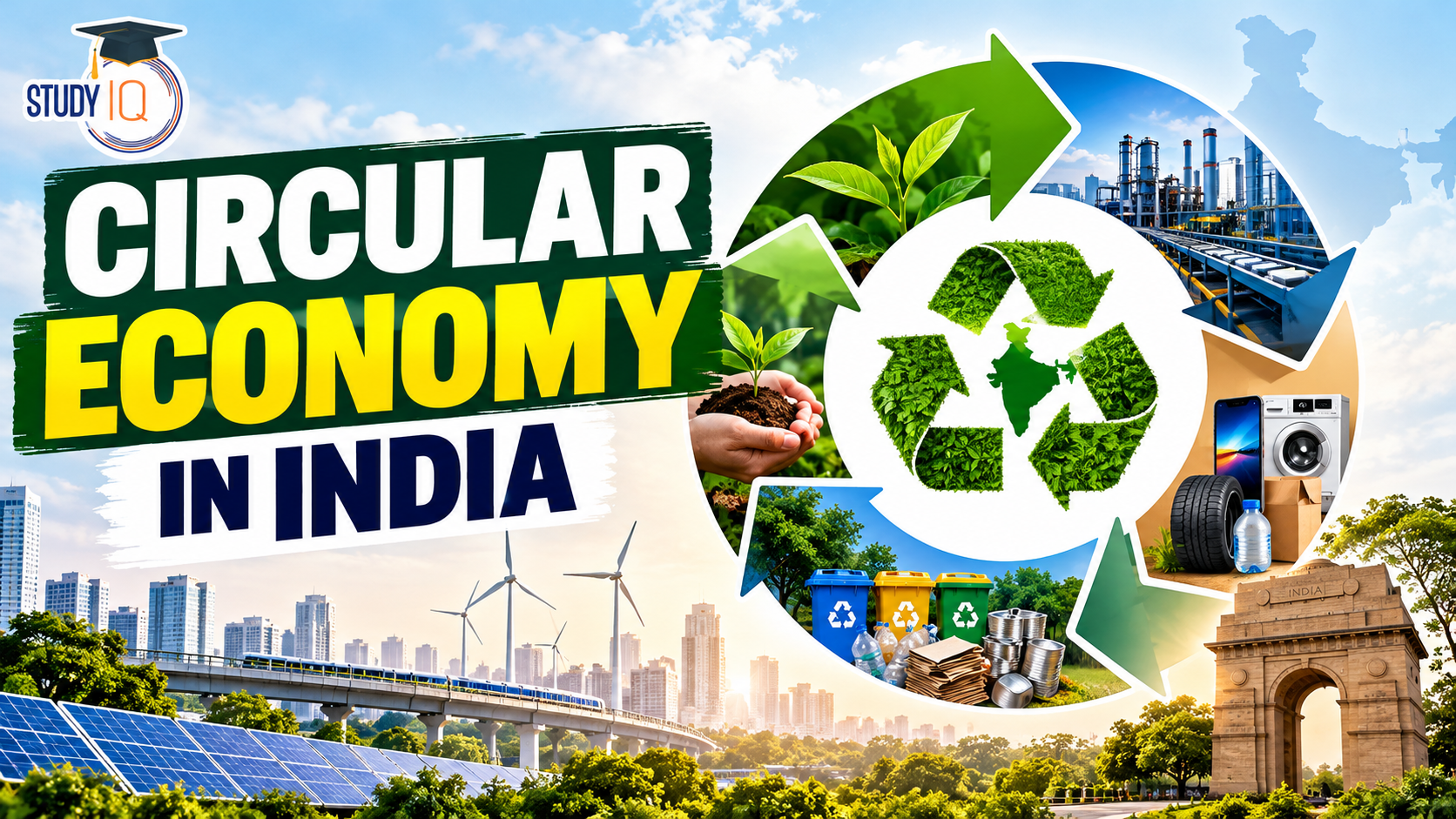
India’s growing consumption, industrialisation and waste generation are increasing pressure on natural resources. A circular economy can help address this challenge by keeping products and materials in use for longer, reducing waste and recovering valuable resources instead of continuously extracting fresh raw materials.
Read Also: UPSC Daily Current Affairs 2026
What is a Circular Economy?
A circular economy is an economic model that aims to minimise waste by promoting the reuse, repair, refurbishment and recycling of products and materials.
| Basis | Linear Economy | Circular Economy |
| Economic model | Take, make and dispose | Reduce, reuse, repair and recycle |
| Resource use | Depends heavily on fresh raw materials | Recovers and reuses existing materials |
| Product life | Products are often discarded after use | Products are repaired, reused or refurbished |
| Waste management | Focuses mainly on waste disposal | Treats recoverable waste as a resource |
| Environmental impact | Increases resource depletion and pollution | Reduces waste and pressure on natural resources |
How can a circular economy help India achieve economic growth?
- Resource conservation: Reusing and recycling materials reduces the need to extract fresh minerals, timber and other natural resources.
- Lower production costs: Repairing products and recovering materials can reduce raw-material expenses for businesses.
- Reduced pollution: Better product design, waste segregation and recycling reduce the amount of waste dumped in landfills or released into the environment.
- Lower import dependence: Recovering metals from electronic waste, batteries and discarded vehicles can reduce the need for imported raw materials.
- Green employment: Repair, recycling, refurbishment and remanufacturing create jobs and livelihood opportunities.
- Inclusive growth: Integrating informal waste workers into organised systems can improve their incomes, working conditions and access to social protection.
- Sustainable development goals: Circular practices directly support SDG 12 (Responsible Consumption and Production) and also contribute to SDG 13 (Climate Action), SDG 11 (Sustainable Cities and Communities)and SDG 8 (Decent Work and Economic Growth).
Why is transitioning to a circular economy challenging for India?
- Consumer behaviour: The widespread use-and-dispose mindset reduces demand for repair, reuse and recycled products.
- Weak waste infrastructure: Poor segregation, collection and processing contaminate recyclable materials and make their recovery more difficult.
- Informal-sector dependence: Many waste pickers and small recyclers work outside formal systems, limiting their access to technology, finance and safer working conditions.
- Technology gaps: Recovering valuable materials from electronic waste, complex plastics and batteries requires specialised technology and skilled workers.
- High initial costs: Recycling facilities, modern machinery and product redesign require investment, which can be difficult for MSMEs to afford.
- Weak enforcement: Inadequate monitoring and compliance can reduce the effectiveness of waste-management rules and Extended Producer Responsibility (EPR).
- Fragmented supply chains: Poor coordination among manufacturers, consumers, waste collectors and recyclers makes material collection and recovery costly and inefficient.
What steps has the Government of India taken to promote a circular economy?
- Resource Efficiency and Circular Economy (RECE): NITI Aayog has promoted resource efficiency and circular-economy approaches to reduce fresh resource use and encourage reuse, repair and recycling.
- Extended Producer Responsibility (EPR): EPR frameworks make producers responsible for specified obligations relating to the collection, recycling or environmentally sound management of products after use.
- Plastic Waste Management Rules: These provide a framework for plastic waste management, including EPR for plastic packaging. Certain identified single-use plastic items have also been prohibited.
- E-Waste Management Rules, 2022: These establish an EPR framework for electronic waste and prescribe obligations for producers to support its environmentally sound management.
- Battery Waste Management Rules, 2022: These require producers to meet EPR obligations and promote the collection, recycling and recovery of materials from waste batteries.
- Extended Producer Responsibility for other waste streams: Frameworks have also been introduced for waste tyres, used oil, end-of-life vehicles, construction and demolition waste, and non-ferrous metal scrap, expanding the scope of resource recovery.
- Solid Waste Management Rules, 2026: These rules, effective from 1 April 2026, require waste segregation at source into four streams: wet waste, dry waste, sanitary waste and special care waste. They also strengthen responsibilities and monitoring across the waste-management process.
- Mission LiFE: This initiative encourages individuals and communities to adopt sustainable lifestyles through mindful consumption, reuse and reduced waste generation.
- Swachh Bharat Mission–Urban 2.0: It supports source segregation, material recovery, scientific processing of municipal waste and the remediation of legacy dumpsites.
Way Forward
- Promote eco-design: Encourage manufacturers to make products durable, repairable, reusable and recyclable, preventing waste at the design stage.
- Expand recycling infrastructure: Develop modern collection, segregation, material-recovery and recycling facilities, particularly in smaller cities.
- Protect informal workers: Integrate waste pickers and scrap collectors into formal systems through training, safety equipment, fair compensation and social protection.
- Connect supply chains: Improve coordination between producers, consumers, recyclers and waste processors to make material recovery more efficient.
- Create demand for recycled materials: Promote appropriate quality standards and encourage the use of recycled materials in manufacturing and public procurement wherever suitable.
- Strengthen the Right to Repair: Improve access to spare parts, repair information and affordable repair services, subject to legitimate safety and intellectual-property requirements.
- Improve consumer awareness: Encourage responsible purchasing, waste segregation, repair, reuse and recycling through education and public campaigns.

 EPFO Wage Ceiling Hike 2026: Social Secu...
 Daily Mains Articles 2026 – Updated Da...
 Daily Current Affairs PDF 2026: Download...













 WhatsApp