Table of Contents
Context
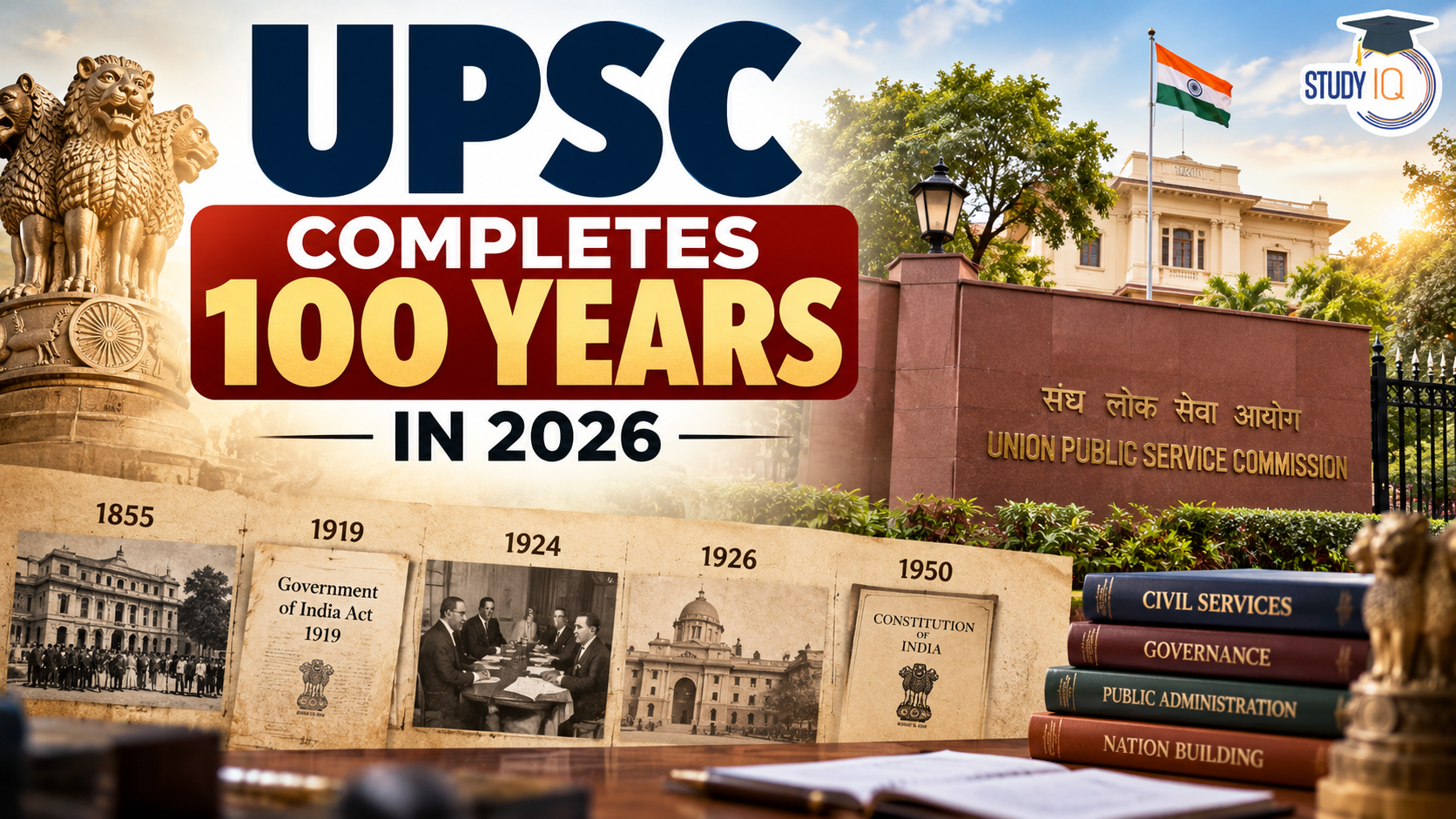
The Union Public Service Commission (UPSC) completed 100 years on 1 October 2026, marking a century since India’s first Public Service Commission was established in 1926.
Read Also: UPSC Daily Current Affairs 2026
About UPSC
- Origin: The first Public Service Commission was established on 1 October 1926 as an advisory body, with its Chairman and Members appointed by the Secretary of State in London.
- Constitutional Status: The Constitution of India provides for the Union and State Public Service Commissions under Part XIV, Articles 315–323.
- Nature: An independent constitutional body responsible for merit-based recruitment to public services and advising governments on personnel matters.
- Headquarters: Dholpur House, New Delhi.
Evolution
- 1855: The Indian Civil Service (ICS) examination introduced open competition, replacing nomination-based recruitment.
- 1919: The Government of India Act provided for a Public Service Commission.
- 1922: The ICS examination was held in India for the first time at Allahabad, alongside London.
- 1924: The Lee Commission recommended establishing a statutory Public Service Commission.
- 1926: The first Public Service Commission was established.
- 1949: Provisions relating to Public Service Commissions were incorporated into Part XIV of the Constitution.
Constitutional Provisions Related to UPSC
The constitutional framework of UPSC is contained in Part XIV of the Constitution of India, covering Articles 315 to 323.
| Article | Constitutional Provision |
|---|---|
| Article 315 | Public Service Commissions for the Union and States |
| Article 316 | Appointment and term of office of members |
| Article 317 | Removal and suspension of members |
| Article 318 | Regulations concerning service conditions and staff |
| Article 319 | Restrictions on further employment after ceasing to hold office |
| Article 320 | Functions of Public Service Commissions |
| Article 321 | Extension of functions of Public Service Commissions |
| Article 322 | Expenses of Public Service Commissions |
| Article 323 | Reports of Public Service Commissions |
These provisions establish the institutional framework for recruitment, functioning, financial arrangements and accountability of Public Service Commissions.
Key Functions
- Recruitment by Examination: Conducts examinations such as Civil Services, Indian Forest Service, Engineering Services, Combined Medical Services, NDA & NA, CDS and CAPF (Assistant Commandants).
- Recruitment by Selection: Conducts interviews and recruitment tests for specialist posts referred by Ministries and Departments.
- Advisory Role: Advises governments on Recruitment Rules, promotions, induction into All India Services and disciplinary matters.
- Police Leadership: Empanels senior IPS officers for appointment as Director General of Police/Head of Police Force in States.
Constitutional Significance
- Ensures merit, impartiality and equal opportunity in public recruitment.
- Its constitutional independence helps protect appointments from nepotism, favouritism and political patronage.
 Daily Current Affairs PDF 2026: Download...
 Gandhi Jayanti 2026: History, Significan...
 Right to Vote in India: Constitutional S...






 WhatsApp