Table of Contents
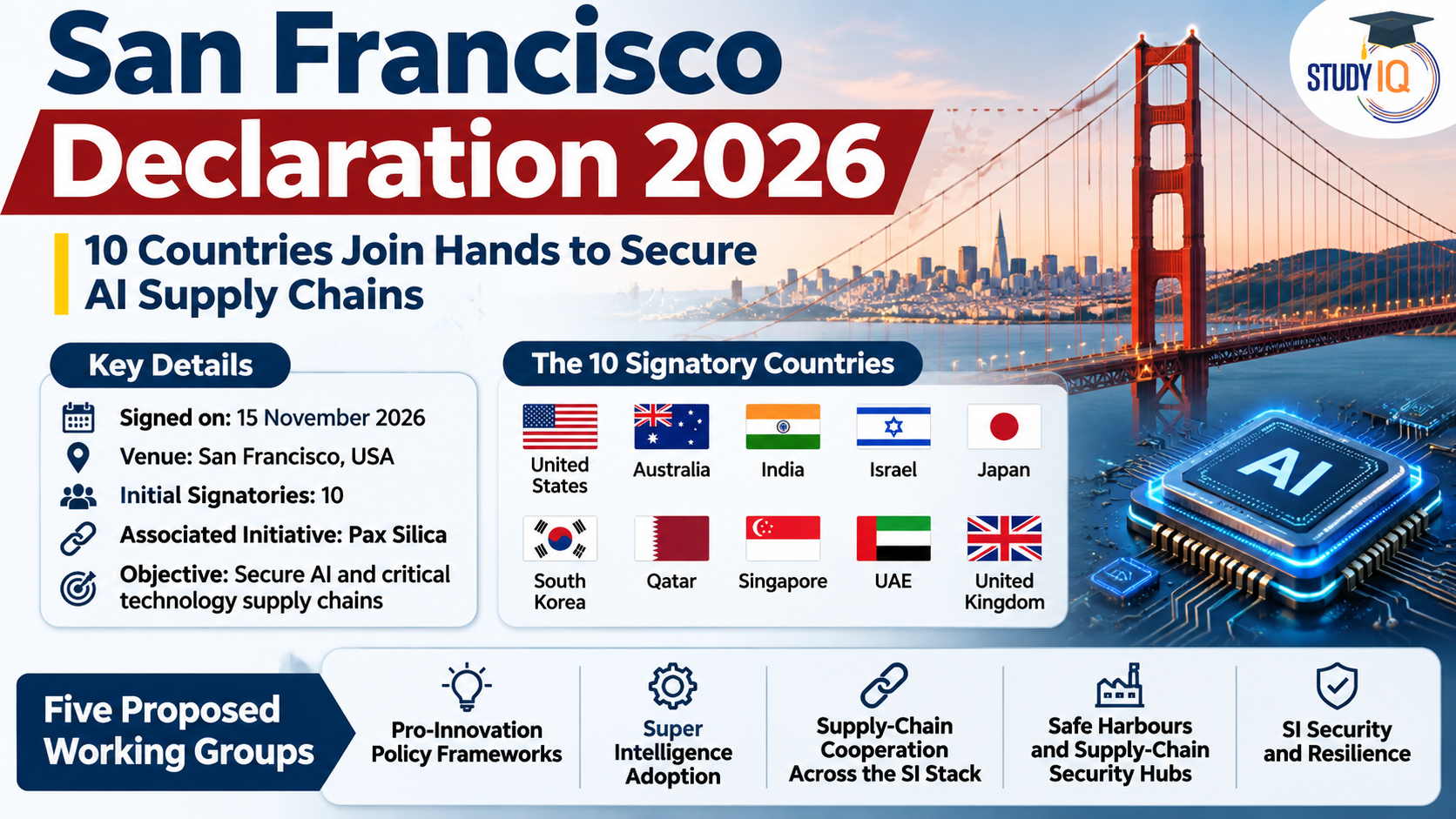
The San Francisco Declaration 2026 is a major international development in artificial intelligence (AI) and economic security. On 15 November 2026, India, the United States and eight other countries signed the San Francisco Declaration on the Secure Foundations of Enduring Prosperity at the Pax Silica Founders Retreat in San Francisco, USA.
The declaration aims to strengthen cooperation in securing global AI supply chains, protecting critical technologies and reducing excessive dependence on vulnerable sources of strategic materials and infrastructure.
The agreement also proposes five working groups to promote technological innovation, AI adoption, supply-chain cooperation and security.
San Francisco Declaration 2026: Key Highlights
| Particulars | Details |
|---|---|
| Declaration | San Francisco Declaration on the Secure Foundations of Enduring Prosperity |
| Signing date | 15 November 2026 |
| Venue | San Francisco, USA |
| Initial signatories | 10 countries |
| Convened by | Jacob Helberg |
| Associated initiative | Pax Silica |
| Pax Silica launched | December 2025 |
| Lead country | United States |
| Main objective | Securing AI and critical technology supply chains |
| Proposed working groups | Five |
| Key sectors | Semiconductors, critical minerals, energy and advanced manufacturing |
10 Countries That Signed the San Francisco Declaration
The ten original signatories of the declaration are:
- United States
- Australia
- India
- Israel
- Japan
- South Korea (Republic of Korea)
- Qatar
- Singapore
- United Arab Emirates
- United Kingdom
The declaration was signed during the Pax Silica Founders Retreat, convened by US Under Secretary of State for Economic Affairs Jacob Helberg.
What Is the San Francisco Declaration 2026?
The San Francisco Declaration is a multilateral initiative aimed at strengthening economic and technological security through international cooperation.
Its central principle is that economic security is fundamental to national security.
Modern AI systems depend on complex global supply chains involving semiconductor chips, critical minerals, advanced manufacturing equipment, electricity, data centres and communication networks.
Disruptions in any of these sectors can affect the development and deployment of advanced AI technologies.
The declaration therefore seeks to:
- Strengthen trusted and diversified supply chains.
- Protect sensitive technologies from theft and unauthorised access.
- Secure critical physical and digital infrastructure.
- Reduce excessive dependence on limited suppliers.
- Promote international cooperation in advanced technology.
- Address economic coercion and supply-chain disruptions.
Importantly, the declaration establishes a framework for cooperation rather than a legally binding global export-control regime.
Five Proposed Working Groups Under the San Francisco Declaration
The declaration proposes five working groups to translate shared principles into practical cooperation.
1. Pro-Innovation Policy Frameworks
This group will focus on creating policies that encourage technological innovation, research, investment and the development of advanced AI capabilities.
It aims to promote an environment in which businesses, startups and research institutions can develop emerging technologies.
2. Super Intelligence Adoption in Key Sectors
This group will explore the adoption of advanced AI or Super Intelligence (SI) in strategically important sectors.
Potential areas include:
- Healthcare
- Manufacturing
- Energy
- Logistics
- Industrial production
The objective is to improve productivity and strengthen the economic applications of advanced AI.
3. Supply-Chain Cooperation Across the SI Stack
This group will promote cooperation across the entire technology ecosystem supporting advanced AI.
Key areas include:
- Semiconductor manufacturing
- Critical minerals
- Advanced computing infrastructure
- Energy supplies
- Manufacturing equipment
- AI-related hardware and software
4. Safe Harbours and Supply-Chain Security Hubs
This group will explore trusted environments for investment, industrial partnerships and secure supply-chain operations.
It seeks to strengthen cooperation among participating economies and reduce vulnerabilities arising from excessive technological dependence.
5. SI Security and Resilience
This group will focus on protecting advanced AI systems and their supporting infrastructure against security threats, disruptions and unauthorised interference.
It will contribute to strengthening the resilience of strategic technology ecosystems.
What Is Pax Silica?
Pax Silica is a US-led international initiative launched in December 2025 to strengthen cooperation on AI infrastructure, critical technologies and global supply-chain security.
It focuses on building reliable supply chains for the industries that support advanced artificial intelligence.
Its major areas of cooperation include:
- Critical minerals and their processing.
- Semiconductor manufacturing.
- Energy infrastructure.
- Advanced manufacturing.
- Artificial intelligence.
- Technology and computing infrastructure.
The term Silica refers to silicon-related materials, which are fundamental to semiconductor manufacturing.
Pax Silica seeks to create a network of trusted economic partners capable of supporting technological innovation and reducing strategic supply-chain vulnerabilities.
India’s Participation in Pax Silica
India formally joined the Pax Silica initiative on 20 February 2026, becoming its tenth signatory at that stage.
The India-US Pax Silica Declaration was signed by US Ambassador to India Sergio Gor, US Under Secretary of State for Economic Affairs Jacob Helberg and India’s Ministry of Electronics and Information Technology Secretary S. Krishnan.
India’s participation is significant for several reasons:
1. Semiconductor Manufacturing: India aims to strengthen its domestic semiconductor ecosystem and reduce dependence on imported advanced electronic components.
2. Critical Minerals: Reliable access to critical minerals and the development of domestic processing capabilities are important for India’s technological ambitions.
3. AI Infrastructure: Cooperation can support investments in data centres, advanced computing and digital infrastructure.
4. Strategic Technology Partnerships: India can strengthen cooperation with technologically advanced economies in research, innovation and manufacturing.
5. Supply-Chain Diversification: Participation creates opportunities to diversify technology supply chains and reduce excessive dependence on individual countries.
Why Are AI Supply Chains Strategically Important?
Artificial intelligence is not dependent only on algorithms and software. It also requires a sophisticated industrial ecosystem.
1. Semiconductors
Semiconductors are essential components of AI processors, memory chips and computing systems.
Advanced AI models require high-performance chips manufactured using sophisticated semiconductor technologies.
2. Critical Minerals
Critical minerals are essential for semiconductor manufacturing, batteries, electronics, electrical equipment and data-centre infrastructure.
Disruptions in mining, refining or processing can affect global technology production.
3. Energy Infrastructure
AI data centres and semiconductor fabrication facilities require substantial and reliable electricity supplies.
Energy security is therefore closely connected with AI development.
4. Advanced Manufacturing
Manufacturing advanced semiconductor chips requires sophisticated machinery, precision engineering, specialised chemicals and highly skilled workers.
5. Digital Infrastructure
Data centres, communication networks, cloud computing systems and logistics platforms provide the infrastructure necessary for modern AI ecosystems.
Expansion of the Pax Silica Initiative
Pax Silica has expanded beyond its original group of participating economies.
According to the US Department of State’s June 2026 fact sheet, the initiative had reached 24 signatories following the addition of ten partners at the 2026 summit.
These included:
- Argentina
- Chile
- Costa Rica
- El Salvador
- European Union
- Germany
- Greece
- Kazakhstan
- Netherlands
- Panama
Important distinction: The 24 signatories of the broader Pax Silica initiative should not be confused with the ten countries that initially signed the San Francisco Declaration on 15 November 2026.
Significance of the San Francisco Declaration for India
The declaration is strategically relevant to India’s ambition to become a major global technology and manufacturing hub.
Its potential benefits include:
- Greater international cooperation in semiconductor manufacturing.
- Access to diversified critical mineral supply chains.
- Increased investment in AI and digital infrastructure.
- Development of advanced manufacturing capabilities.
- Stronger technological partnerships with the United States and other participating countries.
- Improved resilience against global supply-chain disruptions.
However, actual benefits will depend on follow-up agreements, investment commitments and the implementation of proposed working groups.
Challenges and Concerns
Despite its strategic importance, the declaration faces several challenges.
1. Geopolitical Competition: Growing technological competition between major powers can complicate international cooperation.
2. Dependence on Critical Minerals: Concentration of mineral processing and refining capacity in a limited number of countries creates supply-chain vulnerabilities.
3. Technological Gaps: Developing advanced semiconductor manufacturing capabilities requires substantial investment, specialised expertise and sophisticated infrastructure.
4. Implementation Challenges: The declaration proposes cooperation mechanisms, but their effectiveness will depend on concrete actions and coordination.
5. Different National Interests: Participating countries may have different economic priorities, technology policies and approaches towards AI regulation.
Important Technical Concepts for Competitive Exams
Semiconductor: A material whose electrical conductivity lies between that of a conductor and an insulator under particular conditions. Silicon is one of the most widely used semiconductor materials.
Semiconductor Doping: The process of adding controlled impurities to a semiconductor to modify its electrical properties.
Photolithography: A semiconductor manufacturing technique that uses light and photosensitive materials to create microscopic circuit patterns on a wafer.
Critical Minerals: Minerals essential for economic and strategic sectors that may face significant supply risks.
Supply-Chain Resilience: The ability of a supply network to anticipate, withstand, adapt to and recover from disruptions.
Data Centre: A facility containing computing, storage and networking infrastructure used to process and manage digital information.
Advanced Manufacturing: The use of sophisticated technologies, automation, precision engineering and innovative production processes to manufacture goods.
FAQs on San Francisco Declaration 2026
Q1. What is the San Francisco Declaration 2026?
It is a multilateral declaration signed on 15 November 2026 to strengthen cooperation in securing AI supply chains and protecting critical technologies and infrastructure.
Q2. How many countries initially signed the San Francisco Declaration?
Ten countries initially signed the declaration.
Q3. Which country is a participant in the San Francisco Declaration from South Asia?
India.
Q4. What is Pax Silica?
Pax Silica is a US-led international initiative launched in December 2025 to strengthen AI infrastructure and critical technology supply-chain security.
Q5. Who convened the Pax Silica Founders Retreat?
Jacob Helberg, US Under Secretary of State for Economic Affairs.
Q6. How many working groups are proposed under the San Francisco Declaration?
Five working groups.
Q7. Why is the declaration important for India?
It provides a framework for cooperation in semiconductors, critical minerals, advanced manufacturing, AI infrastructure and strategic technology partnerships.
 India’s ₹37,500 Crore Coal Gasificat...
 International Day for Tolerance 2026: Da...
 Mawmluh Cave in Meghalaya: Climate Chang...












 WhatsApp