Table of Contents
U.S. Sanctioning Act 2026: Why in News?
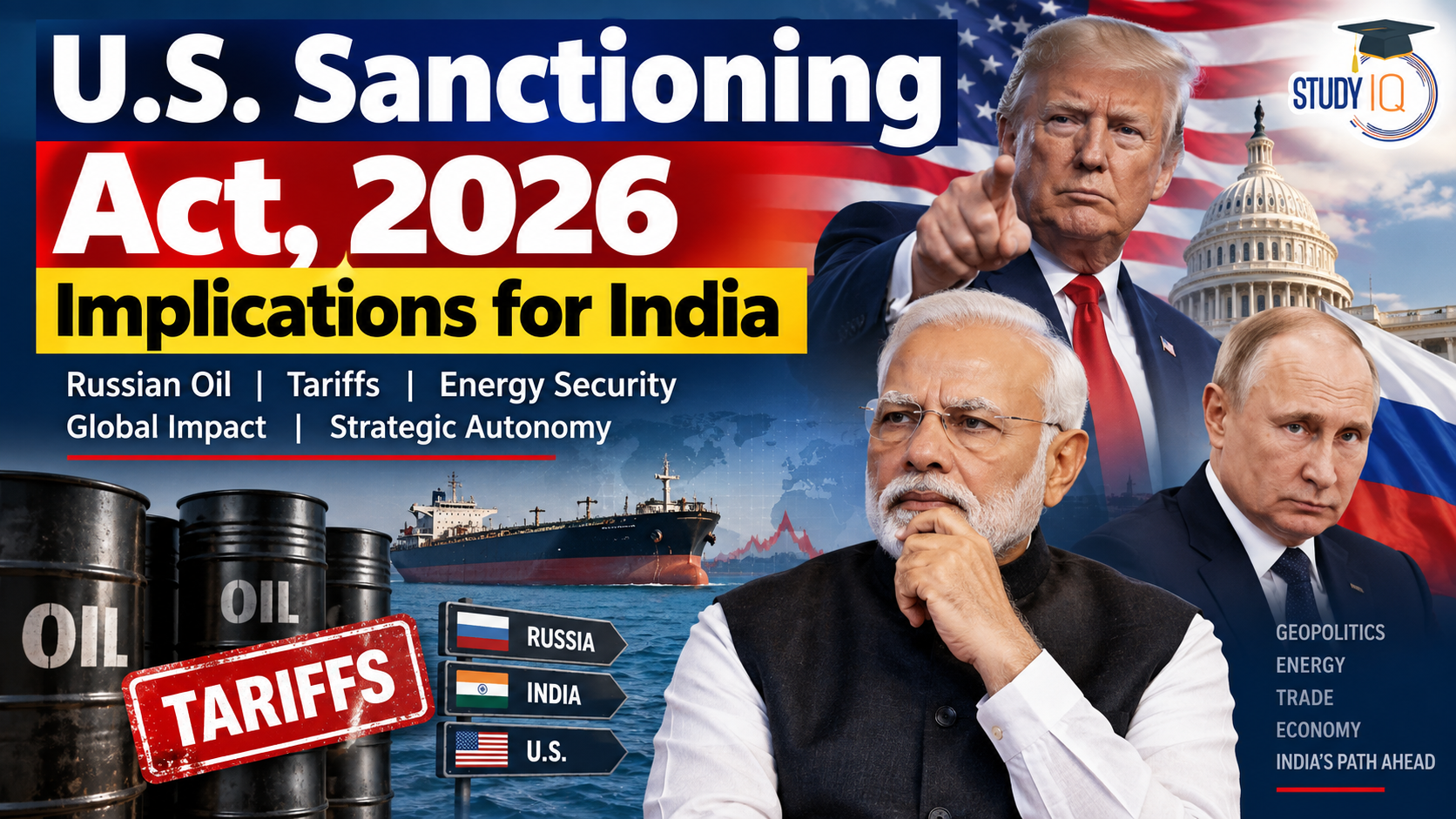
The Lindsey O. Graham Sanctioning Russia and Iran Act of 2026 has emerged as an important development in global geopolitics and economic statecraft. U.S. President Donald Trump signed the legislation into law on 18 September 2026, expanding statutory sanctions and tariff powers against Russia and extending existing sanctions on Iran.
For India, the law is significant because it authorises the U.S. President to impose targeted duties of up to 100% on goods from certain major purchasers of Russian-origin crude oil or natural gas, as well as countries facilitating Russian sanctions evasion. India, as a major buyer of Russian crude, could potentially be affected.
Crucially, the law does not automatically impose a 100% tariff on India. It creates a legal mechanism under which the U.S. administration can impose such duties subject to the conditions specified in the Act.
Read Also: UPSC Daily Current Affairs 2026
What is the U.S. Sanctioning Act 2026?
The Act is primarily designed to increase economic pressure on Russia over the continuing Russia-Ukraine conflict. It also extends the Iran Sanctions Act of 1996 for five years.
Its major components include:
- Sanctions against Russian officials, financial institutions and other entities.
- Measures targeting Russia’s shadow fleet.
- Secondary sanctions against specified foreign actors.
- Authority to impose tariffs of up to 100% on qualifying major purchasers of Russian energy.
- Extension of existing sanctions relating to Iran.
Why is India Concerned?
India’s concern stems primarily from its growing dependence on Russian crude.
Following the Russia-Ukraine conflict, discounted Russian crude became an important component of India’s oil procurement strategy. Current reporting indicates that Russia accounts for a substantial share of India’s crude imports, while India imports more than 88% of its crude-oil requirements.
This creates a strategic equation:
Russian crude → Affordable supply + diversification → Indian energy security
Any major disruption could therefore have consequences beyond foreign policy and extend to the wider economy.
Impact of the Act on India
1. Energy Security
The immediate concern is the possibility of disruption or increased cost of Russian crude.
If Indian refiners reduce Russian purchases, they may need to source more oil from the Middle East, Africa, Latin America or the United States.
However, replacing Russian crude completely is not an immediate or costless process, particularly when global oil markets are already experiencing geopolitical pressures.
2. Inflationary Pressure
Crude oil is a critical input across the economy.
Oil prices ↑ → Transport costs ↑ → Logistics costs ↑ → Production costs ↑ → Inflationary pressure
Therefore, a sustained increase in India’s crude-import costs could contribute to cost-push inflation.
3. Current Account and Rupee
Higher-priced crude imports can increase India’s overall import bill.
Crude import bill ↑
↓
Trade deficit ↑
↓
Potential pressure on CAD and ₹
The final impact, however, would depend on international oil prices, exchange rates, capital flows and India’s ability to diversify suppliers.
4. Impact on Indian Exports
If the United States imposes additional tariffs on Indian goods, India’s exports to the U.S. could become less competitive.
Potentially exposed sectors could include:
- Textiles and apparel
- Engineering goods
- Chemicals
- Pharmaceuticals
- Gems and jewellery
The actual impact would depend on the tariff rate, product coverage and duration.
Strategic Autonomy: The Core Issue for India
The Act highlights a broader foreign-policy challenge for India.
India has important relationships with both Russia and the United States.
Russia
- Defence cooperation
- Energy
- Nuclear cooperation
- Strategic partnership
United States
- Trade and investment
- Defence and technology
- Indo-Pacific cooperation
- Critical and emerging technologies
Therefore, India’s challenge is to protect its energy security without compromising its strategic autonomy.
The Russian oil issue shows why India seeks flexibility in maintaining relationships with multiple major powers.
Secondary Sanctions and Economic Statecraft
One of the most important concepts for UPSC aspirants is secondary sanctions.
Primary sanctions
Target the sanctioned country directly.
U.S. → Russia
Secondary sanctions
Create economic pressure on third countries engaging in specified transactions with the sanctioned country.
U.S. → Third-country buyer → Russian energy
Thus, the Act illustrates the growing use of economic interdependence as an instrument of geopolitical influence.
Way Forward for India
India can reduce vulnerability through a combination of short-term diplomacy and long-term energy transition.
Short Term
- Diversify crude suppliers.
- Maintain adequate strategic petroleum reserves.
- Engage diplomatically with Washington.
- Keep procurement commercially driven.
- Strengthen energy-supply resilience.
Long Term
Renewables + EVs + Biofuels + Green Hydrogen + Energy Efficiency
↓
Lower fossil-fuel dependence
↓
Greater Energy Security
↓
Greater Strategic Autonomy

UPSC IAS Live GS P2I Foundation 2027 Pratigya September Batch (Basic)
Conclusion
The U.S. Sanctioning Act 2026 is more than another sanctions legislation against Russia. For India, it represents a convergence of geopolitics, energy security, trade and strategic autonomy.
India’s policy challenge is not simply choosing between Russian and Western energy sources. It is to build sufficient diversification and domestic energy resilience so that external geopolitical developments do not disproportionately constrain its economic and foreign-policy choices.
 OneTag Facility 2026: How to Change FAST...
 Daily Current Affairs PDF 2026: Download...
 Daily Mains Articles 2026 – Updated Da...













 WhatsApp