Table of Contents
Context
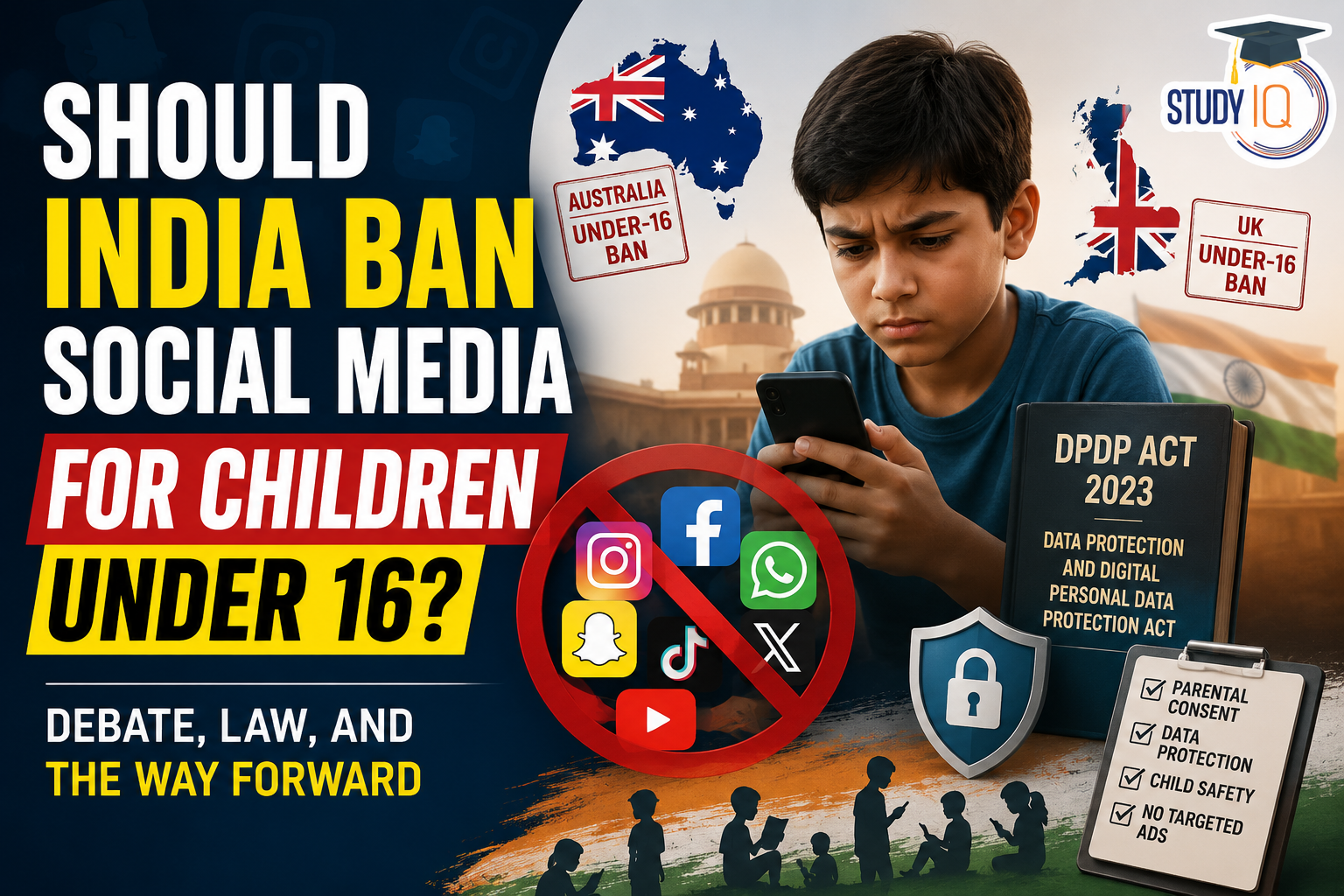
Australia banned social media for under-16s in December 2025. The UK has now announced a similar ban for under-16s, to be enforced by spring 2027. This has revived the debate in India on whether children need legal age limits for social media use.
Arguments in Favour of Age Limits
- Protecting Adolescent Mental Health: Early and intensive social media use among adolescents is linked to higher rates of depression, anxiety, and sleep disruption.
- g., Psychologists link the rise of smartphones and social media to a global spike in teenage mental health problems.
- Children Lack Self-Regulation: Adolescents are still developing self-control, so they cannot be expected to resist addictive design features on their own.
- g., NITI Aayog data shows 16-18 year olds in India spend as much as six hours a day on social media, forums, and shopping platforms.
- Rising Cybercrime Against Children: Greater time spent online has translated directly into greater risk,
- g., NCRB data shows cybercrime against children rising by 32% between 2021 and 2022 alone.
- Platform Safety Tools Are Often Ineffective: Voluntary, company-led protections cannot be relied upon as a substitute for a legal age limit.
- g., a study led by a former senior Meta engineer found that 64% of Instagram’s advertised child safety tools failed to work as intended, a finding Meta disputed.
- Global Policy Convergence: A growing number of countries are moving towards similar restrictions, showing an emerging international consensus on the issue.
- g., Denmark has approved rules to block under-15s from social media, and Spain is considering similar restrictions.
Arguments Against Age Limits
- Limited Real World Effectiveness: Bans are hard to enforce fully, since children can still bypass age checks.
- g., surveys show 70% of children in Australia remain on social media despite the ban, often without creating a formal account.
- Age Verification Threatens Privacy: Enforcing age limits usually requires identity document checks, which risks widespread surveillance and erosion of online anonymity for all users, not just children.
- Risk of Blanket Age Gating: Platforms may respond by requiring every user to prove adulthood, effectively gating large parts of the internet rather than only restricting children.
- Ignores Other Stressors: Critics argue that focusing only on social media risks ignoring other deeper causes of adolescent distress, such as academic pressure or family stress.
- Denies Children a Voice: Social media was meant to give every user, including children, a platform to learn and connect, and a ban removes this access entirely rather than reforming it.
- Implementation Burden on Platforms: Verifying parental identity and consent for every child user is operationally complex and costly, especially for smaller platforms.
What Is India Doing?
- No Statutory Age Limit Yet: India currently has no minimum age requirement for accessing social media platforms, unlike Australia or the UK.
- Parental Consent Under the DPDP Act, 2023: Section 9 mandates that platforms obtain verifiable parental consent before processing the personal data of anyone below 18 years, India’s legal definition of a child.
- Draft DPDP Rules, 2025: Released by MeitY, these rules operationalise consent by requiring platforms to verify both the child’s age and the parent’s identity, using identity proof issued by a government-recognised entity.
- Ban on Tracking and Targeted Ads: Section 9(3) of the DPDP Act prohibits behavioural tracking, profiling, and targeted advertising aimed at children, regardless of consent.
- Screen Time Guidelines for Schools: The Ministry of Education’s PRAGYATA Guidelines, 2020, recommend age-appropriate screen time limits.
- State-Level Push: Some states have begun pressing for stricter measures beyond the Central data protection framework.
- g., Andhra Pradesh has explored following Australia’s under-16 social media ban model, and similar calls have come from Karnataka.
What Is the Way Forward?
- Move From Ban to Design Reform: Mandate safer defaults such as private profiles, no late-night notifications, and no stranger messaging for minors.
- Strengthen Verifiable Parental Consent: Operationalise India’s existing parental consent framework with clear, low-friction verification methods that do not compromise user privacy.
- Adopt a Tiered Age Framework: Consider a graded approach where younger children face stricter restrictions and older teenagers get limited, supervised access, rather than a single hard cutoff.
- Shift Liability to Platforms, Not Children: Place the burden of compliance and penalties on platforms, not on children or parents, to avoid criminalising young users.
- g., Australia’s law does not penalise children or parents for violations, holding only social media companies accountable.
- Build Independent Oversight: Set up a dedicated regulatory body to monitor platform compliance, similar to a sector-specific safety regulator.
- g., Australia’s eSafety Commissioner oversees enforcement of its under-16 ban.
Latest UPSC Updates
| Resource | Link |
|---|---|
| UPSC Prelims Result 2026 | Check Here |
| UPSC Exam Calendar 2027 | View Calendar |
| UPSC Question Paper 2026 | Download PDF |
| UPSC Prelims Answer Key 2026 | Check Answer Key |
| UPSC Cut Off 2026 | View Cut Off |
| UPSC Syllabus 2026 | Read Syllabus |
| Daily Current Affairs 2026 | Read Updates |
| StudyIQ UPSC IAS Foundation 2027 (English) | Join Course |
| StudyIQ UPSC IAS Foundation 2027 (Hindi) | Join Course |
| StudyIQ UPSC IAS Foundation 2027 (Bilingual) | Join Course |
 Anti-Goonda Bill 2026 Explained: Why Pre...
 Cool Leaders Award 2026: Winners, Global...
 Black Carbon and Himalayan Glacier Melt:...











 WhatsApp