Table of Contents
Context
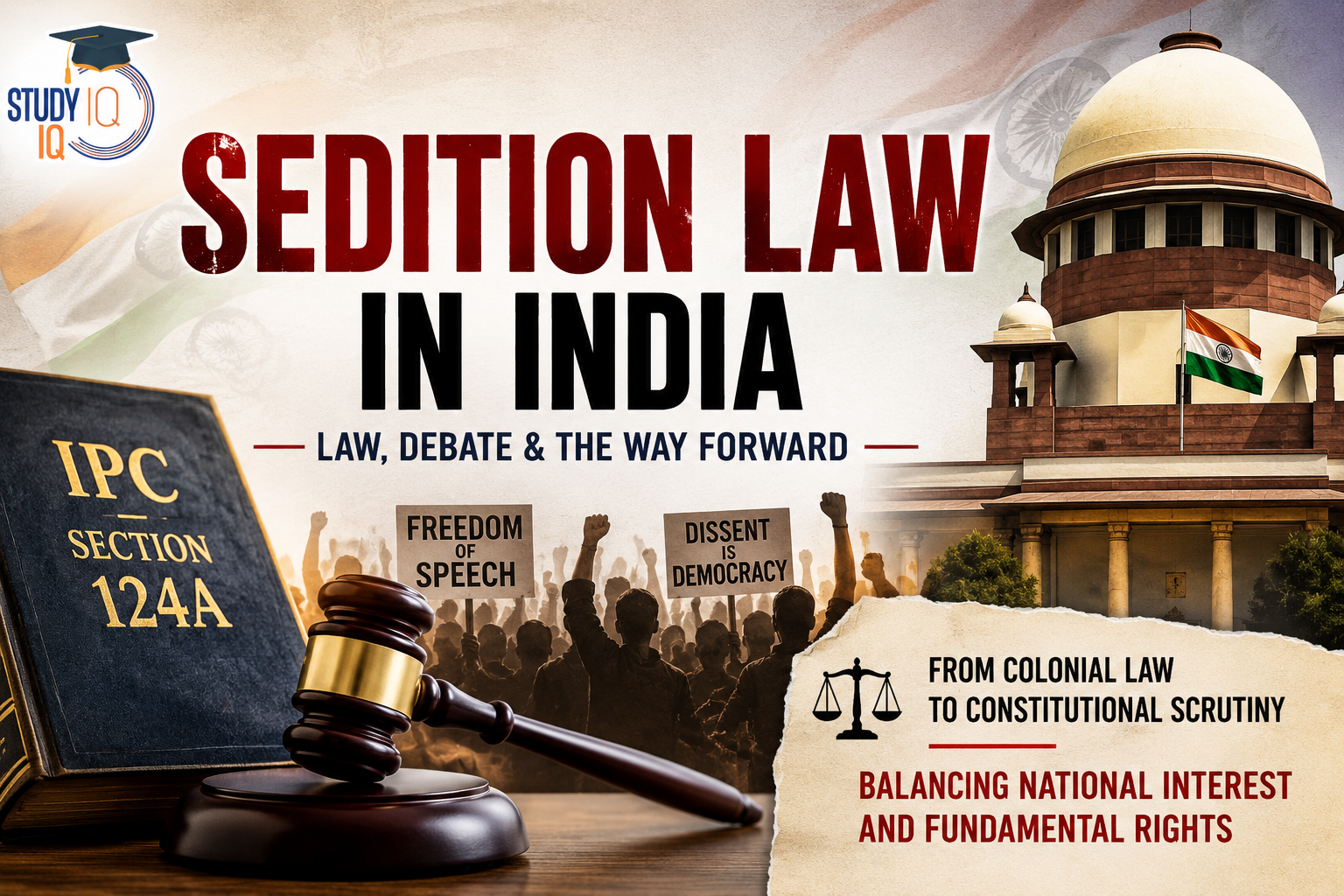
The Supreme Court permitted pending sedition-related cases under Section 124A of the IPC to continue if the accused agrees, despite the earlier suspension of the provision during constitutional scrutiny.
Read Also: UPSC Daily Current Affairs 2026
An overview of Sedition in India
- Sedition refers to any act or attempt to incite hatred, contempt, or disaffection against the government through words or actions.
- The Section 124A of IPC specifically mentions that any person who “excites or attempts to excite disaffection towards the Government established by law” in India shall be punished accordingly under the act provided other conditions under the section are satisfied.
- Under Article 19(2) of the Indian Constitution, certain reasonable restrictions can be provided for national security of the state
|
Data |
| ● Nature of Cases: 96% of sedition cases (405 individuals) over the last decade were registered post-2014, primarily for criticising politicians or governments.
● Conviction Rate (2019): Only 3.3% (NCRB) ● Rate of Increase in Sedition cases: 165% rise in sedition cases since 2016 (NCRB) ● The Law Commission’s April 2023 report supported retaining the sedition law, reasoning that its application in a democratic setup differs from its use under colonial rule. However, given the recurring evidence of misuse, it would be unjust for the government to overlook the law’s problematic implementation. ● Former CJI NV Ramana questioned the Sedition law while calling it a colonial law, which was used by the British to silence Mahatma Gandhi. He further questioned the relevance of the law after 75 years of Independence. |
Sedition under Bharatiya Nyaya Sanhita (BNS)
| Sedition under Bharatiya Nyaya Sanhita (BNS) |
| ● Under the BNS, Sedition is outlined in Section 152.
● Origin: This provision draws its origin from Section 124A of the Indian Penal Code (IPC), 1860, which was initially introduced in 1870 by the British colonial government to penalize expressions of hatred, contempt, or disaffection against the British Crown. ● Punishment under Section 124A of the IPC was either life imprisonment or imprisonment up to three years, with an optional fine. ● In contrast, Section 152 of the BNS prescribes life imprisonment or imprisonment up to seven years, along with a mandatory fine. ● The objective of this provision is to safeguard national integrity and prevent the fragmentation of the country, especially in the context of India’s diverse society and its historical experience with secessionist movements. |
Case Laws
- Tara Singh v. State of Punjab (1950): In this case, the court held the section as unconstitutional as it was against the freedom of speech and expression.
- Ram Nandan v. State of UP (1958): The Allahabad HC held that Section 124A imposed restrictions on the freedom of speech which was not in the interest of the people.
- Kedarnath v. State of Bihar (1962): The Supreme Court observed that the sedition law must be narrowly interpreted.
- Balwant Singh and Another v. State of Punjab (1995): The SC held that the casual raising of slogans once or twice by two individuals cannot be termed as Sedition.
- Shreya Singhal Vs. Union of India (2015): The SC drew distinction between Advocacy and incitement where only incitement can be punished.
- Tejender Pal Singh v. State of Rajasthan & Anr (2024): A bench of Justice Arun Monga held that Section 152 of BNS should not be used to cripple legitimate dissent and only deliberate actions with malicious intent would fall within the ambit of this provision.
Supreme Court’s Clarification (2026)
- Conditional Continuation of Trials: Pending cases may proceed if accused persons do not object.
- Judicial Backlog Reduction: Move intended to ease pendency during BNS transition.
- Questionable Voluntariness of Consent: Incarcerated individuals may lack genuine freedom to refuse.
- Consent under Compulsion: Accused may accept trials merely to avoid indefinite custody.
- “Hobson’s Choice” Situation: Individuals forced between equally unfavourable alternatives.
Arguments in Favour of Sedition Law
- National Security: Helps address threats from insurgent groups and hostile elements.
- State Stability: Protects against anti-national acts and attempts to topple elected governments.
- Preserving Public Order: Enables action against those provoking public emotions leading to unrest.
- Social Harmony: Prevents attempts to incite hatred or disharmony within society.
- Control on Non-State Actors: Deters individuals with terrorist motives or subversive intentions.
- Preventive in Nature: Acts as a deterrent against participation in anti-state activities.
- Combatting Extremism: Useful in dealing with Maoist insurgency and similar internal threats.
- Checks Separatist Movements: Effective against secessionist groups like Khalistan outfits and ULFA.
Arguments against Sedition Law
- Rampant Misuse: The sedition law is often invoked against critics of the government, leading to misuse rather than genuine application.
- Draconian Colonial Legacy: Originating during British rule, the law’s rationale no longer aligns with the principles of a democratic republic. It restricts free speech, a cornerstone of democracy.
- Eg: Leaders like Mahatma Gandhi and Jawaharlal Nehru were prosecuted under this law, indicating its misuse even during the freedom struggle.
- Suppresses Democratic Discourse: The Supreme Court, in 2021, highlighted the need to define limits of sedition while shielding Telugu news channels from state action—underlining its misuse to stifle the media.
- Violation of International Obligations: Despite being a signatory to international human rights covenants, India’s sedition law fails to uphold free speech norms under Article 19.
- Poor Conviction Rate: With a conviction rate of just 3.3% (NCRB), the law disproportionately harms the accused without delivering justice.
- Redundancy in Legal Framework: Many recent sedition charges could have been addressed under existing criminal laws, making its separate invocation unnecessary.
- Threat to Whistle-Blowers: The law may deter individuals from exposing corruption or illegal acts due to fear of prosecution. (Article 19 & Whistleblower Protection Act)
- Infringement on Free Expression: The provision can be misapplied to suppress dissent, curbing the fundamental right to free speech (Article 19)
Way Forward
- Differentiate Nature of Offences: It is crucial to distinguish between seditious speech and actual seditious acts to avoid unnecessary criminalisation of free expression.
- Responsibility of Proof: The onus of proving harm from alleged seditious acts should lie with the complainant.
- Refine Definition: The scope of sedition should be restricted strictly to threats against the sovereignty and territorial integrity of India.
- Judicial Oversight: Higher judiciary must actively guide lower courts and law enforcement on the constitutional boundaries of free speech.
- Police Training: Law enforcement should be made aware that sedition does not cover mere criticism or expression of dissent.
- Use with Restraint: Application should be limited to rare, serious cases to prevent arbitrary or politically motivated use.
Best Practices
| Best Practices |
| ● United Kingdom: The Coroners and Justice Act, 2009 repealed sedition laws, though they remain applicable to non-British nationals in certain cases.
● Indonesia: The judiciary has declared sedition laws unconstitutional, moving away from colonial-era statutes. ● United States: Although Section 2385 of the U.S. Code criminalises advocating the violent overthrow of the government, it is rarely enforced to safeguard freedom of speech |
|
Read More Notes |
|
| Environment Notes | Art and Culture Notes |
| Science and Tech | History Notes |
| Geography Notes | Indian Polity Notes |
| General Knowledge | International Relation |
|
Explore StudyIQ Courses |
|
 Why Do Stampedes Occur in India? Crowd P...
 Strategic Disinvestment in India: IDBI B...
 Women’s Livelihoods in India: Challeng...














 WhatsApp