
Table of Contents
Context
The global space economy is projected to exceed USD 1 trillion by 2030, driven by reduced launch costs, higher launch frequency, and the emergence of reusable rocket technologies.
About Reusable Launch Vehicles
- A Reusable Launch Vehicle (RLV) is the space-faring equivalent of an aircraft.
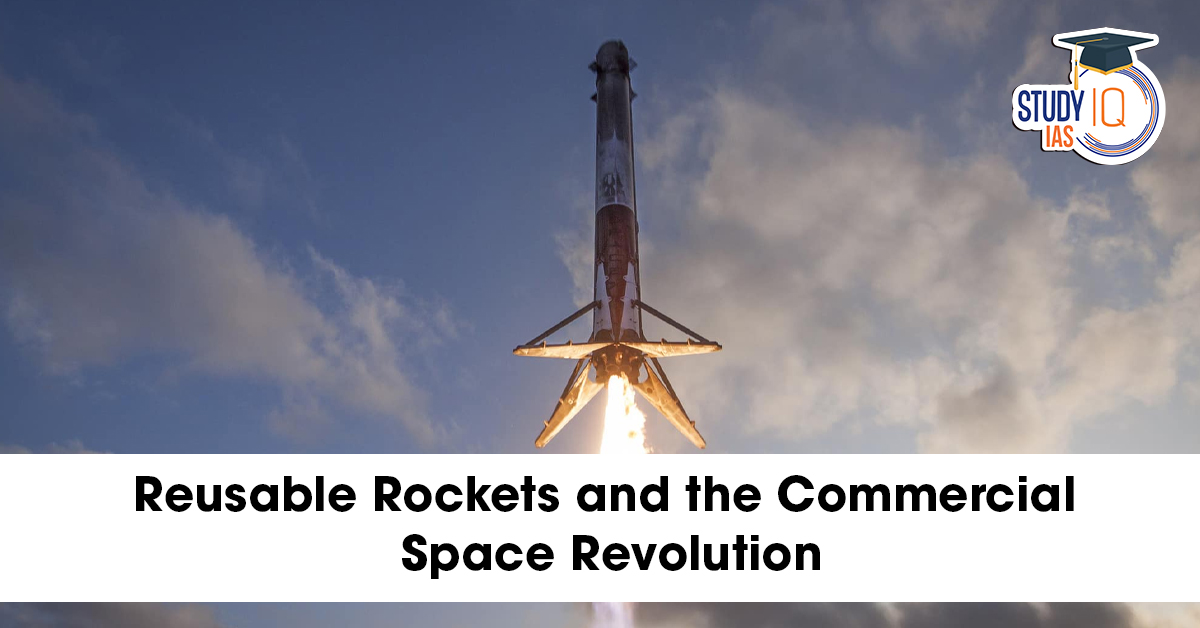
- Unlike traditional rockets that are discarded after a single use, an RLV is designed to launch vertically into space and glide back to Earth for an autonomous landing, allowing it to be refurbished and flown again.
- Design: It must be lightweight yet robust enough to withstand the extreme thermal and mechanical stresses of spaceflight.
- Aeronautics: As a “space plane,” it has a low lift-to-drag ratio. This requires a steep descent angle and high landing speeds (approximately 350 kmph).
- Ideal Goal: The ultimate objective is a “Single-Stage-to-Orbit” (SSTO) system, though current models typically use two stages.
Major RLV Projects
| Project | Agency | Key Characteristics |
| Starship | SpaceX | Fully reusable; most powerful rocket ever built; “belly-flop” atmospheric entry; critical for NASA’s Artemis Moon missions. |
| Falcon 9 | SpaceX | Partially reusable; workhorse for ISS cargo and crew missions. |
| New Shepard | Blue Origin | Suborbital reusable vehicle designed for space tourism and research. |
| RLV-TD | ISRO (India) | A technology demonstrator series aimed at achieving a Two-Stage-to-Orbit (TSTO) reusable system. |
Significance of Reusable Launch Vehicles (RLVs)
- Cost Efficiency: By enabling the repeated use of expensive rocket hardware, RLVs drastically lower the per-launch cost compared to traditional expendable rockets.
- Increased Launch Frequency: Reusability supports a higher launch cadence, which is essential for deploying large satellite constellations and maintaining frequent human spaceflight missions.
- Economic Viability: Lowering the financial barriers makes commercial space activities more profitable and accessible for private enterprises and research institutions.
- Strategic Autonomy: Developing indigenous RLV technology ensures a nation remains self-reliant and competitive in the rapidly evolving global space economy.
- Technological Advancement: The pursuit of reusability drives innovation in heat-shielding materials, autonomous landing systems, and precision navigation.
Challenges of Reusable Launch Vehicles (RLVs)
- Material Fatigue: Repeated cycles of launch and landing lead to structural wear and tear, limiting the number of times a vehicle can be safely reused.
- Extreme Thermal & Mechanical Stress: Spacecraft must endure intense heat during atmospheric re-entry and high pressure during ascent, requiring advanced shielding and robust airframes.
- High Refurbishment Costs: The expense of inspecting, repairing, and assuring the safety of a used vehicle can sometimes rival the cost of building a new one.
- Safety Assurance: Ensuring 100% reliability for repeated missions, especially for human-rated flights, requires rigorous and time-consuming testing protocols.
- Turnaround Time vs. Reliability: Balancing the need for rapid relaunch (to maintain high frequency) with the necessity of thorough maintenance remains a major operational hurdle.
- Payload Penalty: Carrying extra fuel, landing gear, and recovery systems increases the vehicle’s “dead weight,” which reduces the total amount of cargo it can carry into orbit.
 Hindi Diwas 2026: Why September 14 Matte...
 Superalignment: Meaning, AI Safety, Weak...
 DILRMP 3.0 (2026–2031): Bhu-Aadhaar, G...














 WhatsApp





