Table of Contents
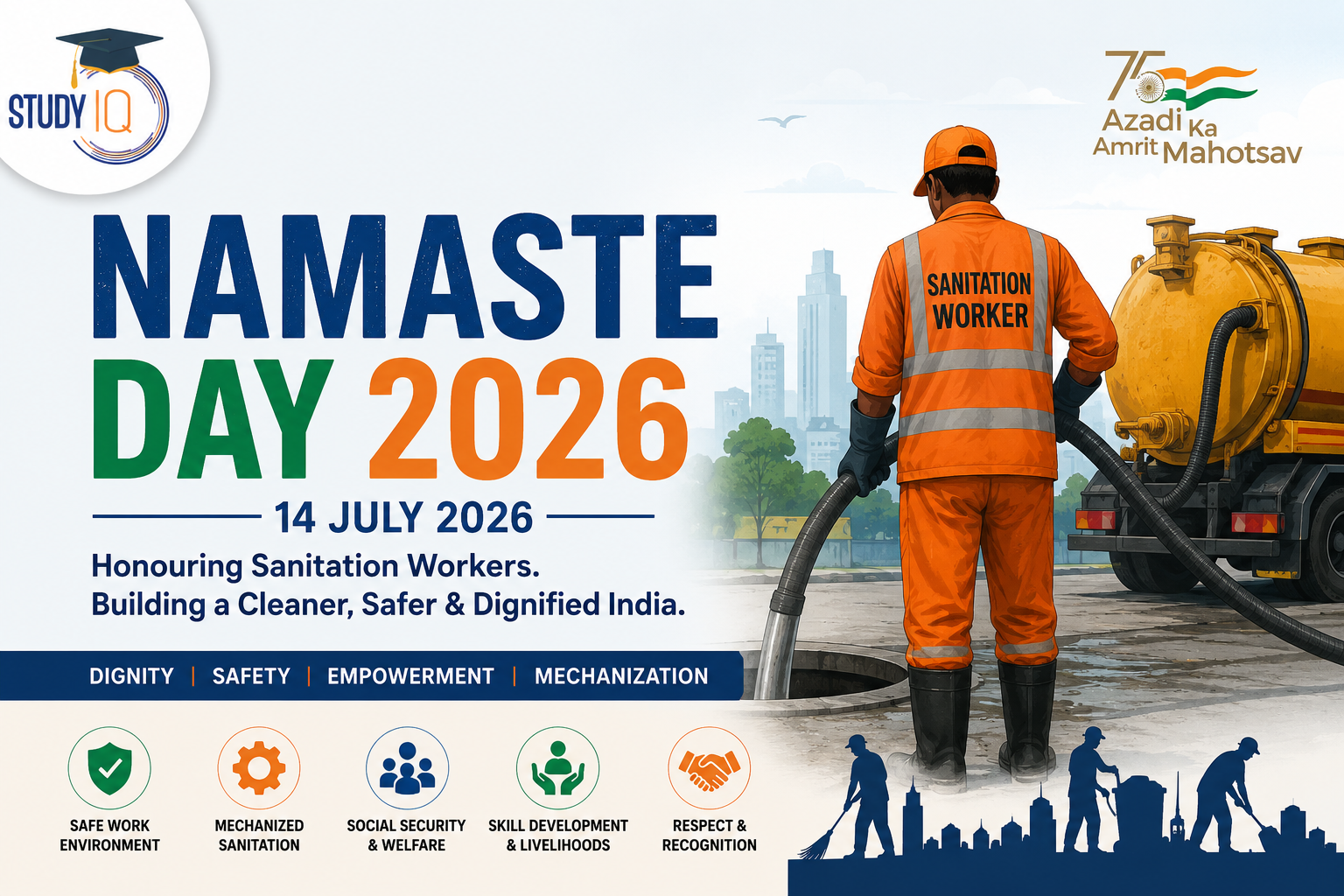
India will celebrate NAMASTE Day 2026 on 14 July 2026, marking the third anniversary of the National Action for Mechanized Sanitation Ecosystem (NAMASTE) Scheme. The nationwide observance recognizes the invaluable contribution of sanitation workers and reaffirms the Government of India’s commitment to ensuring safe, mechanized, and dignified sanitation services.
The Ministry of Social Justice and Empowerment will organize the national celebration at Rabindra Sadan, Kolkata, West Bengal, while Urban Local Bodies (ULBs) across the country will conduct awareness programmes, health camps, safety training, and recognition ceremonies for sanitation workers.
As India continues its mission to eliminate hazardous manual sanitation practices, NAMASTE Day serves as an important occasion to promote worker safety, dignity, and social inclusion.
What is NAMASTE Day?
NAMASTE Day is observed every year on 14 July to honour sanitation workers who play a vital role in protecting public health and maintaining urban sanitation.
The observance recognizes the contribution of:
- Sewer workers
- Septic tank workers
- Waste pickers
- Former manual scavengers
- Other sanitation workers
Beyond celebrating their service, the day spreads awareness about workers’ rights, occupational safety, mechanized sanitation, and access to government welfare schemes.
The 2026 observance marks three years since the launch of the NAMASTE Scheme in 2023.
NAMASTE Day 2026 Celebration
The national event will be held at Rabindra Sadan in Kolkata, alongside the Divya Kala Mela, with similar programmes organized by Urban Local Bodies throughout the country.
The event is expected to witness the participation of:
- Union Minister for Social Justice and Empowerment Dr. Virendra Kumar
- Senior officials from the Central and State Governments
- Members of Parliament
- MLAs
- District administration officials
- National Safai Karamcharis Finance & Development Corporation (NSKFDC)
- Sanitation workers and other dignitaries
The celebration highlights the government’s commitment to improving the dignity, safety, and livelihoods of sanitation workers.
Activities Planned Across India
Urban Local Bodies will organize several welfare-oriented programmes for sanitation workers, including:
- Occupational safety training
- Health check-up camps
- Distribution and facilitation of government welfare benefits
- Demonstration of mechanized sanitation equipment
- Training on the use of Personal Protective Equipment (PPE)
- Recognition and felicitation of sanitation workers
- Awareness campaigns on safe sanitation practices
These initiatives encourage safer working conditions while promoting the adoption of modern sanitation technologies.
What is the NAMASTE Scheme?
The National Action for Mechanized Sanitation Ecosystem (NAMASTE) is a flagship initiative jointly implemented by the Ministry of Social Justice and Empowerment and the Ministry of Housing and Urban Affairs (MoHUA).
Launched in 2023-24, the scheme aims to eliminate hazardous sanitation practices by replacing manual cleaning with mechanized technologies while ensuring dignity, safety, and social security for sanitation workers.
The scheme is one of India’s major initiatives towards ending unsafe sanitation work and promoting modern sanitation infrastructure.
Objectives of the NAMASTE Scheme
The major objectives of the scheme include:
- Ensuring dignity and safety of sanitation workers.
- Eliminating hazardous manual cleaning of sewers and septic tanks.
- Promoting mechanized sanitation services across urban India.
- Preventing direct human contact with human faecal matter.
- Providing skill development and capacity-building opportunities.
- Improving access to welfare schemes and financial assistance.
- Promoting entrepreneurship among sanitation workers.
- Strengthening Emergency Response Sanitation Units (ERSUs).
Key Features of the NAMASTE Scheme
Mechanized Cleaning
The scheme promotes the use of modern technologies such as suction-cum-jetting machines, robotic sewer cleaners, and other mechanized equipment to eliminate hazardous manual cleaning.
Occupational Safety
Workers receive:
- Personal Protective Equipment (PPE)
- Safety training
- Health awareness programmes
- Standard operating procedures for confined-space entry
Skill Development
Sanitation workers are provided with:
- Technical training
- Certification programmes
- Entrepreneurship development
- Alternative livelihood opportunities
Financial Inclusion
The scheme facilitates:
- Access to concessional loans
- Credit support through NSKFDC
- Assistance for purchasing sanitation equipment
- Linkages with welfare programmes
Social Security
Workers are connected to:
- Health insurance
- Social welfare schemes
- Financial inclusion initiatives
- Sustainable livelihood opportunities
Intended Outcomes of the NAMASTE Scheme
The scheme aims to achieve several long-term outcomes:
- Zero fatalities during sanitation work.
- Complete elimination of direct contact with human waste.
- Universal adoption of mechanized sanitation technologies.
- Skilled sanitation workforce across Urban Local Bodies.
- Strong Emergency Response Sanitation Units (ERSUs).
- Empowerment through Self-Help Groups (SHGs) and entrepreneurship.
- Improved social security and financial stability for sanitation workers.
Significance of NAMASTE Day
NAMASTE Day is more than a commemorative event—it is a national campaign promoting dignity, inclusion, and occupational safety for sanitation workers.
Its significance lies in:
- Recognizing sanitation workers’ contribution to public health.
- Promoting mechanized sanitation and modern technologies.
- Raising awareness about workers’ rights and welfare.
- Supporting the elimination of hazardous sanitation practices.
- Encouraging safer workplaces through training and protective equipment.
- Reinforcing India’s commitment to inclusive urban development.
Challenges Ahead
Despite significant progress, several challenges remain:
- Complete mechanization of sanitation services in smaller towns.
- Availability of modern equipment across all Urban Local Bodies.
- Continuous training of sanitation workers.
- Effective implementation of safety protocols.
- Universal access to social security and health insurance.
- Sustained elimination of manual scavenging practices.
Addressing these issues will be crucial for achieving the goals of the NAMASTE Scheme.
Conclusion
NAMASTE Day 2026 highlights India’s commitment to transforming sanitation work into a safe, dignified, and technology-driven profession. Through the NAMASTE Scheme, the government is working towards eliminating hazardous manual cleaning, improving occupational safety, expanding livelihood opportunities, and ensuring social security for sanitation workers.
As the nation celebrates the third anniversary of the scheme, NAMASTE Day serves as a reminder that sanitation workers are indispensable to public health and deserve respect, protection, and equal opportunities.
Latest UPSC Updates
| Resource | Link |
|---|---|
| UPSC Prelims Result 2026 | Check Here |
| UPSC Exam Calendar 2027 | View Calendar |
| UPSC Question Paper 2026 | Download PDF |
| UPSC Prelims Answer Key 2026 | Check Answer Key |
| UPSC Cut Off 2026 | View Cut Off |
| UPSC Syllabus 2026 | Read Syllabus |
| Daily Current Affairs 2026 | Read Updates |
| StudyIQ UPSC IAS Foundation 2027 (English) | Join Course |
| StudyIQ UPSC IAS Foundation 2027 (Hindi) | Join Course |
| StudyIQ UPSC IAS Foundation 2027 (Bilingual) | Join Course |
 World Food Day 2026: Strengthening Nutri...
 International Day for the Eradication of...
 India’s Ramsar Sites Reach 103: Sukhna...














 WhatsApp