Table of Contents
The Delhi High Court has reaffirmed the principle of the Horizontal Application of Fundamental Rights by holding that private media houses performing a public function can be proceeded against under Article 226 of the Constitution for violating an individual’s Right to Privacy. The judgment strengthens constitutional protections in an era where private entities increasingly influence public life and fundamental freedoms.
The ruling builds upon the Supreme Court’s decisions in K.S. Puttaswamy v. Union of India (2017) and Kaushal Kishor v. State of Uttar Pradesh (2023), which recognized that certain Fundamental Rights are enforceable not only against the State but also, in specific circumstances, against private individuals and institutions.
What is the Horizontal Application of Fundamental Rights?
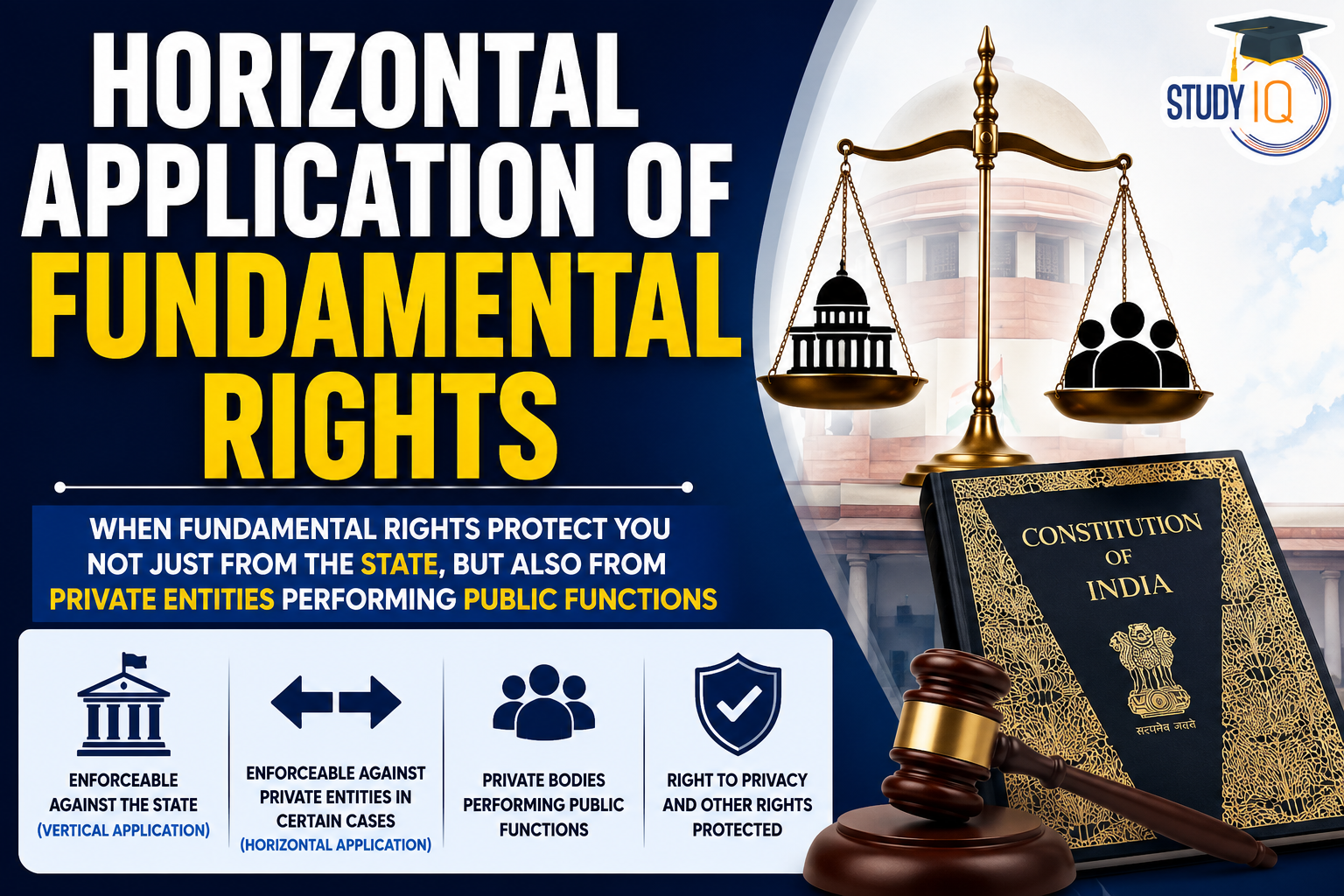
The Horizontal Application of Fundamental Rights refers to the enforcement of certain constitutional rights against private individuals or non-State entities, especially when they perform public functions or infringe rights protected under Part III of the Constitution.
Traditionally, Fundamental Rights are enforceable against the State (vertical application). However, constitutional provisions and judicial interpretations have expanded their scope in select cases to include private actors.
Vertical vs Horizontal Application of Fundamental Rights
| Vertical Application | Horizontal Application |
|---|---|
| Enforceable only against the State | Enforceable against private individuals or non-State entities performing public functions |
| General rule under Part III of the Constitution | Applies only in specific constitutional or judicially recognized situations |
| Example: Challenging arbitrary State action under Article 14 | Example: Challenging a private media house for violating an individual’s Right to Privacy |
Delhi High Court’s Observation
The Delhi High Court observed that private media organizations play a significant role in shaping public discourse and therefore perform a public function. As a result, they may be subjected to writ jurisdiction under Article 226 if their actions violate an individual’s constitutional rights, including the Right to Privacy under Article 21.
The judgment highlights that constitutional protections cannot become ineffective merely because the violation is committed by a private entity performing functions that significantly impact public rights.
Fundamental Rights with Horizontal Application
Several Fundamental Rights already have horizontal applicability either through constitutional provisions or judicial interpretation.
1. Article 15(2): Prohibition of Discrimination
Article 15(2) prohibits discrimination by private individuals regarding access to:
- Shops
- Public restaurants
- Hotels
- Places of public entertainment
- Wells, tanks, roads, and public spaces
This provision directly applies to private persons and establishments.
2. Article 17: Abolition of Untouchability
Article 17 abolishes untouchability in all forms and makes its practice punishable by law. It binds both the State and private individuals, ensuring social equality.
3. Article 23: Prohibition of Human Trafficking and Forced Labour
Article 23 prohibits:
- Human trafficking
- Begar (forced labour)
- Bonded labour
The provision is enforceable against both government authorities and private persons.
4. Article 21: Right to Privacy
The Right to Privacy, recognized as part of Article 21, now extends to situations where private entities performing public functions infringe an individual’s privacy.
This principle has gained further recognition through the Delhi High Court’s recent judgment involving private media organizations.
5. Article 24: Prohibition of Child Labour
Article 24 prohibits the employment of children below the age of 14 years in factories, mines, and hazardous occupations. It is enforceable against both the State and private employers.
Important Constitutional Provisions
Article 21: Right to Life and Personal Liberty
The Supreme Court, in K.S. Puttaswamy v. Union of India (2017), unanimously declared the Right to Privacy as an intrinsic part of Article 21.
The judgment identified privacy as including:
- Personal autonomy
- Freedom of choice
- Bodily integrity
- Informational privacy
- Control over personal data
Article 19(1)(a): Freedom of Speech and Expression
Article 19(1)(a) guarantees citizens the Freedom of Speech and Expression.
However, this right is subject to reasonable restrictions under Article 19(2) on grounds of:
- Security of the State
- Friendly relations with foreign States
- Public order
- Decency or morality
- Contempt of court
- Defamation
- Incitement to an offence
- Sovereignty and integrity of India
Courts often balance freedom of the press with an individual’s Right to Privacy.
Article 226: Writ Jurisdiction of High Courts
Article 226 empowers High Courts to issue writs not only against the State but also against:
- Authorities
- Statutory bodies
- Private organizations performing public duties or public functions
This provision forms the constitutional basis for the Delhi High Court’s ruling against private media houses.
Important Supreme Court Judgments
K.S. Puttaswamy v. Union of India (2017)
A nine-judge Constitution Bench unanimously held that the Right to Privacy is a Fundamental Right protected under Article 21. The judgment became the constitutional foundation for data protection, informational privacy, and individual autonomy.
Kaushal Kishor v. State of Uttar Pradesh (2023)
The Supreme Court Constitution Bench clarified that certain Fundamental Rights can operate horizontally, meaning they may be enforceable against private individuals depending on the nature of the right and the circumstances.
Significance of the Delhi High Court Judgment
The ruling has far-reaching constitutional implications:
- Strengthens protection of individual privacy in the digital and media age.
- Expands accountability of private entities performing public functions.
- Reinforces the evolving doctrine of horizontal application of Fundamental Rights.
- Balances freedom of the press with the constitutional right to privacy.
- Broadens the scope of writ jurisdiction under Article 226.
Conclusion
The Delhi High Court’s decision marks another important step in the evolution of Indian constitutional law. While the traditional framework of Fundamental Rights is primarily vertical, judicial interpretation has gradually recognized that certain rights—particularly those safeguarding dignity, equality, and personal liberty—must also protect individuals from violations by private actors. As private institutions increasingly influence public life, the doctrine of the Horizontal Application of Fundamental Rights ensures that constitutional guarantees remain meaningful and effective in modern India.
Latest UPSC Updates
| Resource | Link |
|---|---|
| UPSC Prelims Result 2026 | Check Here |
| UPSC Exam Calendar 2027 | View Calendar |
| UPSC Question Paper 2026 | Download PDF |
| UPSC Prelims Answer Key 2026 | Check Answer Key |
| UPSC Cut Off 2026 | View Cut Off |
| UPSC Syllabus 2026 | Read Syllabus |
| Daily Current Affairs 2026 | Read Updates |
| StudyIQ UPSC IAS Foundation 2027 (English) | Join Course |
| StudyIQ UPSC IAS Foundation 2027 (Hindi) | Join Course |
| StudyIQ UPSC IAS Foundation 2027 (Bilingual) | Join Course |
 World Food Day 2026: Strengthening Nutri...
 International Day for the Eradication of...
 India’s Ramsar Sites Reach 103: Sukhna...














 WhatsApp