Table of Contents
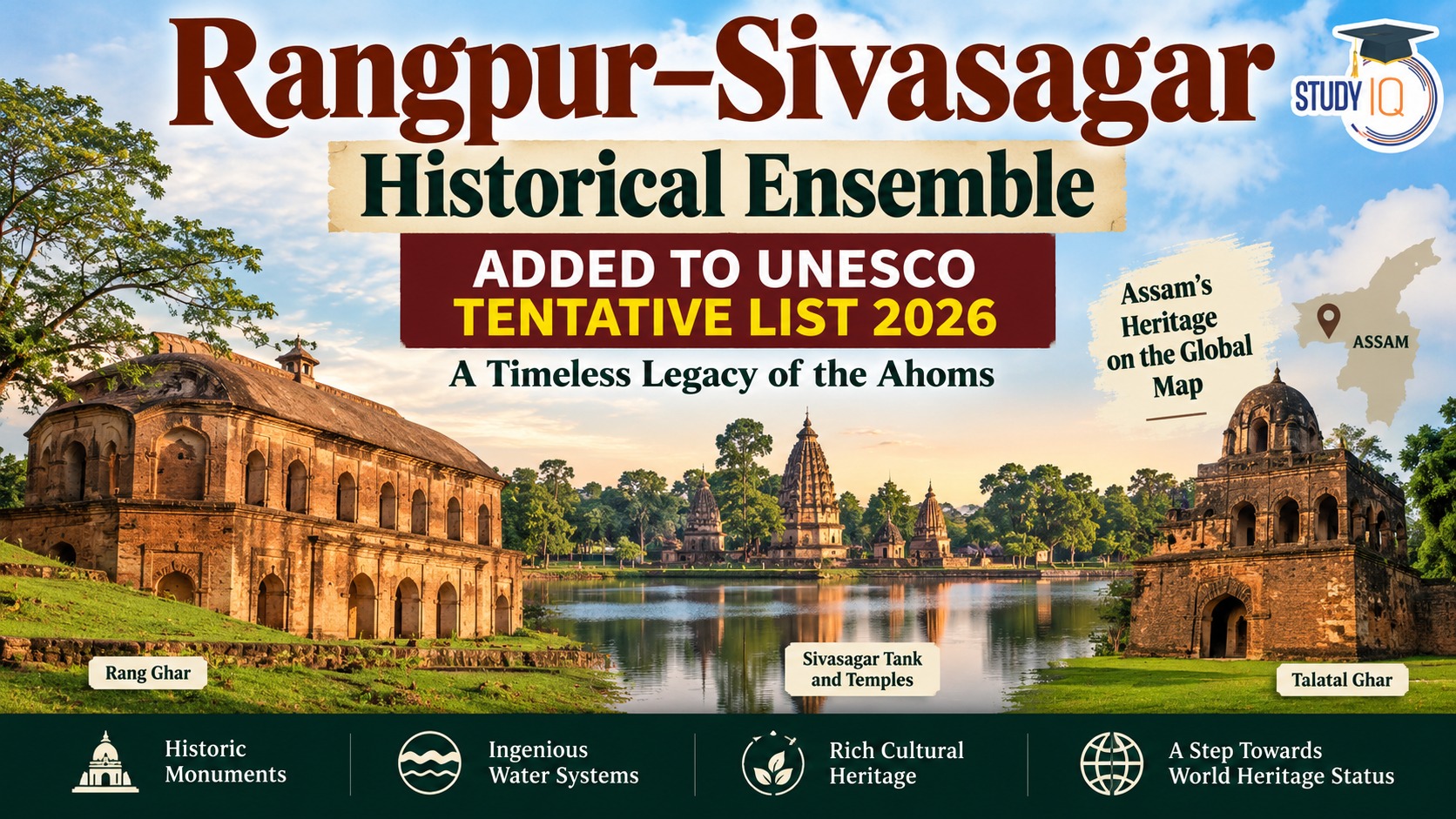
The Rangpur–Sivasagar Historical Ensemble in Assam has been added to UNESCO’s World Heritage Tentative List in 2026, recognising its exceptional cultural, architectural and technological legacy of the Tai-Ahom dynasty. India submitted the property to UNESCO on 19 June 2026 under the Cultural category and proposed it under Criteria (iii) and (iv).
Located in Sivasagar district of Assam, the ensemble represents nearly six centuries of Ahom rule in the Upper Brahmaputra Valley. Its significance extends beyond individual monuments, encompassing an integrated historical landscape of palaces, temples, artificial tanks, fortifications, roads, bridges and ceremonial structures.
Read Also: UPSC Daily Current Affairs 2026
What is the Rangpur–Sivasagar Historical Ensemble?
The ensemble consists primarily of the historic areas of Rangpur and Sivasagar.
Rangpur, also known as Che Muan or the “city of amusement,” was developed as a planned capital by Ahom King Swargadeo Rudra Singha in the early 18th century. The city was strategically integrated with rivers, wetlands, elevated terrain and an extensive water-management system.
The Ahom kingdom was established by Siu-Ka-Pha in 1228 CE and continued for around 600 years in the Brahmaputra Valley. Ahom rule formally ended following the Treaty of Yandabo in 1826.
Major Monuments of Rangpur–Sivasagar
Talatal Ghar
Talatal Ghar, also known as Kareng Ghar, formed part of the royal palace complex at Rangpur. It combined royal, administrative and military functions and was protected by fortifications and defensive water systems.
Rang Ghar
The Rang Ghar was a royal sports and entertainment pavilion where Ahom royalty watched activities such as wrestling and buffalo fights. It was also associated with royal celebrations of Rongali Bihu.
Its distinctive roof, resembling an inverted Ahom boat, is one of its most recognisable architectural features.
Joysagar, Gaurisagar and Sivasagar Tanks
The enormous artificial tanks are among the most remarkable features of the ensemble.
- Joysagar: Constructed by Rudra Singha in memory of his mother, Queen Jayamati.
- Gaurisagar: Associated with Queen Phulesvari Devi, wife of Siva Singha.
- Sivasagar: Constructed during the reign of Siva Singha and gave its name to the present town.
These reservoirs were not merely sources of water. They supported irrigation, drinking water supply, religious activities, ceremonies and community life.
Ahom Hydraulic Engineering
One of the strongest arguments for the site’s heritage significance is its sophisticated water-based urban planning.
The Ahoms integrated large tanks with:
- Embankments
- Moats or yamunas
- Drainage systems
- Roads and pathways
- Temples
- Palaces
- Agricultural areas
- Defensive structures
The surrounding yamunas helped regulate water levels, divert excess water, reduce erosion and strengthen defensive capabilities.
This demonstrates how the Ahoms adapted urban planning to the high-rainfall and riverine environment of the Brahmaputra Valley.
Temple Architecture
The ensemble contains three important temple groups:
- Joysagar Temple Group – Joydol, Sivadol, Devidol and Ghanashyam House.
- Gaurisagar Temple Group – prominently featuring Devidol.
- Sivasagar Temple Group – including temples dedicated to Shiva, Devi and Vishnu.
Ahom religious architecture demonstrates a synthesis of Tai-Ahom traditions with regional Indian architectural influences. Brick and stone became increasingly prominent from the 17th century, replacing earlier dependence on bamboo and timber.
UNESCO Criteria
The Rangpur–Sivasagar Historical Ensemble has been proposed under two UNESCO criteria:
Criterion (iii)
The site provides exceptional testimony to the living cultural traditions, belief systems and statecraft of the Tai-Ahom polity. Its temples, rituals, festivals, water bodies and cultural practices continue to contribute to Assam’s cultural identity.
Criterion (iv)
The ensemble represents an exceptional example of pre-modern water-based urban planning, architecture and ceremonial infrastructure. Its integration of reservoirs, palaces, temples, roads, bridges and defensive structures demonstrates sophisticated planning and engineering.
Why is the Site Important?
The uniqueness of Rangpur–Sivasagar lies in its character as a living cultural landscape rather than merely an archaeological site.
Its heritage value emerges from the interaction between:
Architecture + Hydraulic Engineering + Statecraft + Defence + Religion + Ecology + Living Traditions
The ensemble also reflects the historical position of Assam as part of wider trade and cultural networks connecting Northeast India with East and Southeast Asia.

UPSC IAS Live GS P2I Foundation 2027 Pratigya August Evening Batch 2 (Basic)
Challenges to Conservation
Despite its outstanding heritage potential, the ensemble faces several challenges, including:
- Urban expansion
- Encroachment around historic water bodies
- Sedimentation of tanks
- Reduced water-holding capacity
- Degradation of historic structures
- Pressure on the ecological and visual character of the landscape
Effective conservation, heritage management and protection will therefore be essential if the property is to progress from the Tentative List towards full World Heritage status.
 Supreme Court on Children's Right to Int...
 Daily Current Affairs PDF 2026: Download...
 Daily Mains Articles 2026 – Updated Da...











 WhatsApp