
Table of Contents
The Ramsar Convention 1971 is one of the most important international environmental treaties dedicated to the conservation and sustainable use of wetlands. As wetlands face rapid degradation worldwide, the convention provides a global framework to protect these critical ecosystems that support biodiversity, regulate climate, and sustain human livelihoods.
This detailed article explains the meaning, history, objectives, pillars, structure, key facts, India’s role, and global significance of the Ramsar Convention.
What Is the Ramsar Convention?
The Ramsar Convention is an intergovernmental treaty that focuses on the conservation and wise use of wetlands through national policies and international cooperation.
Core Idea: “Wise Use”
Wise use means sustainable utilisation of wetlands in a way that:
- Maintains ecological balance
- Supports biodiversity
- Ensures long-term ecosystem services
What Are Wetlands Under the Ramsar Convention?
The Ramsar Convention provides a broad definition of wetlands.
Natural Wetlands
-
Lakes and rivers
-
Marshes and swamps
-
Peatlands
-
Estuaries and deltas
-
Mangroves
-
Coral reefs
Man-Made Wetlands
-
Rice fields
-
Reservoirs
-
Fish ponds
-
Salt pans
This wide definition makes Ramsar unique compared to many environmental treaties.
History of the Ramsar Convention 1971
Background
During the 1960s, scientists and conservationists noticed massive wetland loss globally, especially affecting migratory birds and water ecosystems.
Key Timeline
-
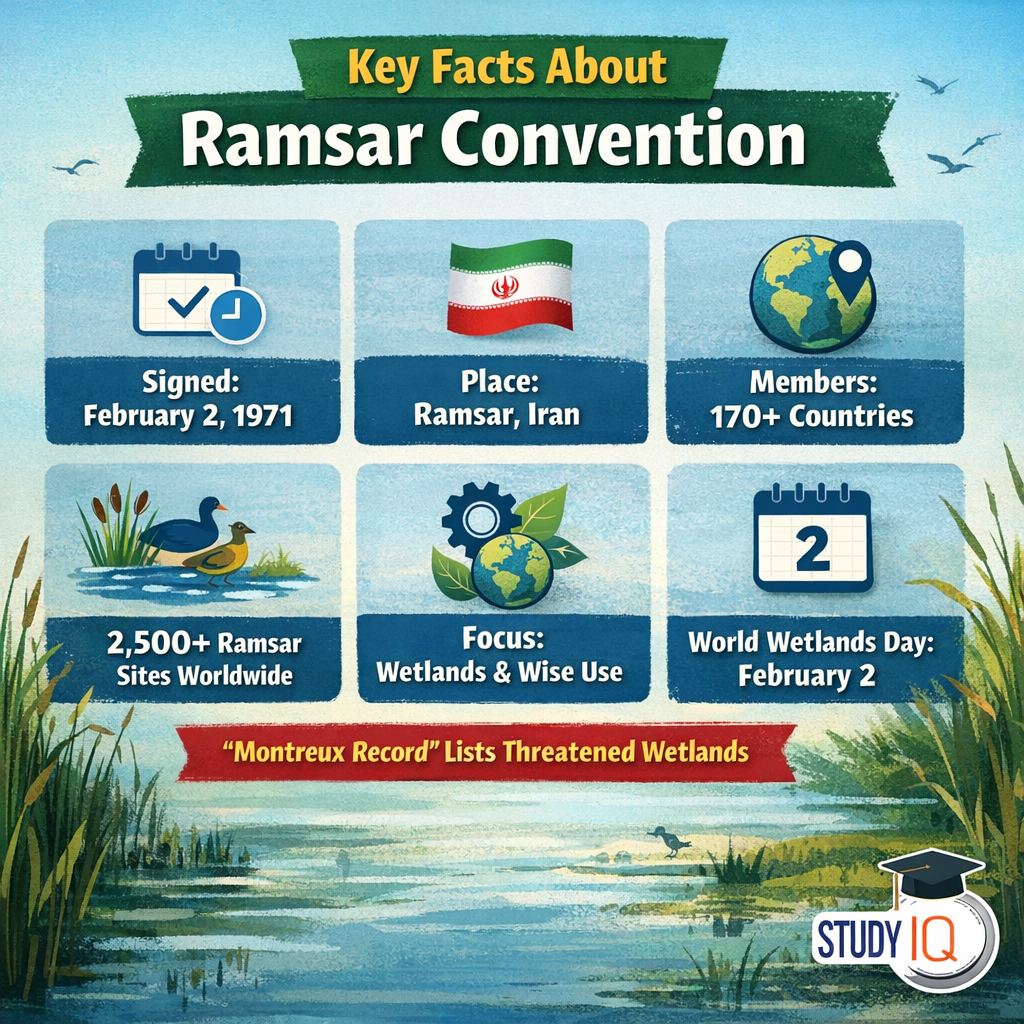
Adopted: 2 February 1971
-
Location: Ramsar City, Iran
-
Came into Force: 21 December 1975
-
Current Members: 170+ Contracting Parties
Initially, the focus was waterfowl conservation, but later expanded to ecosystem protection, climate regulation, and sustainable development.
Objectives of the Ramsar Convention
Wetland Protection and Restoration
-
Prevent wetland destruction
-
Restore degraded wetlands
Sustainable Resource Use
-
Promote wise use of wetland resources
Biodiversity Conservation
-
Protect habitats of aquatic species and migratory birds
Climate Change Mitigation
-
Enhance carbon storage
-
Support flood and drought management
International Cooperation
-
Joint conservation of transboundary wetlands
Three Pillars of the Ramsar Convention
| Pillar | What It Means (Simple Explanation) | Main Focus Areas | Example |
|---|---|---|---|
| Wise Use of Wetlands | Using wetlands sustainably without damaging their ecological balance | Integrating wetlands into national policies, sustainable fishing, pollution control, awareness programs | Promoting eco-friendly fishing methods, restricting industrial waste discharge |
| Designation of Ramsar Sites | Identifying wetlands of international importance and giving them special protection | Listing wetlands under Ramsar List, conservation planning, monitoring ecological health | Chilika Lake (India) designated as Ramsar Site for biodiversity protection |
| International Cooperation | Countries working together to conserve shared wetlands and migratory species | Transboundary wetland management, knowledge sharing, joint conservation projects | Cooperation between countries for migratory bird conservation |
Ramsar Sites: Selection Criteria
Wetlands are selected based on:
-
Rare or unique ecosystems
-
Habitat for endangered species
-
Support for migratory birds
-
Fish breeding grounds
-
Critical life-cycle support for species
Institutional Structure of Ramsar Convention
Conference of Parties (COP)
-
Meets every three years
-
Decides policies and funding
Ramsar Secretariat
-
Coordinates global implementation
International Organization Partners
-
BirdLife International
-
IUCN
-
IWMI
-
Wetlands International
-
WWF
Montreux Record
The Montreux Record lists Ramsar Sites facing ecological threats such as pollution, urbanisation, or technological development.
-
Register under the Ramsar Convention on Wetlands
-
Lists threatened Ramsar Sites
-
Includes sites where ecological character:
-
Has changed
-
Is changing
-
May change in future
-
-
Established in 1990 (Montreux, Switzerland)
-
Acts as a monitoring and conservation tool
-
Helps attract international attention and restoration support
-
Threats include: pollution, urbanisation, water diversion, climate change
-
Also called “Threat List of Ramsar Wetlands”
-
India’s Sites in Montreux Record:
-
Keoladeo National Park (Rajasthan)
-
Loktak Lake (Manipur)
-
Ramsar Convention and India
India’s Wetland Status
-
98 Ramsar Sites (Highest in South Asia)
Important Ramsar Sites in India
-
Chilika Lake
-
Sundarbans
-
Keoladeo National Park
-
Loktak Lake
Importance for India
-
Migratory bird habitat
-
Disaster risk reduction
-
Livelihood support
-
Climate resilience
Importance of Ramsar Convention Globally
Environmental Importance
-
Biodiversity conservation
-
Ecosystem stability
Climate Importance
-
Carbon sequestration
-
Flood control
Economic Importance
-
Fisheries
-
Tourism
-
Agriculture
Social Importance
-
Cultural heritage
-
Community livelihoods
Challenges Faced by Ramsar Convention
-
Weak enforcement in some countries
-
Development pressure
-
Climate change impacts
-
Funding limitations
Future of Wetland Conservation
Future conservation requires:
-
Integration of traditional knowledge
-
Community participation
-
Scientific monitoring
-
Climate adaptation planning
Conclusion
The Ramsar Convention 1971 is a landmark environmental treaty that recognises wetlands as vital ecosystems for biodiversity, climate stability, and human survival. By promoting the wise use of wetlands and international cooperation, the convention plays a crucial role in global environmental governance.
As climate change and biodiversity loss intensify, the importance of Ramsar Convention continues to grow in ensuring sustainable development worldwide.
|
Read More Notes |
|
| Environment Notes | Art and Culture Notes |
| Science and Tech | History Notes |
| Geography Notes | Indian Polity Notes |
| General Knowledge | International Relation |
|
Explore StudyIQ Courses |
|

 Wildlife Sanctuaries of India 2026: List...
 List of Tiger Reserves in India 2026 –...
 Purchasing Power Parity Index, How to Ca...











 WhatsApp





