Table of Contents
Context
The Supreme Court directed the Centre and Delhi Police to prevent unlawful detentions and ensure freedom of movement amid protests linked to the Special Intensive Revision (SIR) and the Chief Election Commissioner.
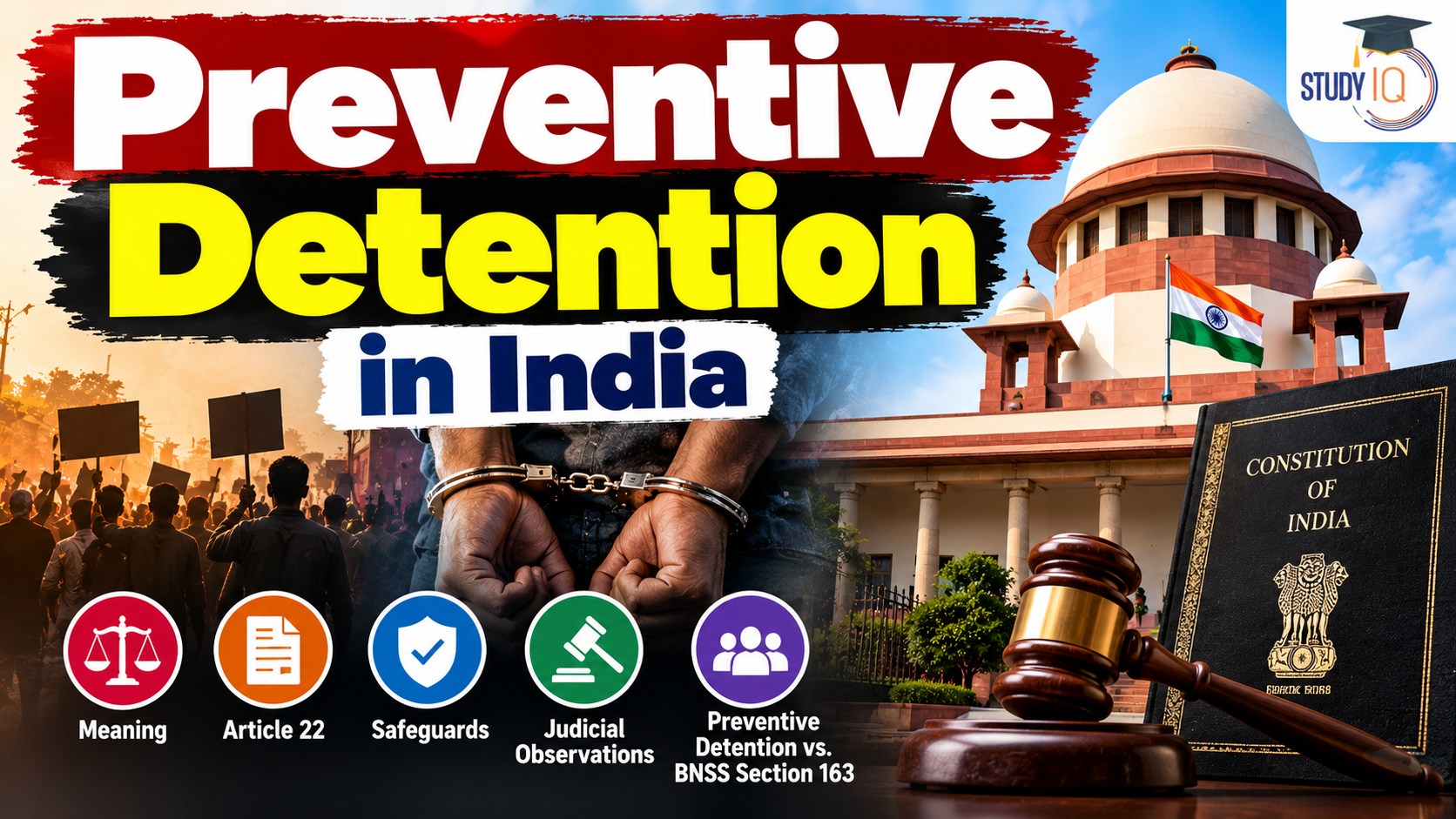
About Preventive Detention
- Meaning: Detention without trial to prevent anticipated threats to national security, public order or essential supplies, rather than punish past offences.
- Constitutional Basis: Article 22(3)–(7) provides the framework for preventive detention and associated safeguards.
Constitutional Provisions
- Article 22(3): Exempts preventive detainees from the ordinary safeguards under Article 22(1) and (2), including production before a magistrate within 24 hours.
- Article 22(4): Generally prohibits detention beyond three months without Advisory Board review, subject to constitutional exceptions.
- Article 22(5): Requires communication of detention grounds and the earliest opportunity to make a representation.
- Article 22(6): Permits withholding facts considered against public interest to disclose.
- Article 22(7): Empowers Parliament to prescribe detention periods, procedures and exceptional circumstances.
Grounds for Preventive Detention
- Union List, Entry 9: Preventive detention related to defence, foreign affairs and the security of India.
- Concurrent List, Entry 3: Preventive detention related to State security, public order and essential supplies and services.
Key Features and Safeguards
- Executive Satisfaction: Detention orders are based on anticipated threats and remain subject to judicial scrutiny.
- Advisory Board Review: Continued detention is subject to review under applicable constitutional and statutory provisions.
- Judicial Review: Courts examine legality, procedural compliance, mala fides and relevance of material.
- Procedural Safeguards: Failure to communicate grounds, provide essential documents in an understood language or consider representations promptly may invalidate detention.
Judicial Observations
- Ameena Begum v. State of Telangana (2023): Emphasised strict scrutiny of preventive detention powers.
- Shaik Nazneen v. State of Telangana (2022): Distinguished ordinary law-and-order issues from threats to public order.
- Mazdoor Kisan Shakti Sangathan (2018): Highlighted the need to balance peaceful protest with public order.
Preventive Detention vs. BNSS Section 163
- Preventive Detention: Allows the confinement of individuals to prevent anticipated threats, subject to specific safeguards.
- BNSS Section 163: Enables urgent orders restricting specified activities or assemblies to prevent imminent threats to public order and safety.

 State of the World’s Forests (SOFO) 20...
 Lakshadweep Achieves 100% Literacy under...
 Khajuraho’s Javari Temple: History, Ar...














 WhatsApp