Table of Contents
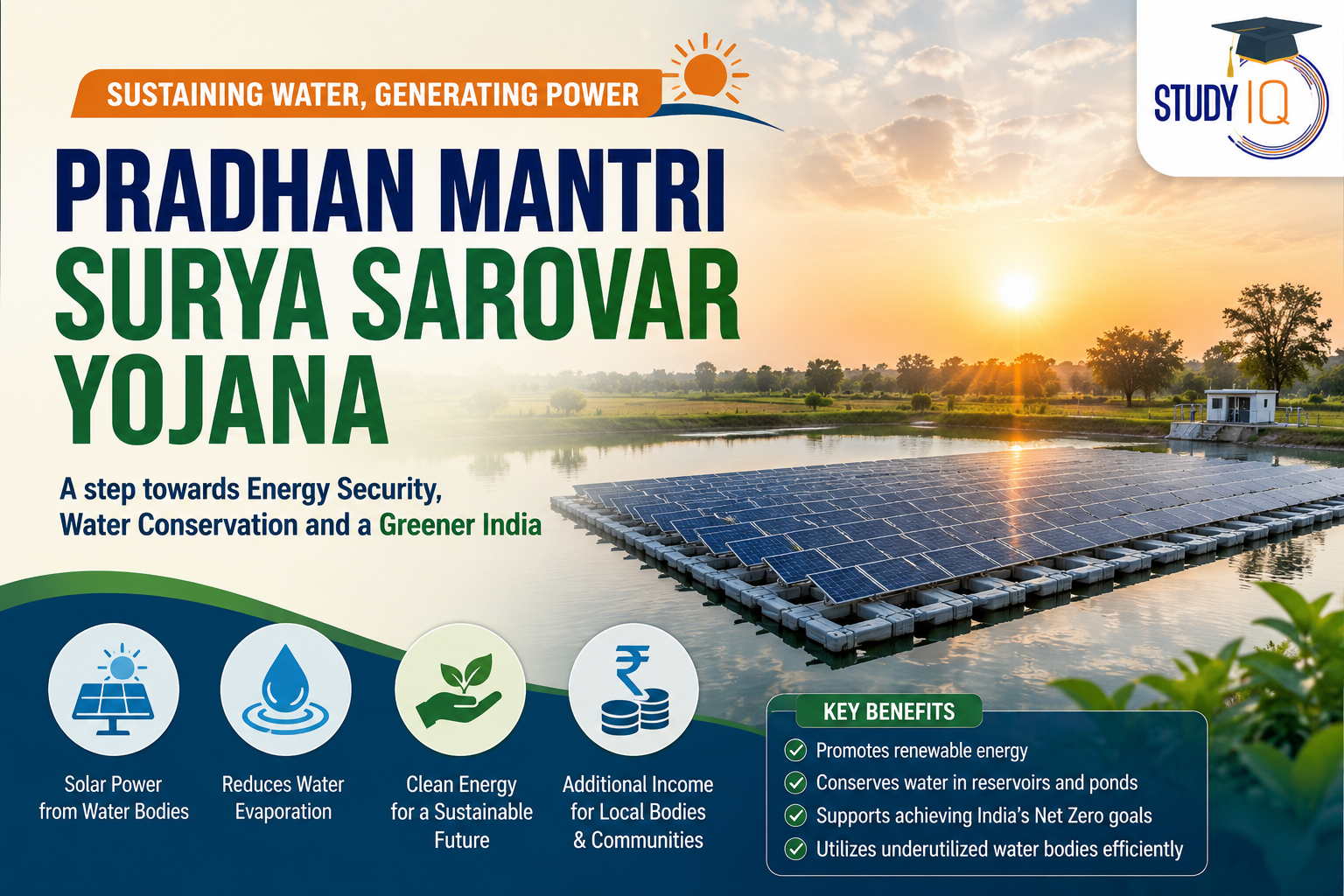
The Union Cabinet has approved the Pradhan Mantri Surya Sarovar Yojana (PM-SSY), a major renewable-energy initiative aimed at accelerating the deployment of Floating Solar Photovoltaic (FSPV) projects integrated with energy storage systems in India.
The scheme has a reported financial outlay of ₹5,070 crore and targets the development of around 5,000 MW (5 GW) of floating solar capacity.
PM-SSY is significant because it attempts to address three major challenges simultaneously: the scarcity of suitable land for large solar projects, the intermittent nature of renewable electricity, and India’s need to rapidly expand clean-energy capacity.
For UPSC aspirants, the scheme is particularly important for GS Paper III – Energy, Infrastructure, Environment and Climate Change, along with Prelims questions on government schemes, renewable-energy technologies and implementing institutions.
What is Pradhan Mantri Surya Sarovar Yojana?
The Pradhan Mantri Surya Sarovar Yojana (PM-SSY) is a Central Sector Scheme associated with the Ministry of New and Renewable Energy (MNRE) for promoting floating solar photovoltaic projects integrated with energy storage.
Instead of installing solar panels only on land or rooftops, floating solar technology places photovoltaic panels on specially designed floating structures over water bodies.
Potential locations include:
- Reservoirs
- Dams
- Artificial lakes
- Irrigation reservoirs
- Other suitable inland water bodies
By utilising water surfaces for electricity generation, India can expand solar capacity without requiring equivalent amounts of additional land.
PM Surya Sarovar Yojana at a Glance
| Particular | Details |
|---|---|
| Scheme | Pradhan Mantri Surya Sarovar Yojana |
| Abbreviation | PM-SSY |
| Sector | Renewable Energy |
| Type | Central Sector Scheme |
| Nodal Ministry | Ministry of New and Renewable Energy (MNRE) |
| Implementing Agency | Solar Energy Corporation of India (SECI) |
| Technology | Floating Solar Photovoltaic (FSPV) |
| Key Component | Floating Solar + Energy Storage |
| Reported Outlay | ₹5,070 crore |
| Target Capacity | 5,000 MW / 5 GW |
| Primary Objective | Expand floating solar power while reducing land requirements and improving grid reliability |
The ₹5,070 crore outlay and 5,000 MW capacity target have been reported following the Cabinet approval.
What is Floating Solar Photovoltaic (FSPV)?
Floating Solar Photovoltaic or FSPV refers to solar photovoltaic panels mounted on floating structures installed on the surface of water bodies.
A typical floating solar power project consists of:
Solar PV modules → Floating platforms → Anchoring & mooring system → Inverters → Transmission infrastructure → Grid
Under PM-SSY, this architecture is strengthened through the integration of energy storage systems.
Thus, electricity generated during periods of high solar radiation can potentially be stored and supplied when required.
Objectives of Pradhan Mantri Surya Sarovar Yojana
1. Expand India’s Floating Solar Capacity
The primary objective is to accelerate large-scale deployment of floating solar projects across suitable water bodies.
The targeted addition of approximately 5 GW could significantly expand India’s floating solar ecosystem.
2. Reduce Pressure on Land
Utility-scale solar projects require substantial land.
This can generate competing demands involving:
- Agriculture
- Forests
- Urban development
- Industrial projects
- Infrastructure
- Conservation
Floating solar provides an alternative by using water surfaces that can simultaneously continue serving their primary functions where technically and environmentally feasible.
3. Integrate Renewable Energy with Storage
Solar electricity is intermittent because generation varies with sunlight and weather conditions.
Energy storage can absorb surplus electricity and release it later, potentially helping to:
- Smooth renewable power output
- Reduce curtailment
- Manage peak demand
- Improve grid stability
- Increase the dispatchability of renewable electricity
The integration of storage therefore makes PM-SSY more than simply another solar-capacity expansion programme.
4. Reduce Water Evaporation
Floating solar panels partially cover water surfaces.
This can reduce direct exposure to sunlight and wind and thereby potentially lower evaporation losses, although the actual benefit depends on reservoir conditions, coverage and local climate.
This feature may be particularly useful in water-stressed regions.
5. Promote Indigenous Manufacturing
The scheme can generate domestic demand for components such as:
- Solar PV modules
- Floating platforms
- Anchoring systems
- Mooring equipment
- Power electronics
- Batteries
- Energy-management systems
This creates opportunities to deepen India’s domestic renewable-energy manufacturing ecosystem.
6. Strengthen India’s Energy Security
Expanding domestic renewable electricity reduces dependence on imported fossil fuels over the long term and contributes to diversification of India’s energy mix.
Why Does India Need Floating Solar?
India’s renewable-energy transition has reached a stage where simply adding solar panels is not sufficient.
Three structural problems are becoming increasingly important.
Land Availability
Large solar parks require significant land. Acquiring contiguous parcels can become difficult because of competing agricultural, ecological and developmental uses.
Renewable Energy Intermittency
Solar power generation peaks during daylight hours but electricity demand does not always follow the same pattern.
Without adequate storage and grid flexibility, rapid renewable expansion can lead to curtailment and balancing problems.
Growing Electricity Demand
India’s expanding economy, urbanisation, industrialisation, electric mobility and digital infrastructure will require enormous additional electricity capacity.
Floating solar offers another pathway for adding renewable generation without relying exclusively on land-based projects.
Why is Energy Storage Important under PM-SSY?
The storage component is arguably one of the most strategically important aspects of the scheme.
Solar power follows a variable generation profile.
During periods of abundant sunlight:
Solar generation → Electricity supplied to grid + Surplus stored
When solar generation declines:
Stored electricity → Released according to grid requirements
This can help address the well-known renewable-energy challenge of matching electricity generation with demand.
Storage can therefore transform renewable energy from a purely variable resource into a more flexible source of electricity.
Advantages of Floating Solar Power
Efficient Use of Water Bodies
Floating solar converts suitable water surfaces into renewable-energy assets without requiring equivalent new land.
Reduced Land Acquisition Problems
Land acquisition is frequently one of the most difficult components of infrastructure development.
FSPV can reduce this constraint, particularly around existing reservoirs.
Potential Reduction in Water Evaporation
Partial surface coverage can reduce evaporation, creating an interesting water-energy nexus.
Cooling Effect
Water can help moderate temperatures around solar panels.
Because photovoltaic efficiency generally declines as panel temperatures rise, the cooler microenvironment may improve operating performance under appropriate conditions.
Existing Infrastructure Advantage
Reservoirs associated with hydropower projects may already have:
- Transmission infrastructure
- Grid connectivity
- Access roads
- Power evacuation facilities
Co-location can therefore offer infrastructure synergies.
Floating Solar + Hydropower: A Powerful Combination
One particularly important possibility is installing floating solar projects on hydropower reservoirs.
This creates a hybrid renewable-energy ecosystem.
During sunny periods, solar plants generate electricity while water can potentially be conserved in the reservoir.
When solar output declines, hydropower generation can provide complementary flexibility.
The combination can therefore improve utilisation of:
- Reservoir surfaces
- Existing transmission infrastructure
- Grid connections
- Renewable-energy resources
For UPSC Mains, this is an excellent example of the water-energy nexus and integrated renewable-energy planning.
PM-SSY and India’s Energy Transition
The Pradhan Mantri Surya Sarovar Yojana should be understood as part of India’s broader shift toward a low-carbon electricity system.
India has committed to expanding non-fossil energy capacity substantially while pursuing net-zero emissions by 2070.
However, large-scale renewable integration requires more than generation capacity.
India simultaneously needs:
Renewable Generation + Energy Storage + Transmission + Smart Grids + Domestic Manufacturing
PM-SSY attempts to connect at least two of these pillars — renewable generation and storage.
PM-SSY and Atmanirbhar Bharat
Another important dimension is industrial policy.
A rapid floating-solar expansion programme creates demand for specialised equipment that India can increasingly manufacture domestically.
Potential manufacturing opportunities include:
Floating Platforms
Specialised structures capable of supporting photovoltaic modules under changing water levels and weather conditions.
Anchoring and Mooring Systems
Engineering systems that keep floating arrays securely positioned.
Solar Modules
Domestic module production can benefit from increased demand.
Battery Energy Storage Systems
The storage requirement can stimulate investment across batteries, battery-management systems and associated power electronics.
Engineering and Maintenance Services
Large floating projects require specialised expertise in marine engineering, electrical systems and reservoir management.
Thus, PM-SSY can contribute to both the energy transition and manufacturing transition.
Economic Significance
Large-scale floating solar deployment can generate investment across several sectors:
- Renewable-energy development
- Engineering and construction
- Battery manufacturing
- Solar manufacturing
- Power electronics
- Transmission infrastructure
- Operations and maintenance
- Research and development
It can also strengthen India’s clean-energy value chain and potentially create skilled employment.
Environmental Significance
PM-SSY has several potential environmental advantages.
Lower Carbon Emissions
Additional solar generation can reduce reliance on fossil-fuel-based electricity over time.
Lower Land Footprint
Using water surfaces reduces pressure to convert land for renewable-energy infrastructure.
Water Conservation Potential
Floating panels can potentially reduce reservoir evaporation.
However, these benefits must be weighed against possible ecological effects on aquatic ecosystems.
Challenges Associated with PM Surya Sarovar Yojana
Despite its advantages, floating solar is not environmentally or technically impact-free.
1. Higher Capital Costs
Floating solar projects require additional infrastructure such as:
- Floats
- Anchoring systems
- Mooring systems
- Specialised cables
- Marine-compatible equipment
This can increase project complexity and costs.
2. Aquatic Ecosystem Concerns
Large-scale surface coverage may alter:
- Sunlight penetration
- Water temperature
- Dissolved oxygen
- Aquatic vegetation
- Fish habitats
Environmental impact assessment and scientifically determined coverage limits are therefore important.
3. Reservoir-Level Fluctuations
Water levels in reservoirs can vary substantially between seasons.
Anchoring systems must accommodate these changes.
4. Extreme Weather
Floating installations must withstand:
- High winds
- Storms
- Waves
- Flood events
- Extreme temperatures
Climate-resilient engineering standards will be essential.
5. Battery Costs
Energy storage remains relatively expensive compared with standalone solar generation.
Large-scale storage deployment will therefore depend on declining technology costs, domestic manufacturing and effective market design.
6. Water-Use Conflicts
Reservoirs may already support:
- Drinking-water supply
- Irrigation
- Fisheries
- Hydropower
- Tourism
- Local livelihoods
Floating solar development must therefore incorporate stakeholder consultation and careful spatial planning.
PM-SSY vs Conventional Ground-Mounted Solar
| Parameter | Floating Solar | Ground-Mounted Solar |
| Land Requirement | Very low additional land | High |
| Location | Water bodies | Land |
| Water Evaporation | Can potentially reduce evaporation | No direct benefit |
| Cooling | Natural water-based cooling effect possible | Comparatively limited |
| Installation Complexity | Higher | Lower |
| Anchoring Requirement | Essential | Not required |
| Aquatic Impact | Needs assessment | Generally absent |
| Land Conflict | Lower | Can be significant |
| Storage under PM-SSY | Integrated/co-located | Depends on project |
Link with Sustainable Development Goals
PM-SSY has relevance to several United Nations Sustainable Development Goals.
SDG 7 – Affordable and Clean Energy: Expands renewable electricity.
SDG 9 – Industry, Innovation and Infrastructure: Encourages new clean-energy technologies and infrastructure.
SDG 12 – Responsible Consumption and Production: Promotes more efficient utilisation of natural resources and infrastructure.
SDG 13 – Climate Action: Supports decarbonisation of electricity generation.
The scheme also illustrates the broader Water-Energy-Climate Nexus.
Read Also: UPSC Daily Current Affairs 2026
 World Pharmacists Day 2026: Date, Theme,...
 UPSC EPFO Exam Strategy 2026: Complete 3...
 Census Town in India: Criteria, Meaning ...














 WhatsApp